
304 Stainless Steel Motorcycle Bolts: Corrosion Resistance, Cleaning & Care
304 stainless steel motorcycle bolts are widely used because they offer a useful combination of corrosion resistance, appearance and availability.
However, 304 stainless steel is not completely corrosion-proof.
Road salt, chloride contamination, trapped moisture, iron particles and unsuitable cleaning products can all contribute to staining or localised corrosion.
Good cleaning and maintenance can help preserve the appearance of stainless motorcycle bolts and reduce the build-up of aggressive contaminants.
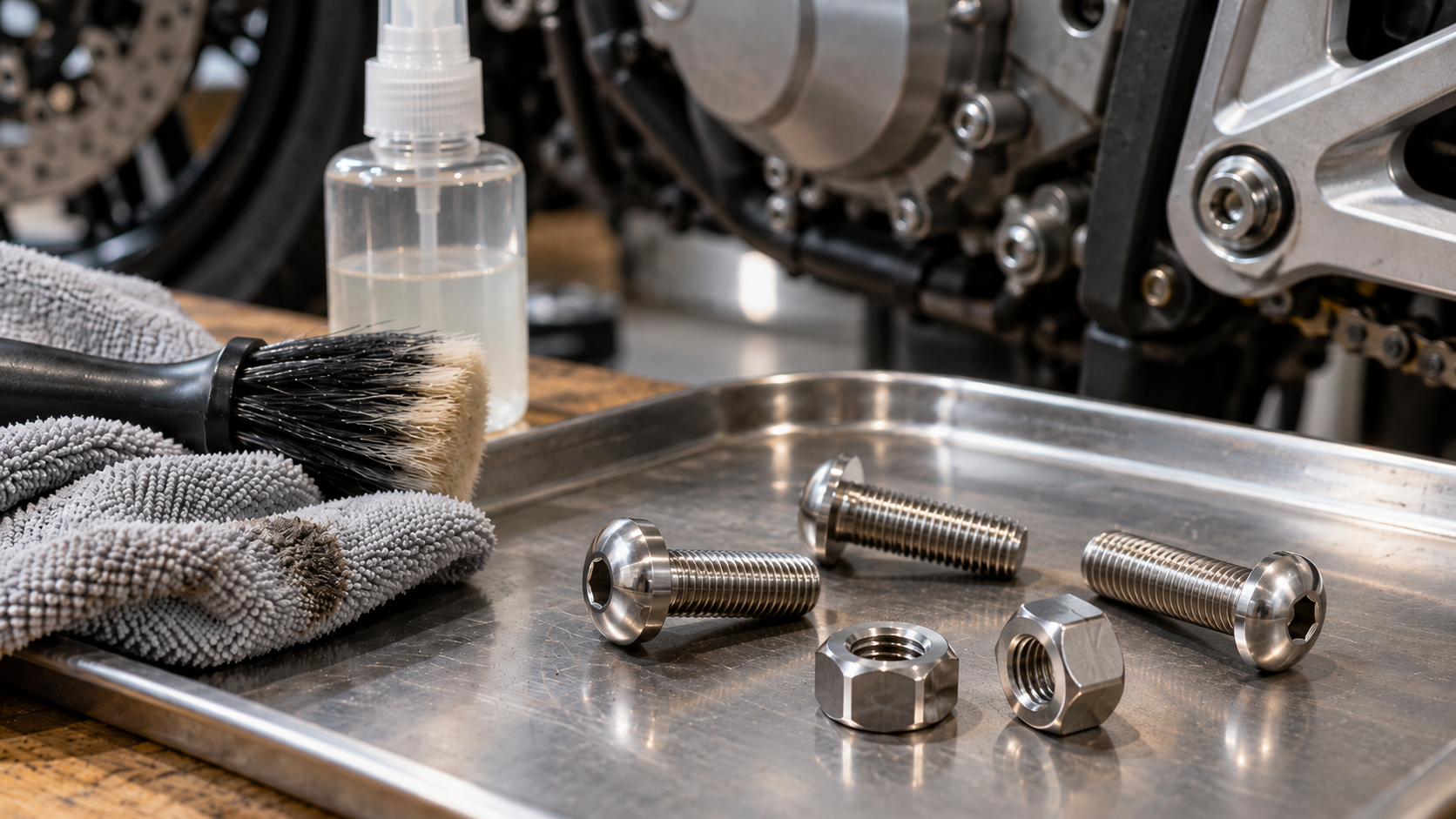
What Is 304 Stainless Steel?
304 is an austenitic stainless steel containing chromium and nickel.
Its corrosion resistance comes largely from a thin passive oxide layer that forms naturally on the surface.
If that passive layer is damaged, it can normally reform when the surface is clean and exposed to oxygen.
For fasteners, 304-type stainless is commonly associated with the A2 designation.
If you want to understand how 304 compares with 316 stainless, titanium and high-tensile steel, see our Motorcycle Bolt Materials Explained guide.
Is 304 Stainless Steel Rust-Proof?
No.
304 stainless steel has good corrosion resistance in many environments, but it should not be described as completely rust-proof.
Under aggressive conditions, stainless steel can develop:
- Surface staining.
- Tea staining.
- Pitting.
- Crevice corrosion.
- Contamination-related rust marks.
The risk increases when chloride-containing deposits such as road salt remain on the surface for prolonged periods.
This is particularly relevant to motorcycles used through winter or in coastal environments.
Why Can Stainless Steel Motorcycle Bolts Show Rust Marks?
Rust-coloured marks on stainless steel do not always mean the stainless itself has failed.
One common cause is iron contamination.
Small particles of ordinary carbon steel can become embedded in the stainless surface through:
- Contaminated tools.
- Wire brushes.
- Abrasive discs.
- Grinding dust.
- Steel wool.
- Contact with rusty components.
- Poor storage or handling.
Those iron particles can then rust and create brown staining on the stainless surface.
What Is Tea Staining?
Tea staining is a brown surface discolouration that can occur on stainless steel exposed to aggressive outdoor environments.
It is more common where:
- Salt is present.
- Surfaces remain damp.
- Contamination is allowed to build up.
- Areas are sheltered from natural rain washing.
- Surface finishes are rougher or retain deposits.
Road salt can create exactly the kind of chloride-rich environment that encourages this type of staining.
Tea staining is generally an appearance issue initially, but repeated or prolonged chloride exposure can also contribute to more serious localised corrosion.
Why Road Salt Matters
Road salt contains chlorides.
Chloride ions can attack the passive surface layer that protects stainless steel and increase the risk of localised corrosion such as pitting.
304 stainless performs well in many normal environments, but 316 stainless generally offers improved resistance to chloride-related corrosion because it contains molybdenum.
That does not make 304 unsuitable for motorcycle use.
It simply means that environmental exposure matters.
If your motorcycle is used on salted winter roads, regular washing becomes more important regardless of whether the fasteners are stainless or plated steel.
How Often Should Stainless Motorcycle Bolts Be Cleaned?
There is no single cleaning interval that suits every motorcycle.
How often cleaning is needed depends on:
- Weather exposure.
- Road salt.
- Coastal conditions.
- Frequency of use.
- Storage conditions.
- Whether the motorcycle is regularly washed.
- Whether dirt and moisture become trapped around the fastener.
A motorcycle used only in dry summer conditions may require very little attention.
A motorcycle ridden through winter road salt may benefit from much more frequent rinsing and cleaning.
The important principle is to avoid allowing salt and corrosive deposits to remain on stainless surfaces for long periods.
How to Clean 304 Stainless Steel Motorcycle Bolts
For routine cleaning, start with the least aggressive method.
A sensible approach is:
- Rinse away loose dirt and road salt.
- Wash with warm water and a mild detergent suitable for the surrounding motorcycle surfaces.
- Use a soft cloth, sponge or non-scratching brush where necessary.
- Rinse thoroughly with clean water.
- Dry the area where practical.
Avoid aggressive scrubbing unless it is genuinely necessary.
Always consider the surrounding component as well. A cleaner that is safe for stainless steel may not necessarily be suitable for paint, anodised aluminium, polished finishes, plastics or rubber.
Can You Use Metal Polish on Stainless Motorcycle Bolts?
A suitable non-abrasive or mildly abrasive metal polish can sometimes be used to improve the appearance of stainless steel.
However, use care.
Repeated aggressive polishing can alter the finish, and residue may collect around bolt heads or adjoining components.
Always follow the polish manufacturer’s instructions and make sure the product is suitable for stainless steel and for any nearby materials it may contact.
For routine maintenance, washing away dirt and salt is generally more important than continuously polishing the bolts.
Cleaning Light Rust Staining From Stainless Steel
Light rust staining may sometimes be removable without replacing the fastener.
Start with gentle cleaning.
If staining remains, a cleaner specifically intended for stainless steel may be appropriate.
If corrosion appears deep, heavily pitted or structurally significant, do not simply polish the surface and assume the fastener is sound.
Inspect the fastener properly and replace it where necessary.
Avoid Steel Wool and Carbon-Steel Brushes
Do not clean stainless motorcycle bolts with ordinary steel wool or a carbon-steel wire brush.
These can deposit iron particles onto the stainless surface.
Those particles may later rust and create staining that appears to be corrosion of the stainless itself.
If a brush is needed, use one specifically suitable for stainless steel and ensure it has not previously been used on ordinary steel.
The same principle applies to abrasive discs and workshop tools.
Cross-contamination can occur surprisingly easily.
Be Careful With Chloride-Containing Cleaners
Certain cleaning chemicals can damage stainless steel.
In particular, avoid products containing strong chloride-based chemicals unless the manufacturer specifically confirms suitability for the application.
These are not normal motorcycle cleaning products, but workshop chemicals, wheel cleaners and general household cleaners can vary widely.
Always check the product instructions rather than assuming that “stainless steel” means the surface is resistant to every cleaner.
Does Stainless Steel Need Protective Coating?
Usually, stainless steel is chosen because it does not rely on a traditional paint or plated coating for its basic corrosion resistance.
The passive surface layer is part of the material itself.
That does not mean adding a suitable protective product is never useful.
Some motorcycle owners use corrosion-protection sprays or waxes to help reduce exposure to moisture and road salt.
If you do this, make sure the product is suitable for the surrounding surfaces and does not contaminate braking components, tyres or other safety-critical areas.
Do not apply products indiscriminately around brake discs, pads or tyre surfaces.
Should You Grease Stainless Steel Bolts to Stop Corrosion?
Not simply for corrosion prevention.
Grease, lubricant and anti-seize can alter thread friction and affect the relationship between tightening torque and clamp load.
That means thread treatment should be based on the installation requirements rather than used automatically as a corrosion-prevention measure.
For more information, see our Stainless Steel Motorcycle Bolt Torque, Anti-Seize & Galling Guide.
Our How to Fit Stainless Steel Motorcycle Bolts guide also explains installation precautions.
What About Stainless Steel Bolts in Aluminium?
Motorcycles commonly use stainless fasteners alongside aluminium components.
Where dissimilar metals are exposed to moisture and salts, galvanic interaction can become a consideration.
The real-world effect depends on factors including:
- The metals involved.
- Moisture exposure.
- Road salt.
- Surface area.
- Protective finishes.
- Joint design.
- Maintenance.
A future Biker Bling guide will cover motorcycle bolts into aluminium in more detail.
For now, the important point is to keep the joint clean, avoid trapped salt and follow the manufacturer’s installation requirements.
Should You Replace a Stainless Bolt That Has Surface Staining?
Not necessarily.
Light surface staining does not automatically mean the bolt has lost its mechanical integrity.
However, appearance alone cannot confirm condition.
Replace or investigate a fastener if you see:
- Significant pitting.
- Heavy corrosion.
- Damaged threads.
- Cracking.
- Distorted heads.
- Severe galling.
- Loss of material.
- Any other damage that could affect function.
Where the fastener is safety-critical, do not rely on cosmetic cleaning to establish whether it remains suitable.
If you are selecting a replacement, see our How to Choose the Correct Replacement Motorcycle Bolt guide.
304 vs 316 Stainless for Corrosion Resistance
Both 304 and 316 stainless provide useful corrosion resistance.
The main advantage of 316 is its improved resistance to localised corrosion in chloride-containing environments.
That is why 316 is often preferred where exposure to salt or aggressive conditions is greater.
However, grade alone is not enough to determine whether a fastener is suitable.
You must also consider its mechanical properties and intended application.
Our Motorcycle Bolt Strength Grades Explained guide explains why material and strength/property class should not be treated as the same thing.
Does 304 Stainless Need Maintenance?
Yes, in the sense that it benefits from sensible cleaning.
Stainless steel is often described as low maintenance, but that does not mean no maintenance.
Removing road salt, dirt and contamination helps preserve both appearance and corrosion resistance.
A simple routine is usually enough:
- Rinse away salt and grime.
- Wash with a mild cleaner.
- Avoid contaminating the surface with ordinary steel tools.
- Rinse cleaning products away thoroughly.
- Inspect the fasteners during normal motorcycle maintenance.
You do not need to constantly polish stainless bolts to keep them serviceable.
Important Safety Information
This guide covers general cleaning and corrosion-care information for stainless steel motorcycle fasteners.
It does not determine whether a particular bolt is suitable for a specific motorcycle application.
Always follow the motorcycle manufacturer’s workshop manual, parts information and fastener requirements.
Do not continue using a fastener simply because surface corrosion can be cleaned away if there is evidence of structural damage, severe pitting, damaged threads or other deterioration.
Take particular care with bolts associated with:
- Brakes.
- Steering.
- Suspension.
- Wheels and axles.
- Structural mountings.
- Other highly loaded assemblies.
If you are unsure whether a fastener remains serviceable, use the manufacturer-specified replacement or obtain advice from a competent motorcycle technician.
304 Stainless Motorcycle Bolt Care: The Simple Rule
304 stainless steel offers good corrosion resistance, but it is not immune to staining or corrosion.
With sensible cleaning and care, 304 stainless steel motorcycle bolts can retain their appearance and corrosion resistance for longer.
The most useful maintenance steps are simple:
- Remove road salt and dirt.
- Avoid prolonged chloride contamination.
- Use suitable cleaning products.
- Avoid carbon-steel contamination.
- Rinse cleaners away thoroughly.
- Inspect bolts for genuine damage rather than judging only by appearance.
Good maintenance helps stainless motorcycle fasteners retain their appearance and reduces unnecessary exposure to aggressive contaminants.
Shop Stainless Steel Motorcycle Bolt Kits
Looking for replacement stainless steel fasteners for your motorcycle?
Biker Bling supplies stainless steel motorcycle bolt kits for a range of makes, models and applications.
Shop Stainless Steel Motorcycle Bolt Kits →
Always check the individual product description, intended fitment and fasteners supplied before ordering.