
Inside Biker Bling: Our Workshop, Bikes & How We Work
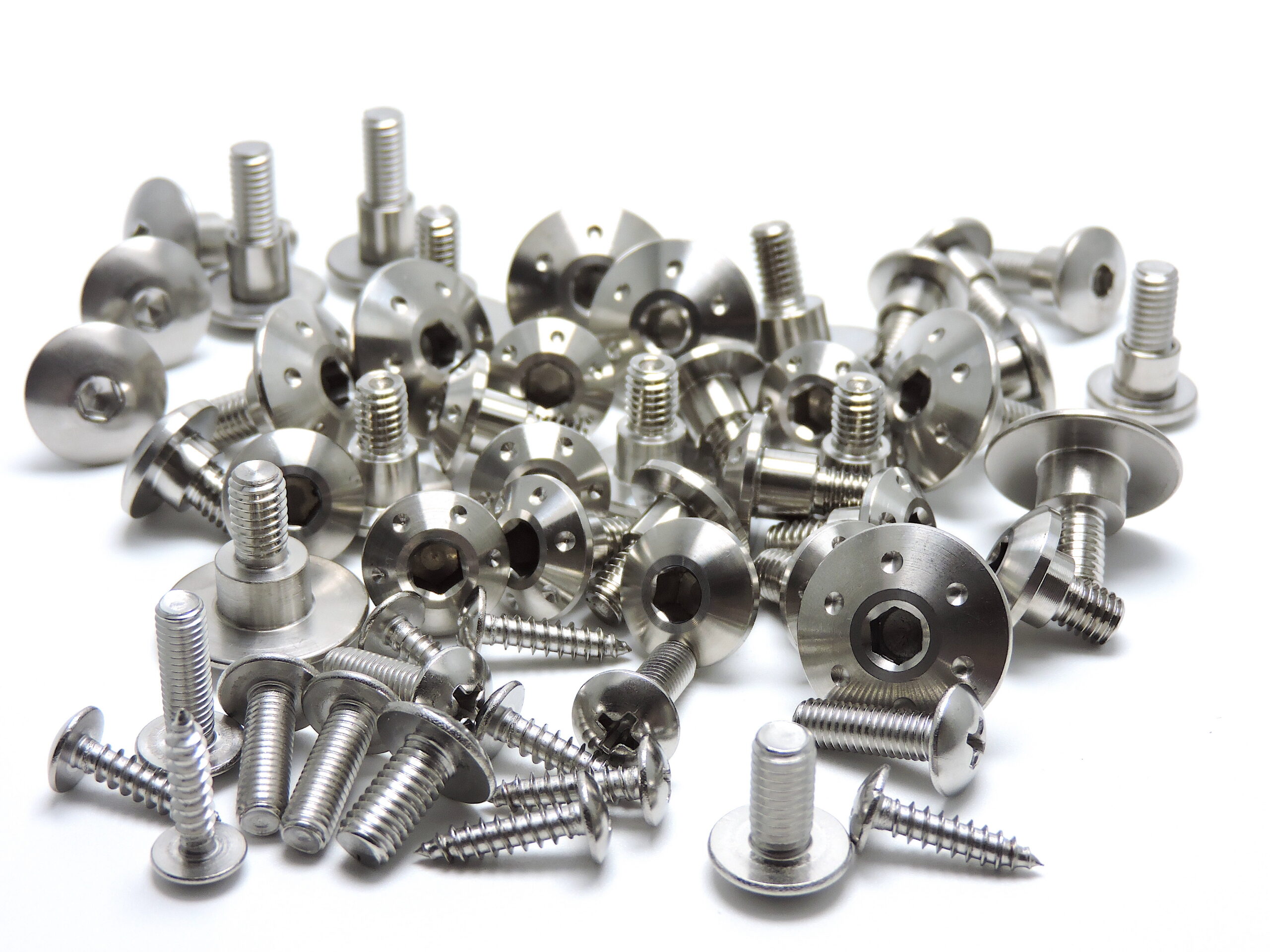
Inside Biker Bling, there is a lot more involved in creating a motorcycle bolt kit than simply finding a stainless steel bolt with the right thread.
Motorcycles can use different bolt lengths, thread pitches, shoulders, head diameters, washers, collars, spacers, clips, well nuts and other special fixings — sometimes within the same body panel or assembly.
Our approach is therefore based around identifying the original application as accurately as possible, researching the OEM parts information, physically measuring original parts where required and building model-specific fastener kits around the motorcycle rather than treating every fixing as interchangeable.
Where appropriate, selected products can also be physically fitted and used on a motorcycle made available to us for product-development checks. This provides another useful real-world check alongside catalogue research and measurement.
We also organise our kits so the customer can identify where the supplied fixings belong: the fasteners are separated into labelled bags according to their fitting location.
This page explains how we research motorcycle fasteners, source and check our products, verify dimensions, use our internal reference information, carry out practical fitting checks where appropriate and prepare Biker Bling kits for customers.
What Biker Bling Does
Biker Bling specialises in motorcycle fasteners and model-specific bolt kits for a wide range of makes, models and applications.
Depending on the motorcycle, our product range can include fasteners for areas such as:
- Fairings and bodywork.
- Windscreens.
- Engine casings and covers.
- Handlebars and controls.
- Yokes and front-end components.
- Chain guards.
- Mudguards.
- Footrests and hangers.
- Reservoirs.
- Headlight mountings.
- Radiator mountings.
- Bar ends.
- Other model-specific fixing points.
Different applications require different approaches.
A bolt suitable for a lightly loaded bodywork panel should not automatically be treated as a replacement for a manufacturer-specified structural or high-strength fastener.
That distinction is a central part of how we approach motorcycle fasteners.
A UK-Registered Motorcycle Fastener Business
Biker Bling Limited is a UK-registered private limited company.
The company was incorporated in 2014 and is registered at Companies House under company number 09063449.
Our work is focused on motorcycle fasteners, model-specific bolt kits and the technical information that supports them.
Inside Biker Bling, the product customers see online is therefore only the final stage of a process that can involve sourcing, research, OEM-number checking, physical measurement, test fitting, quality checks, kit preparation and customer support.
Inside Biker Bling: How We Source and Check Our Fasteners
Developing Biker Bling products also means finding manufacturers capable of supplying fasteners to the standards required for our range.
We source products from manufacturers internationally and assess the components before they become part of the Biker Bling range.
Depending on the product and application, areas we consider can include:
- Thread quality and finish.
- Bolt-head and surface finish.
- Dimensional consistency.
- Material specification.
- Mechanical-strength requirements, including tensile-strength information where relevant.
- Corrosion resistance.
- Practical fitting quality.
These checks do not replace application-specific research.
A well-made fastener still has to be the correct fastener for the motorcycle and mounting position in which it will be used.
That is why sourcing and quality control sit alongside our OEM research, physical measurements and real-world fitting checks rather than replacing them.
First-Hand Experience With Motorcycles
Motorcycle fasteners are not something we only study on a computer.
Biker Bling has first-hand experience working on and rebuilding motorcycles.
That practical experience is one of the reasons we pay attention to details such as shoulders, head diameters, collars, washers, spacers and fitting locations rather than treating every bolt of the same diameter as interchangeable.
Working with motorcycles firsthand also helps put the catalogue information into context.
A parts diagram may tell us where a component belongs, but seeing how motorcycle components actually fit together provides another useful perspective when developing a kit.
How a Biker Bling Model-Specific Kit Starts
A model-specific kit begins with the motorcycle itself.
Inside Biker Bling, the research process starts with identifying the motorcycle, model year and exact component or assembly being worked on.
The research normally starts by establishing:
- Manufacturer.
- Model.
- Variant where relevant.
- Model year or year range.
- Target component or assembly.
From there, the relevant parts catalogue, fiche or exploded parts information can be examined.
The aim is to identify exactly which fixings belong to the target component rather than simply collecting every fastener shown on the same diagram.
This is one of the important differences between building a researched model-specific kit and filling a bag with generic bolts.
Our Generic Motorcycle Bolt Kits vs Model-Specific Kits guide explains this difference in more detail.
Why We Research OEM Part Numbers
OEM part numbers provide an important reference when identifying original motorcycle fasteners.
Where available, we record information such as:
- OEM part number.
- Diagram reference.
- Quantity.
- Original component description.
- Mounting position.
An OEM number can help distinguish two fasteners that look very similar but are actually different.
However, an OEM description does not always provide every measurement needed to identify a replacement.
A parts catalogue might identify a fixing only by a general description without stating the exact bolt length, shoulder dimensions or head diameter.
That is why our process does not stop at reading a parts fiche.
We Buy OEM Parts to Physically Check the Dimensions
Where fastener dimensions need confirming, Biker Bling buys original OEM parts so they can be physically measured.
Inside Biker Bling, having the genuine OEM component available gives us a physical reference when published dimensions are incomplete or unavailable.
This gives us a real component to compare against rather than trying to estimate dimensions from an exploded drawing or relying only on a brief catalogue description.
Depending on the fastener, useful measurements can include:
- Thread diameter.
- Thread pitch.
- Bolt length.
- Shoulder length.
- Shoulder diameter.
- Head diameter.
- Flange diameter.
- Head type.
- Captive washer or collar dimensions.
- Other special features.
This physical reference is particularly useful where the OEM catalogue identifies the part number and location but does not publish all of the dimensions.
For example, a catalogue description may establish that a particular fastener is a 6 mm flange bolt without telling us everything required to reproduce the correct fixing.
Having the OEM part allows those missing dimensions to be checked directly.
It also gives us another way to verify information already contained in our internal fastener records.
The aim is simple:
Where a dimension matters, we want it established rather than guessed.
Inside Biker Bling: Real-World Product Testing
Where appropriate, some Biker Bling products are physically fitted and tested on a motorcycle made available to us for product-development and fitting checks.
This is another part of Inside Biker Bling that customers may not see when looking at the finished product online.
This gives us an additional opportunity to assess the fastener or kit in a real motorcycle application rather than relying only on parts diagrams, measurements and catalogue information.
Depending on the product, fitting and real-world use can help us check:
- Bolt length.
- Thread engagement.
- Head clearance.
- Shoulder location.
- Washer or collar arrangement.
- Panel alignment.
- Mounting position.
- Clearance around neighbouring components.
- Whether the supplied fixings correspond with their intended locations.
- Whether the selected fastener and material perform appropriately in the intended application during normal motorcycle use.
This practical testing is valuable because a component can look correct on paper and measure correctly on the bench while its behaviour in the assembled motorcycle may reveal something that is not obvious from a parts diagram alone.
Where suitable products remain fitted during normal use, this can also provide real-world feedback on how the fastener arrangement performs over time.
It gives us another practical check that the fastener and material selected for that particular application are appropriate for their intended use.
Not every Biker Bling product is physically tested on a motorcycle because our range covers a large number of motorcycle makes, models and years.
Real-world testing is also not a substitute for the motorcycle manufacturer’s specifications or formal material and mechanical testing. It should not be treated as proof that a particular material is suitable for every application.
For safety-critical or highly loaded positions, the required OEM specification, fastener geometry, mechanical properties and manufacturer instructions must still take priority.
Where test fitting and practical use are relevant, however, they provide another useful layer of verification alongside OEM parts research, physical measurement and our internal fastener reference data.
The Biker Bling Fastener Reference Data
Over time, Biker Bling has built internal reference information for motorcycle fasteners and OEM part numbers.
Inside Biker Bling, this information forms part of the reference material used when researching and checking new kits.
Depending on the fastener, this information can include details such as:
- Thread diameter.
- Bolt length.
- Shoulder dimensions.
- Head type.
- Head diameter.
- Flange dimensions.
- Other useful identifying measurements.
This can provide information that is not always visible in a standard parts catalogue.
It also helps us cross-reference OEM numbers and distinguish between apparently similar fixings.
Where appropriate, that information can also be checked against an original OEM fastener that we have physically measured.
For riders identifying their own fasteners, our How to Measure Motorcycle Bolts and Motorcycle Metric Thread Pitch Reference Chart explain the main measurements.
We Do Not Treat an Exploded Diagram as Proof of Bolt Size
Parts diagrams are extremely useful, but they have limitations.
An exploded drawing can show:
- Where a fastener is fitted.
- Which component it secures.
- The number of mounting positions.
- Associated washers, collars or clips.
- The relevant diagram reference.
What it does not necessarily prove is the exact physical size of the fastener.
A drawing should therefore not be used to estimate bolt length, shoulder length or thread pitch from appearance.
Where dimensions cannot be established from reliable information, they need further checking.
That may include obtaining the original OEM fastener and measuring it directly.
Guessing a fastener size because it “looks about right” is not part of the Biker Bling approach.
Why the Complete Fixing Matters
Motorcycle fastener research is not only about bolts.
A mounting point may also contain:
- Washer.
- Collar.
- Spacer.
- Rubber grommet.
- Well nut.
- Clip nut.
- Plastic rivet.
- Captive washer.
- Other specialised hardware.
Missing one of these parts can change how the assembly works.
For example, a collar inside a rubber grommet may control how much the grommet can be compressed.
A shoulder on a bolt may locate a component or control clamping distance.
A well nut may provide both the threaded fixing and some vibration isolation.
This is why our research considers the complete mounting arrangement rather than simply replacing the visible bolt.
See our Motorcycle Washers, Spacers & Collars Explained and Motorcycle Fairing Well Nuts, Clips & Washers Explained guides for more information.
Why Shouldered Motorcycle Bolts Need Special Attention
Shouldered bolts are a good example of why dimensions matter.
Two fasteners may share the same:
- Thread diameter.
- Thread pitch.
- Overall length.
but still perform differently because one has a carefully defined unthreaded shoulder.
The shoulder can act as:
- A locating surface.
- A spacer.
- A bearing surface.
- A controlled stop.
- A guide through a grommet or component.
Replacing a special shoulder bolt with a fully threaded bolt simply because the thread fits can alter the assembly.
Physical comparison with an original OEM fastener can be especially useful with unusual shoulder dimensions or head geometry.
Our Motorcycle Shoulder Bolts Explained guide covers this in detail.
How We Handle Missing or Conflicting Information
Motorcycle parts information is not always complete.
An official parts catalogue may establish the OEM number without providing dimensions.
Different supporting sources can also disagree.
Unusual shoulders, flanges or captive components may require additional checking.
Our rule is straightforward:
Do not silently turn uncertain information into confirmed information.
Where something cannot be reliably established, it should be flagged for checking.
Depending on the information available, a fastener may need:
- Further catalogue research.
- Cross-referencing against internal data.
- Comparison with another model or year.
- Measurement of an original OEM part.
- Physical verification.
- Practical test fitting where appropriate.
- Manual review.
This is particularly important with unusual or safety-critical fasteners.
Our Source and Verification Process
Not every source of fastener information carries the same weight.
Where possible, we start with primary or authoritative information such as:
- Motorcycle manufacturer parts information.
- Official parts catalogues.
- Recognised OEM fiche systems.
- Original OEM part numbers.
These can then be cross-referenced against Biker Bling’s internal fastener information.
Where dimensions need physical confirmation, an original OEM component can be obtained and measured.
Where practical and appropriate, selected products can also be fitted and used on a motorcycle to provide another real-world check.
Secondary information can sometimes help when dimensions are unavailable elsewhere, but secondary-source information should not automatically be treated as confirmed fact.
If there is a conflict, the answer is not to choose whichever measurement is most convenient.
The conflict needs checking.
Checking Quantities
Part quantities can also cause mistakes.
A parts table may list a quantity that relates to an entire assembly, several mounting positions or a larger group of components.
That does not always mean every listed fastener belongs in the kit being researched.
The actual diagram needs to be inspected to establish:
- Which fixing secures the target component.
- How many relevant mounting points are shown.
- Whether adjacent fasteners belong to another component.
- Whether washers, collars, clips or other parts are also required.
This is especially important when developing fairing and bodywork kits containing many similar-looking fixings.
Checking Motorcycle Year Ranges
A model name alone does not guarantee that the same fasteners were used throughout its entire production run.
Manufacturers can change:
- Bodywork.
- Brackets.
- Fasteners.
- Part numbers.
- Assemblies.
- Mounting arrangements.
When researching year coverage, the relevant parts information can be compared across model years.
If the same components, OEM fixing numbers, quantities and mounting arrangements continue across several years, that can support a wider kit fitment range.
If the information changes, the year boundary needs further investigation.
We would rather narrow a fitment range than extend it purely on assumption.
Why OEM Part-Number Cross-Referencing Is Useful
Motorcycle manufacturers often reuse the same fastener across several models or assemblies.
An OEM part number can therefore provide useful clues about compatibility.
Cross-referencing a confirmed part number may reveal:
- Other motorcycles using the same fixing.
- Additional model years.
- Common fasteners across several assemblies.
- Existing stock that can be used in another appropriate kit.
- Potential gaps in the Biker Bling product range.
However, the part number still needs to be linked to the correct mounting position.
The fact that a bolt appears somewhere on another motorcycle does not automatically mean it performs the same function there.
From Research to a Biker Bling Kit
Once the relevant information has been collected and checked, it can be organised into a practical kit list.
Inside Biker Bling, the research information is converted into a practical kit that the customer can understand and use.
Depending on the product, that may include:
- Bolt sizes.
- Quantities.
- OEM reference numbers.
- Washers.
- Collars.
- Well nuts.
- Clips.
- Rivets.
- Spacers.
- Application notes.
The final customer-facing product needs to remain easy to understand even though considerable research may sit behind it.
The aim is not to overwhelm the rider with internal research data.
The aim is to use that research to make the product information clearer and more useful.
Inside Biker Bling: How Our Kits Are Bagged and Labelled
Once a kit has been assembled, the organisation does not stop at putting all of the fasteners into one packet.
Biker Bling kits are separated into bags, with each bag labelled to identify the location where those fixings fit on the motorcycle.
This packaging stage is an important part of Inside Biker Bling because it carries the fixing-location information from our research through to the finished kit.
Depending on the kit, the labels may identify areas such as:
- Windscreen.
- Front fairing.
- Side fairing.
- Lower fairing.
- Engine casing.
- Chain guard.
- Mudguard.
- Handlebar.
- Footrest or hanger.
- Reservoir.
- Other kit-specific mounting locations.
This is particularly useful when a kit contains several stainless steel bolts that appear similar but have different lengths or functions.
Instead of asking the customer to work out which bolt belongs where from a mixed collection of hardware, the labelled bags provide a clear starting point for installation.
The exact contents vary between products, so customers should still follow the individual kit information and motorcycle manufacturer’s fitting instructions where appropriate.
Why We Do Not Mix Everything Into One Unlabelled Bag
A model-specific kit may contain several bolts with:
- The same thread diameter.
- Similar-looking heads.
- Small differences in length.
- Different shoulders.
- Different washers or collars.
Those differences can matter.
Putting every component into one unlabelled bag would make it unnecessarily difficult for the rider to identify the intended mounting point.
Separating and labelling the kit helps preserve the location information established during the research stage all the way through to the customer.
In other words, the work involved in identifying the correct fixing should not be lost when the kit is packaged.
How Biker Bling Fitting Diagrams Are Developed
For suitable products, fitting diagrams can make it much easier to understand where different fasteners belong.
A Biker Bling diagram may include:
- The relevant motorcycle assembly.
- Arrows or highlighted reference locations.
- Quantity.
- OEM part-number references.
- Diagram reference numbers where useful.
- Biker Bling branding.
The purpose of the diagram is practical.
A kit containing several similar bolts is much easier to understand when the rider can see which mounting point each component relates to.
Combined with the labelled bags supplied in the kit, this can make the individual fixing locations easier to identify.
The diagram does not replace the motorcycle manufacturer’s workshop manual or fitting instructions.
Quality Checks Before a New Kit Is Approved
Our product-development process is built around a number of basic checks.
The quality checks used Inside Biker Bling are intended to catch uncertain information before it becomes part of a finished product.
These include confirming that:
- Each item has a defined location.
- OEM numbers correspond with the relevant component or diagram.
- Quantities are checked against the mounting arrangement.
- Washers, clips, collars, rivets and other non-bolt fixings have been considered.
- Dimensions have an identifiable source or have been physically verified where required.
- Original OEM components are measured where appropriate.
- Product finish and thread quality meet our requirements.
- Relevant material and mechanical specifications have been considered.
- Unverified secondary information is flagged.
- Special shoulders or flanges are not silently replaced with generic bolts.
- Conflicting information is investigated rather than guessed.
- Year coverage has supporting evidence.
- Selected products are practically test-fitted where useful and possible.
- Safety-critical applications receive additional scrutiny.
That does not mean every motorcycle fastener can be identified from a parts fiche alone.
Sometimes the correct outcome of the research is simply:
Further verification required.
That is better than presenting uncertain information as though it had been confirmed.
Stainless Steel Is Not a Universal Replacement
Biker Bling supplies 304 stainless steel fasteners for many suitable motorcycle applications.
304 stainless steel — commonly associated with the A2 fastener designation — provides useful corrosion resistance and appearance for many motorcycle fastener applications.
However, stainless steel should not automatically replace every OEM bolt.
Some positions may require:
- A particular mechanical property class.
- A specialised shoulder.
- Specific geometry.
- A manufacturer-defined fastener.
- A particular tightening procedure.
Braking, steering, suspension, wheel, structural and other highly loaded applications deserve particular care.
Our Motorcycle Bolt Materials Explained and Motorcycle Bolt Strength Grades Explained guides explain why material and strength should be considered separately.
Customer Feedback and Long-Term Experience
Biker Bling has been selling motorcycle products for many years and has sold more than 68,000 items through eBay.
Over that time, we have received tens of thousands of positive customer feedback ratings.
That level of sales and customer feedback represents years of supplying motorcycle fasteners and related products to riders.
Customer feedback forms an important part of our experience because it provides real-world information about our products, kit organisation, packaging and service.
Biker Bling is also active on Facebook, where customers can follow company and product updates.
Visit the Biker Bling Facebook Page →
The value of customer feedback is not simply the number beside an account.
It is another way of learning how products perform once they leave us and are used by motorcycle owners in the real world.
Helping Riders Identify the Correct Fastener
Not every customer arrives with an OEM part number.
Sometimes the starting point is an old bolt on the workbench.
In that situation, useful information can include:
- Motorcycle make and model.
- Model year.
- Original mounting position.
- Thread diameter.
- Thread pitch.
- Bolt length.
- Head type.
- Shoulder dimensions.
- Washers or collars.
Our How to Choose the Correct Replacement Motorcycle Bolt guide explains the identification process.
For unfamiliar terminology, our Motorcycle Fastener Glossary provides a reference to common motorcycle bolt and fixing terms.
Technical Information Is Part of the Product
Selling a motorcycle fastener should not end at putting a bolt in a packet.
Correct identification, physical verification where required, practical testing where appropriate, clear packaging and sensible fitting information matter too.
Inside Biker Bling, that technical information is treated as part of the product-development process rather than something added afterwards.
That is why Biker Bling is building a dedicated technical library covering subjects including:
- Bolt measurement.
- Thread pitch.
- Materials.
- Strength grades.
- Shoulder bolts.
- Washers and collars.
- Banjo bolts.
- Fairing fasteners.
- Stainless steel care.
- Threadlocker and anti-seize.
- Seized fastener removal.
- Correct installation.
Where relevant, our product and technical information should help riders understand not only what a component is, but also why the details matter.
Fitting the Correct Bolt Correctly
Even a correctly identified replacement fastener can cause problems if it is installed incorrectly.
Before fitting a replacement, consider:
- Thread condition.
- Correct starting alignment.
- Washer and spacer arrangement.
- Whether the manufacturer specifies thread treatment.
- Appropriate tightening procedure.
- Any model-specific instructions.
Our How to Fit Stainless Steel Motorcycle Bolts guide explains the general installation principles.
Motorcycle manufacturer workshop information should always take priority where a particular procedure or torque is specified.
Inside Biker Bling: The Simple Principle
The principle behind the Biker Bling product-development process is simple:
Identify it. Research it. Measure it where required. Test it in the real world where appropriate. Verify it. Label it. Do not guess.
A motorcycle bolt is more than a thread diameter and length.
Its:
- Position.
- Thread.
- Head.
- Shoulder.
- Material.
- Strength.
- Washer.
- Collar.
- Spacer.
- Clip.
- Intended application.
can all matter.
Our process is designed to carry that information from product sourcing and original parts research through OEM component measurement, physical fitting and real-world testing where appropriate, and finally into the finished labelled kit.
Where necessary, original OEM parts are purchased and physically measured to help verify the dimensions.
Where appropriate, selected products can be fitted and used on a motorcycle to provide a practical real-world check of fitment and performance in that application.
When the kit is assembled, the fixings are separated into labelled bags so the customer knows which area of the motorcycle they are intended to fit.
Our aim is to keep improving the information behind Biker Bling products so that model-specific kits are supported by technical research, physical checks, practical experience and careful organisation rather than assumptions.
Shop Biker Bling Motorcycle Fasteners
Looking for stainless steel motorcycle fasteners or model-specific bolt kits?
Biker Bling supplies motorcycle bolt kits and replacement fasteners for a wide range of makes, models and applications.
Shop Motorcycle Fasteners at Biker Bling →
Always check the individual product description, intended fitment and components supplied before ordering.