
When Should Motorcycle Bolts Be Replaced?
Motorcycle bolts do not always need replacing simply because they have been removed.
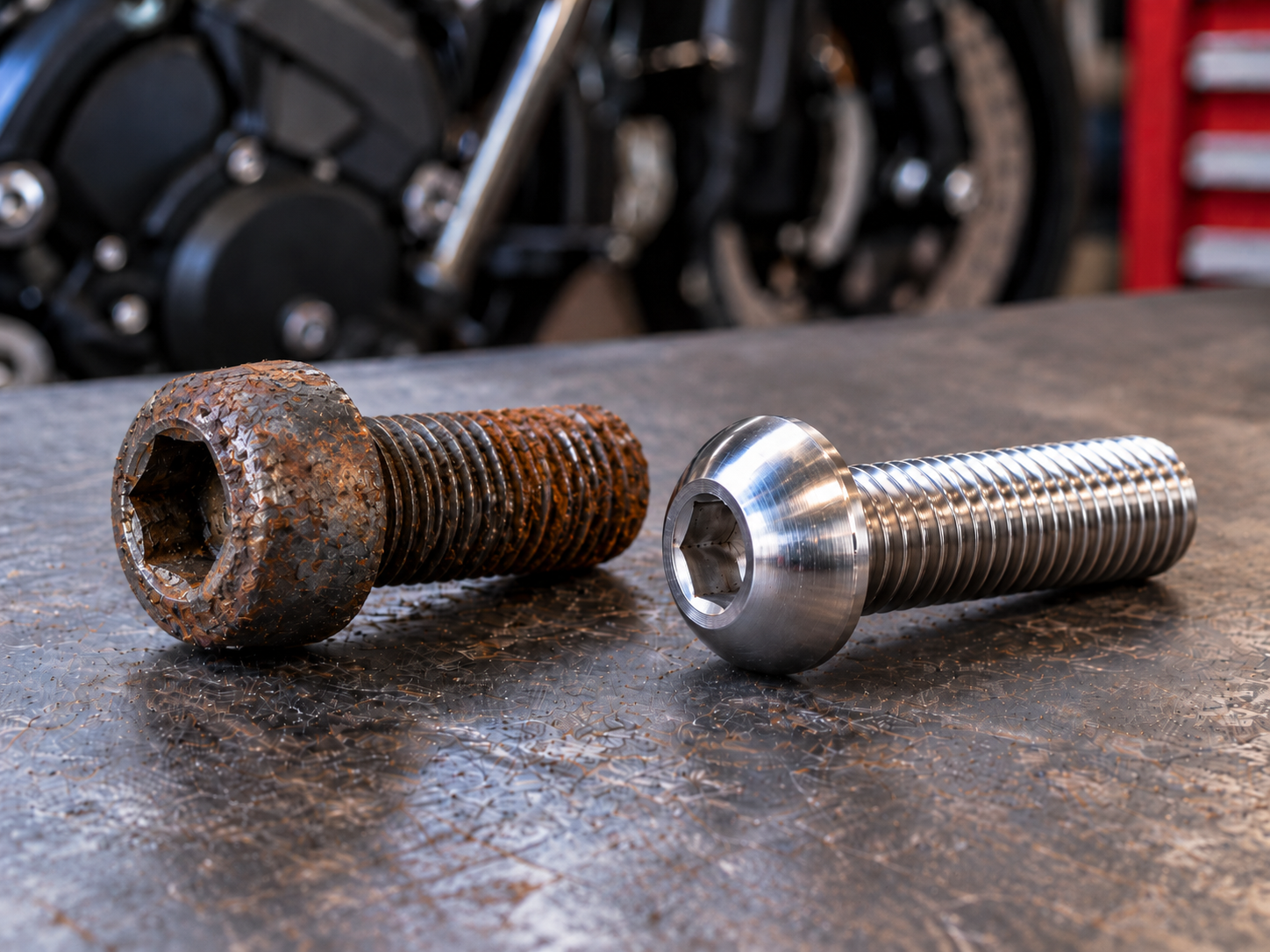
However, some fasteners should be replaced when they show signs of damage, corrosion, stretching, thread wear or other deterioration.
The correct decision depends on the condition of the bolt, the application and the motorcycle manufacturer’s instructions.
For safety-critical areas, a bolt that looks questionable should never be reused simply because it still fits.
When Should Motorcycle Bolts Be Replaced?
A motorcycle bolt should be inspected before reuse.
Replacement may be appropriate if the bolt has:
- Damaged threads.
- A rounded or damaged drive recess.
- A distorted or damaged head.
- Significant corrosion.
- Visible stretching or deformation.
- Worn shoulders or locating surfaces.
- Damage caused during removal.
- Signs of previous cross-threading.
- Heat damage.
- Surface damage that could affect seating or clamping.
- Been identified by the manufacturer as a single-use fastener.
The exact replacement decision depends on the fastener and its application.
Damaged Threads
Thread damage is one of the clearest reasons to replace a motorcycle bolt.
Look for:
- Flattened thread crests.
- Torn or distorted threads.
- Missing sections of thread.
- Cross-threading.
- Galling.
- Heavy corrosion.
- Metal transfer.
- Threads that no longer run smoothly.
A damaged bolt can also damage the female thread in the motorcycle component.
This is particularly important where the bolt screws into aluminium.
See our Motorcycle Bolts Into Aluminium: How to Avoid Damaged & Stripped Threads guide for more information.
Rounded Allen, Torx or Hex Drives
A damaged drive is another common reason to replace a bolt.
Examples include:
- Rounded Allen or hex-socket recesses.
- Damaged Torx recesses.
- Rounded external hex flats.
- Distorted screwdriver slots or cross-head drives.
A bolt may still tighten, but a damaged drive can make future removal difficult or impossible.
If the tool no longer fits the fastener correctly, replacing it before reassembly can prevent a much larger problem later.
Our Motorcycle Bolt Head Types guide explains the main head and drive types used on motorcycle fasteners.
Should You Reuse a Rounded Bolt?
Usually, a rounded or badly damaged bolt should be replaced rather than refitted.
Reusing it may leave you with a fastener that cannot be removed during future servicing.
This can turn a simple maintenance job into drilling, extraction or component repair.
If you are already dealing with a damaged fastener, see our How to Remove Seized, Stuck & Rounded Motorcycle Bolts guide.
Corroded Motorcycle Bolts
Light surface marking does not automatically mean a bolt must be replaced.
However, more serious corrosion can reduce the effective cross-section of the fastener and damage the threads or seating surfaces.
Replace or investigate further if you find:
- Deep pitting.
- Heavy rust.
- Significant material loss.
- Corrosion around the thread roots.
- Corrosion under the bolt head.
- Flaking or severely damaged plating.
- Localised corrosion that appears to have penetrated the surface.
The level of concern should increase with the importance and loading of the fastener.
Stainless Steel Bolts and Corrosion
Stainless steel is corrosion resistant, but it is not completely immune to staining or corrosion.
304 stainless steel can develop surface staining, tea staining, crevice corrosion or localised attack under certain conditions.
Road salt and chloride contamination can increase the risk.
Our 304 Stainless Steel Motorcycle Bolts: Corrosion Resistance, Cleaning & Care guide explains this in more detail.
Visible Stretching or Deformation
A bolt that has visibly stretched, bent or changed shape should not normally be reused.
Signs can include:
- A narrowed section of shank.
- Distortion near the threads.
- A visibly bent bolt.
- A stretched or elongated appearance.
- Damage around the transition between the threaded and unthreaded sections.
- A deformed head or flange.
Visible deformation suggests the bolt may have been loaded beyond its intended condition.
Replacing it is normally safer than assuming it still has its original mechanical properties.
Can a Bolt Stretch Without Looking Damaged?
Yes.
A bolt can experience permanent elongation without an obvious visual change.
Some motorcycle fasteners may also be designed to operate close to, or beyond, the elastic region during installation.
These are sometimes referred to as torque-to-yield or stretch fasteners.
Where a manufacturer specifies that a fastener must be replaced after removal, follow that instruction even if the bolt appears undamaged.
Single-Use Motorcycle Bolts
Some motorcycle manufacturers specify certain fasteners as single-use items.
Examples may include particular:
- Engine fasteners.
- Connecting-rod bolts.
- Cylinder-head fasteners.
- Flywheel or rotor fasteners.
- Brake-related fasteners.
- Suspension fasteners.
- Drivetrain fasteners.
- Special locking bolts.
This varies significantly between motorcycles.
Do not assume that a bolt can be reused simply because another visually similar bolt can.
The workshop manual or manufacturer’s parts information should take priority.
Damaged Bolt Shoulders
Some motorcycle bolts have an unthreaded shoulder that performs an important locating, spacing or bearing function.
Replace a shoulder bolt if the shoulder is:
- Worn.
- Grooved.
- Corroded.
- Bent.
- Undersized through wear.
- Damaged where it passes through a bush or bearing.
The threaded section may still look perfect while the shoulder itself is no longer suitable.
See our Motorcycle Shoulder Bolts Explained guide for more information.
Damaged Seating Surfaces
The underside of the bolt head is part of the joint.
Damage here can affect how the load is distributed.
Look for:
- Deep scoring.
- Heavy corrosion.
- Distorted flanges.
- Damaged serrations.
- Raised burrs.
- Uneven contact surfaces.
A damaged seating face can make a bolt behave differently even when the threads are still usable.
Does Bolt Appearance Tell You Everything?
No.
A bolt may look similar to the original while having a different:
- Thread pitch.
- Length.
- Shoulder.
- Material.
- Property class.
- Head shape.
- Drive type.
- Surface treatment.
- Intended application.
This is why a damaged motorcycle bolt should be replaced with a correctly specified fastener rather than simply the nearest bolt that fits the hole.
See our How to Choose the Correct Replacement Motorcycle Bolt guide.
Check the Bolt Length Before Replacing It
Replacing a damaged bolt with one that is too long or too short can create new problems.
A bolt that is too long may:
- Bottom out in a blind hole.
- Contact an internal component.
- Prevent correct clamping.
- Damage the bottom of a threaded hole.
A bolt that is too short may not provide enough thread engagement.
Our How to Measure Motorcycle Bolts guide explains how different bolt head types are measured.
Check the Thread Pitch
The replacement must also use the correct thread pitch.
Two bolts can have the same nominal diameter but different pitches.
Forcing the wrong pitch into an existing thread can damage both the bolt and the component.
Our Motorcycle Metric Thread Pitch Reference Chart explains common motorcycle metric thread pitches.
Bolt Strength Must Match the Application
A new-looking bolt is not automatically a suitable replacement.
Strength and material specification still matter.
Fastener markings such as:
- 8.8.
- 10.9.
- 12.9.
- A2-70.
- A4-70.
- A4-80.
describe different mechanical classifications.
These markings should not be treated as interchangeable.
See our Motorcycle Bolt Strength Grades Explained guide.
Be Careful Chemically Cleaning High-Strength Steel Bolts
High-strength steel fasteners require particular care when removing rust or old coatings.
Some acid-based cleaning, pickling and surface-treatment processes can introduce hydrogen into high-strength steel.
In susceptible materials, this can contribute to hydrogen embrittlement, which can make a fastener vulnerable to brittle failure even when it appears visually acceptable.
This is particularly important with higher-strength fasteners such as some 10.9 and 12.9 property-class bolts.
For highly loaded or safety-critical motorcycle fasteners, do not assume that aggressive chemical rust removal is harmless.
If a high-strength bolt is badly corroded, chemically attacked or of uncertain service history, replacing it with the correct specified fastener is generally preferable to attempting an uncontrolled chemical restoration.
See our Motorcycle Bolt Strength Grades Explained guide for more information on fastener property classes.
Material Choice Also Matters
Motorcycle fasteners can be made from materials including:
- Carbon or alloy steel.
- Stainless steel.
- Titanium.
- Other specialised materials.
Changing material can affect corrosion resistance, strength, weight and installation requirements.
A stainless replacement is not automatically suitable for every original steel bolt.
See our Motorcycle Bolt Materials Explained guide before changing fastener material.
Should You Replace a Bolt After It Has Seized?
A bolt that has seized does not automatically need replacing, but it should be inspected carefully after removal.
Seizure can damage:
- Threads.
- Surface finish.
- Bolt heads.
- Shoulders.
- Female threads.
Stainless-steel threads can also suffer galling, where material transfers between the mating surfaces.
If the fastener shows torn threads, heavy marking or distortion after removal, replacement is usually appropriate.
Galling and Stainless Steel Bolts
Galling can occur when stainless-steel threads seize and damage one another during tightening or removal.
A bolt that has suffered significant galling should normally be replaced.
Do not simply clean up badly damaged threads and reinstall the fastener without checking whether the thread form remains usable.
Our Stainless Steel Motorcycle Bolt Torque, Anti-Seize & Galling Guide explains galling and thread treatment in more detail.
Threadlocker and Bolt Reuse
A bolt that previously used threadlocker may sometimes be reusable, but the condition of the fastener and the manufacturer’s instructions still matter.
Old threadlocker residue may need to be removed before reassembly.
Do not simply apply fresh threadlocker over damaged or contaminated threads.
If threadlocker is specified, use the appropriate product and installation procedure.
See our Threadlocker vs Anti-Seize on Motorcycle Bolts guide.
Anti-Seize Does Not Make a Damaged Bolt Reusable
Anti-seize can help reduce friction, galling and seizure in suitable applications.
However, it cannot repair:
- Damaged threads.
- A rounded drive.
- A bent bolt.
- A worn shoulder.
- Corrosion damage.
- Permanent stretching.
Do not use anti-seize as a way of making a damaged fastener feel easier to install.
If the bolt itself is damaged, replace it.
How Many Times Can a Motorcycle Bolt Be Reused?
There is no universal number.
Some bolts can be removed and refitted many times if they remain within specification and are correctly installed.
Others may have a specified replacement interval or may be single-use.
Factors include:
- Bolt design.
- Material.
- Property class.
- Application.
- Tightening method.
- Thread treatment.
- Service history.
- Condition.
- Manufacturer instructions.
For this reason, rules such as “replace every bolt after three removals” are not technically reliable.
Inspect Bolts During Routine Servicing
Routine servicing is a good opportunity to inspect fasteners that have been removed.
Before refitting, check:
- Threads.
- Head and drive condition.
- Shank.
- Shoulder.
- Flange or seating face.
- Corrosion.
- Straightness.
- Any locking features.
Cleaning the bolt can make damage easier to see.
However, cleaning should not remove material or disguise damage.
When Cosmetic Damage Is Acceptable
Not every scratch or mark requires replacement.
A small cosmetic mark on a lightly loaded visible fastener may have no meaningful effect on its function.
The important question is whether the damage affects:
- Tool engagement.
- Thread condition.
- Seating.
- Alignment.
- Strength.
- Corrosion protection.
- Future servicing.
If it does, replacement becomes more important.
Safety-Critical Motorcycle Bolts
Extra caution is required with fasteners associated with:
- Brakes.
- Steering.
- Suspension.
- Wheels and axles.
- Engine mountings.
- Structural components.
- Drivetrain components.
- Other highly loaded assemblies.
Do not reuse a questionable fastener in a safety-critical application simply to avoid replacing it.
Where the manufacturer specifies replacement, use a correctly specified new fastener.
When Should Motorcycle Bolts Be Replaced? The Simple Rule
The simple rule is:
Replace a motorcycle bolt when damage, wear, corrosion, deformation or manufacturer instructions mean its condition or suitability can no longer be confidently established.
Check more than just the threads.
Inspect:
- The head.
- Drive recess.
- Shank.
- Shoulder.
- Seating surface.
- Threads.
- Corrosion condition.
- Overall straightness.
If the bolt is damaged, do not rely on extra torque, threadlocker or anti-seize to compensate for the problem.
Frequently Asked Questions
Can You Re-Thread a Stretched or Elongated Motorcycle Bolt?
Re-cutting or chasing the threads does not restore a bolt that has permanently stretched or deformed.
If a fastener shows elongation, necking, bending or other permanent deformation, it should normally be replaced with the correct specified bolt.
A repaired-looking thread does not restore the original strength or dimensions of a stretched fastener.
Are Zinc-Plated Motorcycle Bolts Safe to Reuse if They Are Rusty?
It depends on the amount and location of the corrosion.
Light surface discolouration may not automatically make a fastener unusable.
However, deep rust, pitting, material loss, damaged threads or corrosion around the seating surface are reasons for replacement or further assessment.
Safety-critical fasteners deserve particular caution.
A shiny or plated appearance should never be used as the only indication that a bolt remains safe to reuse.
How Do You Know if a Cylinder-Head Bolt Is Torque-to-Yield or Single-Use?
You cannot reliably identify a torque-to-yield or single-use fastener from appearance alone.
Check the motorcycle manufacturer’s:
- Workshop manual.
- Service information.
- Tightening procedure.
- Parts information.
If the manufacturer specifies a new fastener after removal, follow that instruction.
Do not reuse a bolt solely because it looks undamaged.
Important Safety Information
This guide provides general information about motorcycle fastener inspection and replacement.
It does not establish whether a specific bolt is safe to reuse.
Always follow the motorcycle manufacturer’s workshop manual and component instructions.
Particular care is required with fasteners associated with brakes, steering, suspension, wheels, axles, structural components and other safety-critical assemblies.
If the condition or specification of a fastener cannot be confidently established, replace it with the correct specified fastener or obtain advice from a competent motorcycle technician.
Shop Stainless Steel Motorcycle Bolt Kits
Need to replace damaged, corroded or worn motorcycle fasteners?
Biker Bling supplies stainless steel motorcycle bolt kits for a range of makes, models and applications.
Shop Stainless Steel Motorcycle Bolt Kits →
Always check the individual product description, intended fitment and fasteners supplied before ordering.