
Motorcycle Washers, Spacers & Collars Explained
Motorcycle washers, spacers and collars may look like simple pieces of metal, but they can perform very different jobs.
Some spread load beneath a bolt head. Others control spacing, locate components, protect softer materials or provide a bearing surface between moving or clamped parts.
Because these parts can affect alignment, clamping and component position, they should not be omitted or replaced casually.
Understanding the difference between motorcycle washers spacers and collars can make it much easier to identify the correct replacement fastener assembly.
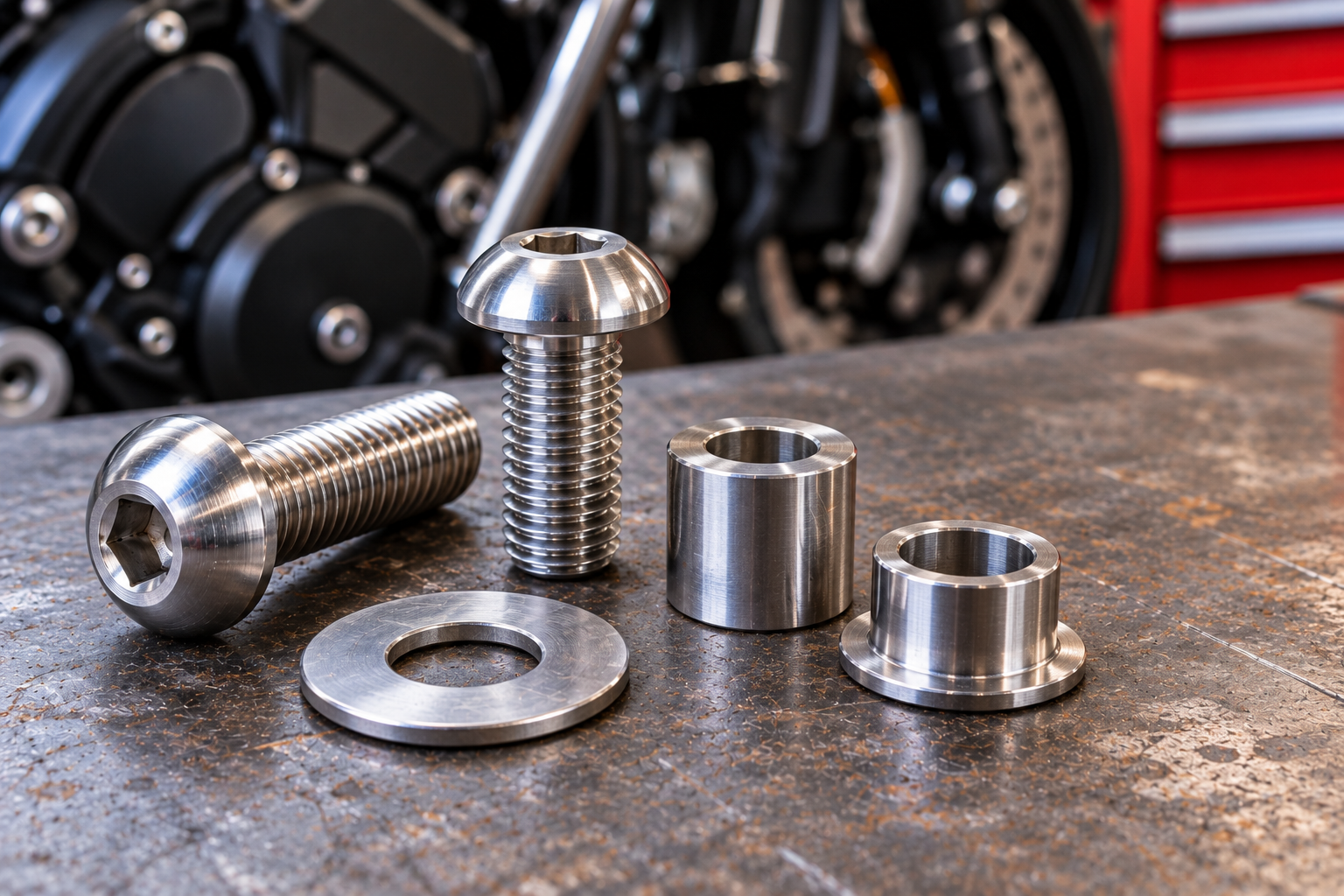
What Is a Motorcycle Washer?
A washer is usually a thin ring fitted beneath a bolt head, screw head or nut.
Depending on the application, a washer may:
- Spread the clamping load.
- Protect the surface beneath the fastener.
- Provide a smooth bearing surface.
- Help prevent the bolt head or nut damaging softer material.
- Form part of a locking system.
- Provide a defined spacing or seating surface.
Not every motorcycle bolt requires a washer.
If the manufacturer did not originally use one, adding a washer can change how the joint fits or how much thread engagement remains.
What Is a Motorcycle Spacer?
A spacer is normally used to maintain a defined distance between two components.
Unlike a simple flat washer, a spacer is often thicker and may be shaped specifically for the assembly.
Motorcycle spacers may be found around:
- Wheels.
- Axles.
- Brake components.
- Fairings.
- Mudguards.
- Fuel tanks.
- Footrests.
- Handlebars.
- Suspension components.
- Engine and frame mountings.
The exact dimensions of a spacer can be important because it can control alignment and component position.
What Is a Motorcycle Collar?
A collar is generally a sleeve-shaped component that fits around a bolt, screw, pin or axle.
It may:
- Locate the bolt within an oversized hole.
- Protect a rubber grommet or bush from crushing.
- Provide a controlled clamping distance.
- Act as a bearing surface.
- Position a bodywork panel.
- Prevent a bolt from tightening directly against softer material.
The terms collar, sleeve, bush and spacer are sometimes used differently by manufacturers, so the parts catalogue or workshop manual should take priority.
Motorcycle Washers, Spacers & Collars: The Main Difference
The simplest distinction is:
- A washer is usually a thin ring beneath a fastener.
- A spacer maintains a specific distance between components.
- A collar usually fits around a bolt or through another component to control position, support or clamping.
However, real motorcycle parts do not always fit neatly into these definitions.
A thick washer may also act as a spacer.
A collar may also control spacing.
A flanged collar may combine several functions.
For this reason, the original part and assembly should always be checked rather than relying only on its name.
Why Washers Matter on Motorcycle Bolts
Washers can influence how the load from a fastener is transferred into the component.
A suitable washer can help spread load over a larger area.
This can be particularly important where a bolt clamps against:
- Aluminium.
- Plastic.
- Fibreglass.
- Painted bodywork.
- Rubber-mounted parts.
- Thin brackets.
However, fitting a larger washer is not automatically better.
A washer that is too wide, too thick or the wrong shape can interfere with surrounding components or alter the intended seating of the bolt.
Flat Washers
Flat washers are among the simplest types.
They provide a flat bearing surface between the bolt head or nut and the component beneath it.
They may be used to:
- Spread load.
- Protect the surface.
- Bridge a slightly oversized hole.
- Provide a smooth bearing face.
Flat washers come in different:
- Outside diameters.
- Inside diameters.
- Thicknesses.
- Materials.
- Surface finishes.
Two washers for the same bolt diameter may therefore not be interchangeable.
Large-Diameter Washers
Some motorcycle bodywork uses larger-diameter washers to spread load over plastic or thin panels.
These may help reduce local pressure around the mounting hole.
However, the correct washer size still matters.
A washer that is too large can interfere with moulded bodywork, adjacent fasteners or panel contours.
A washer that is too small may concentrate load around the hole.
Rubber Washers and Grommets
Motorcycle bodywork often uses rubber washers, bushes or grommets.
These can help:
- Isolate vibration.
- Protect painted or plastic surfaces.
- Reduce direct metal-to-plastic contact.
- Allow a controlled amount of movement.
- Support bodywork without rigidly clamping it.
These parts should not automatically be replaced with metal washers.
Doing so may change how the panel is supported and can increase the risk of cracking or marking.
Our future guide to motorcycle fairing well nuts, clips and washers will cover these bodywork-specific parts in more detail.
What Are Crush Washers?
Some washers are specifically designed to deform when tightened.
These are commonly referred to as crush washers or sealing washers.
They may be used where the joint also needs to seal fluid or gas.
Common motorcycle examples can include certain:
- Brake-hose banjo bolts.
- Oil drain plugs.
- Hydraulic fittings.
- Engine plugs.
A crush washer should not be confused with an ordinary flat washer.
Crush washers are sealing components and should not be treated like ordinary reusable washers.
Once compressed, their sealing surface and thickness may have changed.
If the motorcycle or component manufacturer specifies a new sealing washer after removal, fit a new one rather than relying on its appearance.
Our future guide to motorcycle banjo bolts and copper washers will cover brake and hydraulic sealing washers separately.
Lock Washers and Locking Features
Some motorcycle assemblies may use locking washers or other mechanical locking features.
Examples can include:
- Spring washers.
- Tab washers.
- Serrated washers.
- Special locking plates.
Their suitability depends on the joint design.
Do not automatically add or remove a locking washer because another motorcycle uses one in a similar-looking location.
If the manufacturer specifies a locking feature, it forms part of the fastener assembly.
Do Not Automatically Reuse Locking Tab Washers
Locking tab washers are designed to provide a mechanical locking feature by bending one or more tabs against a nut, bolt or adjacent component.
Repeatedly bending a locking tab backwards and forwards can weaken the material at the bend.
For this reason, many service procedures specify fitting a new tab washer after removal.
Do not assume a previously bent locking tab is suitable for reuse simply because it can be flattened and bent again.
Follow the motorcycle manufacturer’s service instructions and replace the locking device where specified.
Why Motorcycle Spacers Matter
A spacer controls the distance between components.
That means even a small dimensional difference can affect:
- Alignment.
- Bearing position.
- Panel spacing.
- Brake component position.
- Wheel position.
- Clearance.
- Clamp load.
- Component movement.
This is why an improvised stack of washers should not automatically be used in place of a proper spacer.
A stack of washers may have the same approximate thickness, but it may not provide the same fit, support or alignment.
Wheel and Axle Spacers
Wheel spacers are particularly important.
They can position the wheel, bearings and other components relative to the forks or swingarm.
Incorrect spacer dimensions can affect alignment and bearing loading.
Wheel and axle components are safety-critical.
Do not substitute washers or improvised spacers for the correct wheel spacer.
Always use the manufacturer’s specification or correct replacement component.
Fairing and Bodywork Spacers
Bodywork often uses spacers to stop panels being pulled too tightly against the frame or brackets.
A fairing bolt may pass through:
- A decorative washer.
- A rubber grommet.
- A metal collar.
- A plastic spacer.
- A well nut.
- The panel itself.
Removing one of these parts can change how the load is distributed.
This is one reason why a fairing bolt kit needs more than simply matching the thread diameter.
See our How to Choose the Correct Replacement Motorcycle Bolt guide for more information on identifying the complete fastener assembly.
Why Collars Are Used With Rubber Components
A common arrangement is a metal collar passing through a rubber grommet or bush.
The collar can limit how far the bolt compresses the rubber.
Without it, tightening the bolt may crush the rubber excessively or pull the surrounding component out of position.
This means the collar thickness and length can be just as important as the bolt itself.
Inspect Collars and Spacers for Wear Grooves
Collars and spacers can develop grooves, ridges or stepped wear where they contact brackets, bushes or other components.
Run a clean fingertip around the working surfaces while inspecting the part under good light.
Look and feel for:
- Grooves.
- Ridges.
- Raised burrs.
- Uneven wear.
- Ovality.
- Distorted edges.
A worn collar or spacer may no longer locate or support the component correctly, even if its overall length still appears correct.
If the wear affects the seating, alignment or bearing surface, replace the component with the correct specified part.
Collars and Shoulder Bolts
A collar and a shoulder bolt can sometimes perform similar locating functions, but they are not the same thing.
A shoulder bolt has an integral unthreaded section built into the bolt.
A separate collar is an individual component fitted around a bolt or screw.
If the original assembly uses a shoulder bolt, do not automatically replace it with a fully threaded bolt and loose collar.
Likewise, a separate collar should not be omitted simply because the replacement bolt appears to fit without it.
See our Motorcycle Shoulder Bolts Explained guide.
Do Washers Change Bolt Length Requirements?
They can.
Adding a washer beneath a bolt head reduces the amount of bolt length available to enter the female thread.
A thicker washer or spacer can therefore reduce thread engagement.
Removing a washer or spacer can have the opposite effect and allow the bolt to enter deeper than intended.
This matters particularly with blind threaded holes.
A bolt that becomes effectively too long may bottom out before the joint is correctly clamped.
Our How to Measure Motorcycle Bolts guide explains how bolt length should be measured.
Blind Holes and Incorrect Spacer Thickness
If a bolt screws into a blind hole, changing the washer or spacer thickness can affect how deeply the bolt enters.
A bolt that previously fitted correctly may bottom out if:
- A washer is omitted.
- A spacer is replaced with a thinner one.
- The replacement bolt is longer.
- The component stack is assembled incorrectly.
If the bolt stops before the joint is seated, do not simply apply more torque.
Check the complete assembly.
For more information, see our Motorcycle Bolts Into Aluminium guide.
Washers and Tightening Torque
A washer can affect friction beneath the bolt head or nut.
That means changing the washer material, finish or surface condition may change how the fastener behaves during tightening.
Torque specifications are based on a particular joint condition.
Do not assume that adding a stainless washer, changing a coated washer or lubricating the washer face has no effect.
Our Stainless Steel Motorcycle Bolt Torque, Anti-Seize & Galling Guide explains why friction matters when tightening motorcycle fasteners.
Should You Lubricate Washers?
Not automatically.
Lubrication beneath the bolt head or nut can change friction and therefore affect the relationship between tightening torque and clamp load.
If the manufacturer specifies lubrication, follow that instruction.
If the joint is specified dry, do not add grease or anti-seize without understanding the effect.
See our Threadlocker vs Anti-Seize on Motorcycle Bolts guide for more information on thread treatments.
Stainless Steel Washers
Stainless steel washers can be useful in suitable applications because of their corrosion resistance.
However, material alone does not determine suitability.
A replacement washer still needs the correct:
- Internal diameter.
- Outside diameter.
- Thickness.
- Shape.
- Surface finish.
- Mechanical function.
A stainless washer is not automatically a correct replacement for a hardened, spring, sealing or specialised OEM washer.
See our Motorcycle Bolt Materials Explained guide for more information about fastener materials.
Can You Replace a Special Washer With a Standard Flat Washer?
Not always.
A special washer may be:
- Hardened.
- Dished.
- Tapered.
- Serrated.
- Sealing.
- Spring-loaded.
- Tabbed.
- Captive.
- Formed to fit the component.
Replacing it with a standard flat washer may remove an important feature of the joint.
If the washer looks unusual, check its intended purpose before substituting it.
What About Wave Washers?
Wave washers are formed washers with a wavy profile.
They can provide a small amount of spring force or controlled axial preload in suitable assemblies.
They are not simply decorative washers.
Do not flatten, omit or replace one with a standard flat washer unless the manufacturer’s specification allows it.
What About Belleville or Disc Spring Washers?
A Belleville washer is a conical spring washer.
It can provide spring force within a compact space.
These washers may appear in specialised mechanical assemblies.
Their orientation, dimensions and stiffness matter.
Do not replace them with ordinary flat washers.
Spacers and Bolt Strength
A spacer does not determine the strength of the bolt passing through it.
Likewise, fitting a stronger bolt does not compensate for an incorrect spacer.
Bolt strength, spacer dimensions and joint design are separate issues.
Our Motorcycle Bolt Strength Grades Explained guide explains common fastener property classes such as 8.8, 10.9, 12.9 and stainless property classes.
Check the Thread Pitch as Well
Washers, collars and spacers do not tell you the bolt thread size.
If replacing the bolt at the same time, check the correct:
- Diameter.
- Thread pitch.
- Length.
- Head type.
- Material.
- Strength specification.
Our Motorcycle Metric Thread Pitch Reference Chart can help identify common metric pitches.
Head Type Can Affect Washer Choice
Different bolt heads can have different:
- Diameters.
- Bearing surfaces.
- Heights.
- Underside profiles.
For example, a button-head bolt may seat differently from a socket-cap or flange-head bolt.
Changing head type can therefore change how the bolt interacts with the washer or surrounding component.
See our Motorcycle Bolt Head Types guide.
Captive Washers and SEMS Fasteners
Some bolts are supplied with a washer permanently retained on the shank.
These are often described as captive-washer or SEMS-style fasteners.
The washer may rotate freely but cannot normally fall off the bolt.
This arrangement can:
- Simplify assembly.
- Prevent the washer being lost.
- Ensure the correct washer is always fitted.
- Speed servicing or production.
If replacing a captive-washer bolt with separate parts, make sure the replacement assembly performs the same function.
Do Not Omit Parts Because They Look Unimportant
Small washers, collars and spacers are easy to lose during disassembly.
They are also easy to dismiss as unimportant.
However, removing one can alter:
- Alignment.
- Bolt depth.
- Panel support.
- Bearing preload.
- Component clearance.
- Load distribution.
- Vibration isolation.
If you are unsure where a washer, spacer or collar belongs, check the OEM parts diagram or workshop manual before reassembly.
Inspect Washers, Spacers and Collars Before Reuse
These parts should be inspected just like the bolts themselves.
Look for:
- Cracking.
- Distortion.
- Heavy corrosion.
- Grooving.
- Excessive wear.
- Crushing.
- Oval holes.
- Damaged sealing surfaces.
- Missing plating or severe surface damage.
A damaged washer or spacer can affect the joint even when the bolt remains serviceable.
Our When Should Motorcycle Bolts Be Replaced? guide explains when damaged fasteners may need replacement.
Measuring a Motorcycle Spacer or Collar
If a replacement must be identified, useful measurements can include:
- Outside diameter.
- Inside diameter.
- Overall length or thickness.
- Flange diameter where applicable.
- Flange thickness.
- Shoulder length.
- Bore size.
A vernier caliper can help with these measurements.
However, dimensions alone may not establish material, hardness or intended function.
For critical applications, use the manufacturer’s specification.
Can You Make Your Own Spacer?
For non-critical applications, a correctly made spacer may sometimes be practical.
However, the material, dimensions, alignment and bearing surfaces still matter.
A homemade spacer should not be assumed suitable for:
- Wheels.
- Axles.
- Brakes.
- Suspension.
- Steering.
- Structural assemblies.
- Other highly loaded applications.
For safety-critical locations, use the specified component or a properly engineered equivalent.
Motorcycle Washers, Spacers & Collars: Common Mistakes
Common mistakes include:
- Leaving out a washer because the bolt still fits.
- Replacing a spacer with stacked washers.
- Fitting a washer with the wrong outside diameter.
- Crushing a rubber grommet because its collar is missing.
- Using a standard washer instead of a sealing washer.
- Reusing a crush washer where replacement is specified.
- Reusing a locking tab washer when replacement is specified.
- Ignoring grooves or stepped wear on collars and spacers.
- Changing washer thickness without checking bolt engagement.
- Adding washers to make an over-long bolt fit.
- Using an incorrect wheel spacer.
- Assuming all collars and bushes are interchangeable.
- Replacing a specialised washer with a plain flat washer.
Motorcycle Washers, Spacers & Collars: The Simple Rule
When dealing with motorcycle washers spacers and collars, the simple rule is to treat them as part of the complete fastener assembly, not as optional extras.
Treat washers, spacers and collars as part of the fastener assembly, not as optional extras.
Before replacing or omitting one, establish:
- What it does.
- Where it fits.
- Its dimensions.
- Its material where relevant.
- Whether it controls spacing or alignment.
- Whether it provides sealing or locking.
- Whether it is reusable.
- Whether the manufacturer specifies a particular replacement.
A bolt can be the correct size and still be the wrong assembly if the washer, spacer or collar is missing or incorrect.
Important Safety Information
This guide provides general information about motorcycle washers, spacers, collars and related fastener components.
It does not establish the suitability of a particular component for a specific motorcycle application.
Always follow the motorcycle manufacturer’s workshop manual, parts information and component instructions.
Particular care is required with fastener assemblies associated with:
- Brakes.
- Steering.
- Suspension.
- Wheels and axles.
- Engine mountings.
- Structural components.
- Other safety-critical or highly loaded areas.
Do not improvise washers, spacers or collars in these locations unless the replacement has been properly specified for the application.
If the function or dimensions of a component are uncertain, use the correct OEM specification or obtain competent technical advice.
Shop Stainless Steel Motorcycle Bolt Kits
Looking for replacement stainless steel motorcycle fasteners and model-specific bolt kits?
Biker Bling supplies stainless steel motorcycle bolt kits for a range of makes, models and applications.
Shop Stainless Steel Motorcycle Bolt Kits →
Always check the individual product description, intended fitment and fasteners supplied before ordering.