
How to Choose the Correct Replacement Motorcycle Bolt
Choosing the correct replacement motorcycle bolt means matching the important features of the original fastener and making sure it is suitable for the job it performs on the motorcycle.
Choosing a replacement motorcycle bolt involves more than finding one that looks similar or has the same diameter and length.
The correct replacement needs to match the important features of the original fastener and be suitable for the job it performs on the motorcycle. Depending on the application, that can include the thread diameter, thread pitch, length, head type, shoulder dimensions, strength, material, washers, spacers and other special features.
For non-critical fittings, identifying a suitable replacement can often be straightforward. For structural, braking, suspension, steering or other safety-critical applications, the motorcycle manufacturer’s specification should always take priority.
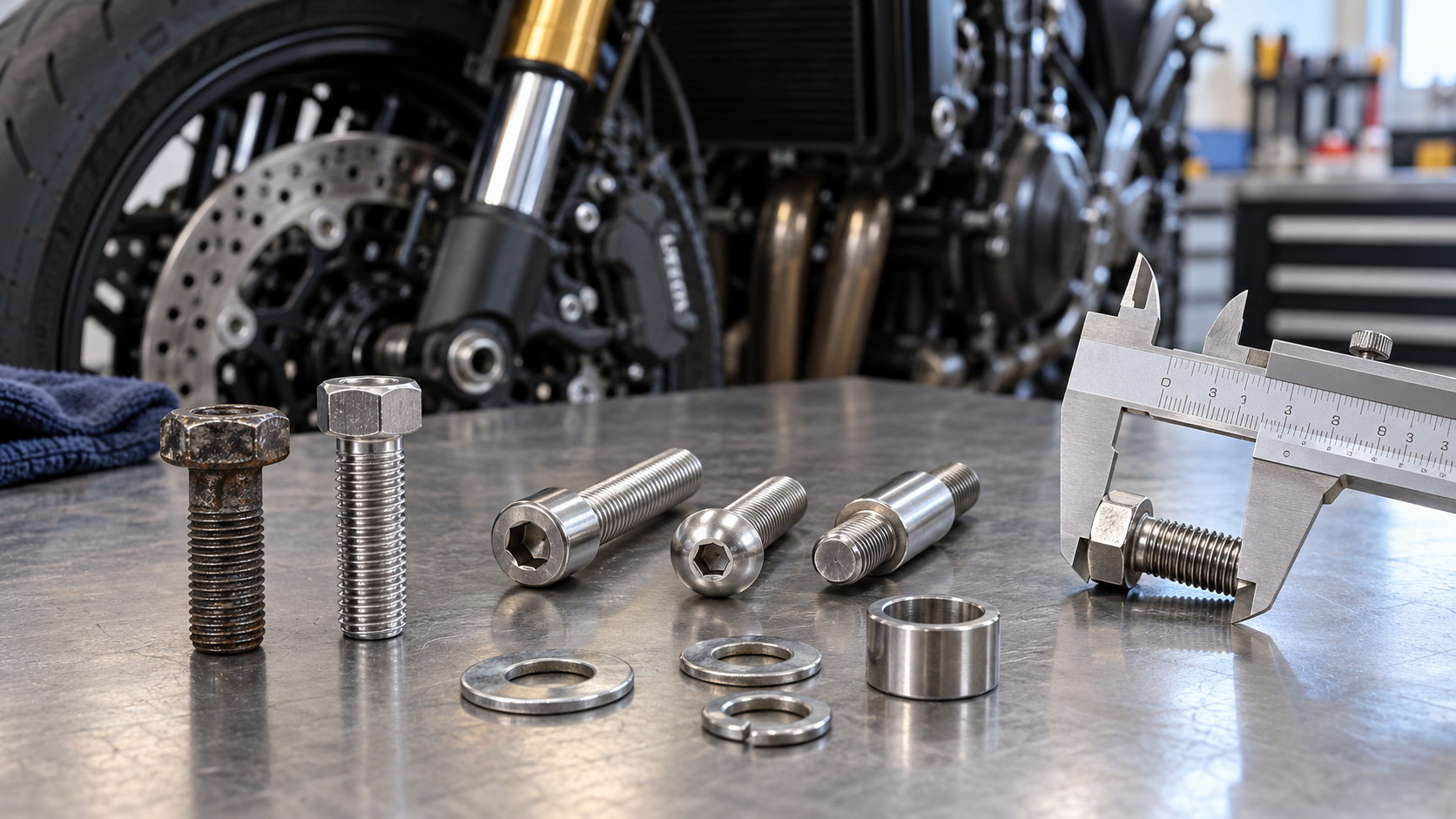
How to Choose the Correct Replacement Motorcycle Bolt
Before choosing a replacement, check as many of the following as apply:
- Bolt diameter
- Thread pitch
- Bolt length
- Threaded length
- Head type and head dimensions
- Drive type
- Whether the bolt has a shoulder or plain shank
- Shoulder diameter and length
- Strength or property class
- Material and finish
- Washers, collars or spacers
- Flange dimensions
- Captive washers or other special features
- OEM part number where available
- The job the bolt performs on the motorcycle
Two bolts can share the same basic dimensions but still be intended for very different applications.
That is why identifying a motorcycle bolt simply as, for example, M8 x 30 may not provide enough information to select the correct replacement.
Start With the Original Motorcycle Bolt
Whenever possible, use the original bolt as your reference.
Inspect it before discarding it. Look for differences that might not be obvious at first glance, including:
- An unthreaded shoulder
- An unusually long or short threaded section
- A flange beneath the head
- A captive washer
- A reduced or enlarged shank
- A locating section
- A special head profile
- Manufacturer markings
- Strength or property-class markings
If the original bolt is missing, damaged beyond measurement or clearly not original, refer to the motorcycle manufacturer’s parts information or workshop documentation where possible.
An OEM part number can also be extremely useful because it helps identify exactly which fastener the manufacturer specified for that position.
Check the Bolt Diameter
Motorcycles commonly use metric fasteners.
The nominal diameter is normally identified by the letter M followed by the diameter in millimetres.
For example:
- M5 = approximately 5 mm nominal thread diameter
- M6 = approximately 6 mm
- M8 = approximately 8 mm
- M10 = approximately 10 mm
Measure across the outside of the threads using a vernier or digital caliper where possible.
Do not assume the size by looking at the bolt head. Different bolt sizes and head styles can use the same tool size, while bolts of the same thread diameter can have different head designs.
For a more detailed measuring procedure, see our How to Measure Motorcycle Bolts guide.
Check the Thread Pitch
Matching the diameter is not enough. The replacement must also have the correct thread pitch.
Metric thread pitch is the distance from one thread to the next, normally expressed in millimetres.
For example, two bolts may both be M10 but use different thread pitches.
A bolt with the wrong pitch may begin to enter a threaded hole but then tighten abnormally or damage the threads if it is forced.
This is particularly important when threading a bolt into aluminium components, where damaged internal threads can be expensive to repair.
A thread-pitch gauge is the best method when the pitch is unknown. You may also be able to compare the replacement directly with a known original bolt.
If a bolt does not screw in smoothly by hand when it reasonably should, stop and check the diameter and pitch rather than using extra force.
Check the Correct Bolt Length
Most motorcycle bolts with heads that sit above the mounting surface are measured from directly beneath the head to the end of the bolt.
Countersunk bolts are different because their heads sit into the component. Their length normally includes the countersunk head.
This distinction can cause incorrect replacements to be ordered even when the thread diameter and pitch are correct.
A bolt that is too short may not achieve sufficient thread engagement.
A bolt that is too long may bottom out in a blind threaded hole, contact another component or give the misleading impression that the joint is tight before the parts are properly clamped.
Do not simply assume that a slightly longer bolt is an acceptable substitute.
Our How to Measure Motorcycle Bolts guide explains bolt length and other measurements in more detail.
Threaded Length Can Matter Too
Two bolts of the same overall length do not necessarily have the same threaded length.
One may be fully threaded while another has a substantial plain shank.
That difference can be important.
The plain section of a bolt may pass through a component, locate parts relative to one another or carry load in a way that the threaded section was not intended to.
When replacing a partially threaded OEM bolt, compare both the overall length and the position at which the thread begins.
Does the Bolt Have a Shoulder?
A shoulder bolt has a defined unthreaded section between the head and the thread.
On a motorcycle, a shoulder may perform functions such as:
- Locating a component
- Maintaining alignment
- Passing accurately through a bracket or bush
- Providing a bearing surface
- Controlling where the threaded section sits within an assembly
Replacing a shouldered bolt with an ordinary fully threaded bolt of the same nominal diameter and overall length may therefore change how the assembly fits or carries load.
Measure the shoulder diameter and shoulder length as well as the thread.
See Motorcycle Shoulder Bolts Explained for a more detailed explanation of why this feature matters.
Match the Head Type and Drive
Motorcycle fasteners use many head styles, including:
- Socket cap
- Button head
- Hex head
- Flange head
- Pan head
- Countersunk
- Torx and other specialist designs
Head style is not purely cosmetic.
The underside of the head, flange diameter, seating surface and overall head dimensions can affect how the bolt bears against the component.
Clearance may also matter. A replacement with a taller or wider head could interfere with bodywork, brackets or moving parts.
Where the manufacturer used a specific head or flange arrangement for a reason, replacing it simply because another bolt has the same thread can be inappropriate.
Check Washers, Collars and Spacers
Do not look at the bolt in isolation.
Many motorcycle assemblies use:
- Flat washers
- Spring or specialised washers
- Sealing washers
- Copper washers
- Collars
- Sleeves
- Bushes
- Spacers
These parts can affect spacing, alignment, sealing and how clamping force is transferred into the component.
If the original arrangement includes a collar or spacer, fitting a replacement bolt without it can alter how the assembly is clamped even when the bolt itself appears to fit correctly.
Keep the complete original fastener arrangement together wherever possible until the replacement has been identified.
Do Not Assume the Same Size Means the Same Strength
A bolt that has the correct diameter, pitch and length is not automatically a suitable replacement.
Fasteners are manufactured from different materials and to different mechanical-property classes.
This is particularly important on motorcycles because some bolts are used in highly loaded or safety-critical locations.
Do not assume that changing an original high-strength steel fastener to stainless steel is automatically an upgrade.
Stainless steel is useful for corrosion resistance in many suitable motorcycle applications, but it should not automatically replace every OEM steel fastener.
Where fastener strength is important, confirm the manufacturer’s specification or obtain appropriate technical advice before changing the material or property class.
This is especially important around components associated with:
- Brakes
- Suspension
- Steering
- Wheels and axles
- Engine internals
- Structural mountings
- Highly loaded assemblies
If there is any doubt about the required mechanical specification, use the manufacturer-specified fastener rather than choosing a replacement based on appearance.
Stainless Steel Is Not Automatically Suitable Everywhere
Stainless steel motorcycle bolts can be an excellent choice in appropriate applications, particularly where corrosion resistance and appearance are important.
However, suitability depends on the application.
The fact that a stainless bolt physically fits an OEM location does not by itself confirm that its mechanical properties, head form or other characteristics make it an appropriate replacement.
Biker Bling therefore does not recommend treating stainless steel as a universal replacement for every original motorcycle fastener.
For model-specific kits, the intended application should still be checked and installation carried out in accordance with the motorcycle manufacturer’s requirements.
Generic Bolts and Model-Specific Bolt Kits
There are two common ways of buying replacement motorcycle fasteners.
A generic bolt is selected from its dimensions and specification.
A model-specific kit is selected for a particular motorcycle and application.
Generic fasteners can be useful when you already know exactly what specification you need. Model-specific kits can make identification easier where the fasteners have already been selected for a defined motorcycle application.
However, neither approach removes the need to understand what the bolt is doing.
Our guide to Generic Motorcycle Bolt Kits vs Model-Specific Kits: What’s the Difference? explains the differences in more detail.
Check the OEM Part Number Where Possible
If an OEM part number is available, record it before removing or replacing the bolt.
Manufacturers can use the same fastener across several models and years, while bolts that look almost identical may have different part numbers because their specification differs.
The OEM number can therefore provide another useful check alongside physical measurements.
Parts diagrams can also help establish whether washers, collars, spacers or other associated parts belong with the fastener.
Do not rely on an illustration alone for precise dimensions unless the manufacturer specifically provides them.
What If the Original Bolt Is Missing?
When there is no original bolt to measure, avoid guessing.
Identifying the correct replacement motorcycle bolt is especially important when the original fastener is missing or cannot be measured reliably.
Useful sources of information can include:
- The motorcycle manufacturer’s parts catalogue
- The OEM part number
- The workshop manual
- Another identical fastener from the same assembly, where appropriate
- Reliable model-specific parts information
- Measurements of the mounting components, used carefully and only where the required specification is understood
Be particularly cautious about determining bolt length by inserting an object into a threaded hole and simply choosing a bolt that appears to fit.
The depth of a hole does not necessarily tell you the correct bolt length, required thread engagement or whether internal clearance is needed.
Never Force a Replacement Bolt Into the Thread
A correctly identified clean fastener should engage normally with the mating thread.
If resistance appears unexpectedly during hand installation, stop.
Possible causes include:
- Incorrect diameter
- Incorrect thread pitch
- Cross-threaded engagement
- Damaged threads
- Contamination
- Corrosion
- Threadlocker residue
- A damaged bolt
Using a spanner, ratchet or power tool to overcome unexpected resistance can turn an identification problem into damaged threads.
That can be particularly serious in aluminium motorcycle components.
If you are dealing with a fastener that is already seized, stuck or rounded, see our How to Remove Seized, Stuck & Rounded Motorcycle Bolts guide.
Check the Required Thread Treatment
Before installation, establish whether the application requires anything on the threads.
Depending on the motorcycle and component, the manufacturer may specify:
- Clean, dry threads
- Lubricant
- Anti-seize compound
- Threadlocking compound
- Another specific treatment
Do not automatically apply anti-seize or threadlocker to every replacement bolt.
Lubrication and other thread treatments can alter friction and therefore affect the relationship between tightening torque and resulting clamp load.
Always follow the motorcycle manufacturer’s workshop information and any relevant component instructions.
See our Stainless Steel Motorcycle Bolt Torque, Anti-Seize & Galling Guide for more information about tightening torque, lubrication, anti-seize and thread galling.
Check the Correct Replacement Motorcycle Bolt Before Installation
Before tightening the replacement bolt, make one final comparison.
Ask:
- Is the diameter correct?
- Is the thread pitch correct?
- Is the length correct?
- Does the threaded length match where necessary?
- Does it require a shoulder?
- Is the head and seating surface suitable?
- Are the washers, collars or spacers correct?
- Is the material appropriate?
- Is the required strength or property class known?
- Is the bolt suitable for this particular application?
- Are the threads in good condition?
- Have the manufacturer’s installation instructions been checked?
Once those details are known, choosing the correct replacement motorcycle bolt becomes much more reliable.
If the answer to an important question is unknown, especially on a safety-critical assembly, establish the correct specification before proceeding.
Important Safety Information
Motorcycle fasteners can form part of safety-critical assemblies.
This guide provides general information for identifying replacement fasteners and cannot determine the correct specification for every motorcycle or application.
Always follow the motorcycle manufacturer’s workshop manual, parts information and specified fastener requirements.
Do not substitute fastener materials, strengths, dimensions or designs in braking, steering, suspension, wheel, structural or other safety-critical applications unless suitability has been properly established.
If you cannot positively identify the required fastener or are unsure whether a replacement is suitable, obtain advice from a competent motorcycle technician or the motorcycle manufacturer before installation.
Choosing the Correct Bolt: The Simple Rule
The safest approach is to match the function and specification of the original fastener, not just its appearance.
For many motorcycle bolts, that means checking:
Diameter + thread pitch + length + head + shoulder + material/strength + associated hardware + application
With those checks complete, you will have a much clearer basis for deciding whether a replacement fastener is suitable.
If you still need to identify the dimensions of an existing fastener, start with our How to Measure Motorcycle Bolts guide.
Once you have established that the replacement fastener is suitable, our How to Fit Stainless Steel Motorcycle Bolts guide explains good installation practice, thread preparation, starting the fastener correctly and the checks worth making before final tightening.
Shop Stainless Steel Motorcycle Bolt Kits
Looking for replacement stainless steel fasteners for your motorcycle?
Biker Bling supplies stainless steel motorcycle bolt kits for a range of makes, models and applications.
Shop Stainless Steel Motorcycle Bolt Kits →
Always check the individual product description, intended fitment and hardware supplied before ordering.