
Motorcycle Banjo Bolts & Copper Washers Explained
Motorcycle banjo bolts and copper washers are commonly used in hydraulic systems such as motorcycle brakes and, on some machines, clutch systems.
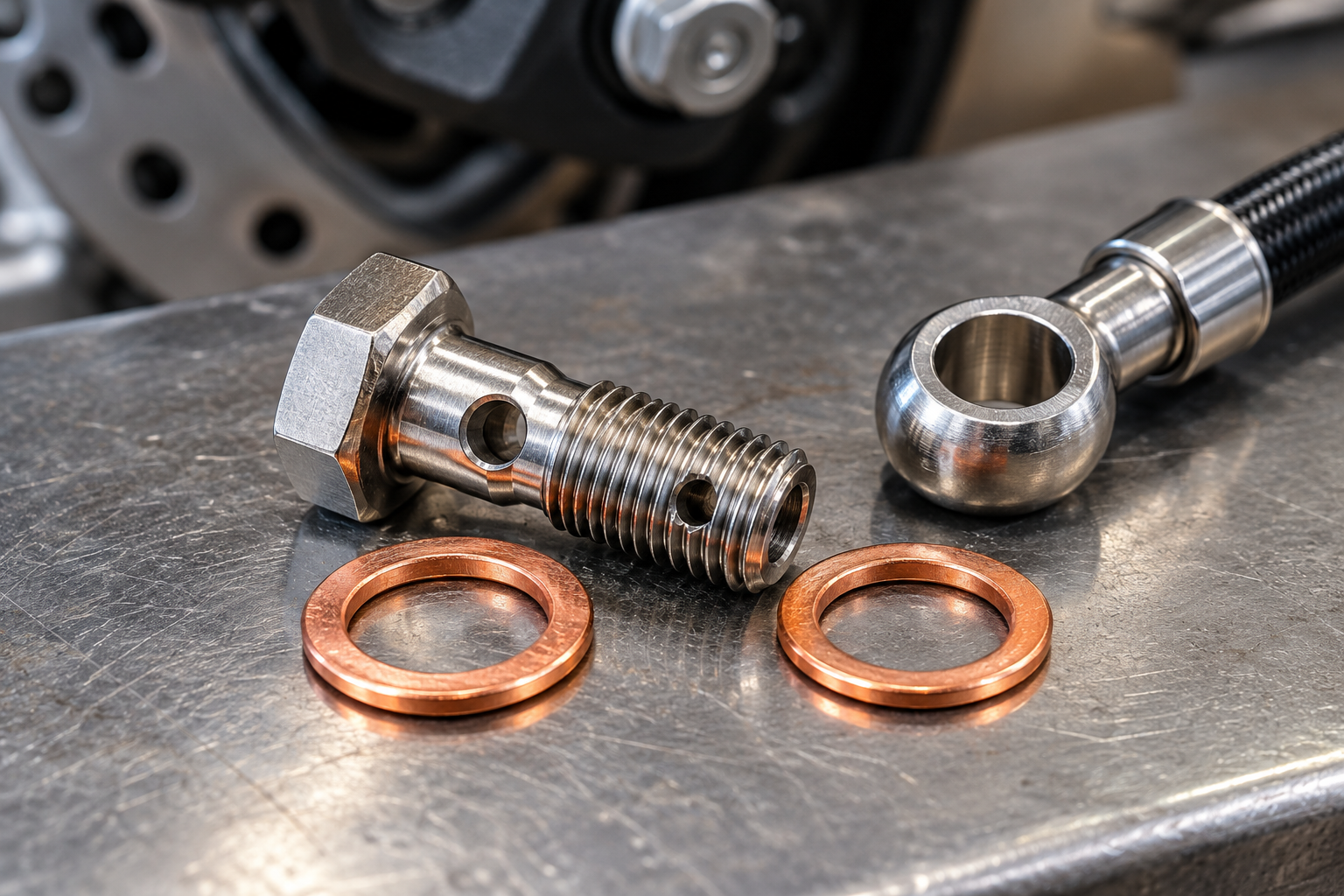
A banjo bolt is different from an ordinary solid bolt because it contains internal fluid passages that allow hydraulic fluid to pass through the bolt and into the banjo fitting.
The copper washers fitted around the connection provide the sealing surfaces.
Because these components can form part of a safety-critical hydraulic system, the correct banjo bolt, thread, washers and tightening procedure all matter.
What Are Motorcycle Banjo Bolts?
A banjo bolt is a hollow or internally drilled bolt designed to allow fluid to pass through it.
It normally contains:
- An axial internal passage.
- One or more cross-drilled fluid holes.
- A threaded section.
- A head for tightening.
- Sealing surfaces used with suitable washers.
The bolt passes through a banjo fitting on the end of a hydraulic hose.
Fluid can then travel through the internal passages in the bolt and into or out of the hose fitting.
This arrangement is commonly used where a compact hydraulic connection is required.
Where Are Banjo Bolts Used on Motorcycles?
Banjo bolts may be found on:
- Front brake master cylinders.
- Front brake calipers.
- Rear brake master cylinders.
- Rear brake calipers.
- ABS hydraulic units.
- Hydraulic clutch systems.
- Other specialised fluid systems.
The exact arrangement varies between motorcycles.
Do not assume that every hydraulic fitting uses the same banjo bolt simply because it looks similar.
How Does a Banjo Fitting Work?
The banjo fitting has a circular eye through which the banjo bolt passes.
The fitting normally contains an internal fluid passage connected to the hydraulic hose.
When assembled correctly, fluid travels through the drilled passages in the bolt and fitting while sealing washers prevent fluid escaping from the joint.
The sealing system therefore depends on more than the bolt thread alone.
The complete assembly can include:
- Banjo bolt.
- Banjo fitting.
- Sealing washers.
- Master cylinder, caliper or hydraulic component.
- Hydraulic hose.
- Correct tightening procedure.
What Are Copper Banjo Washers Used for?
Copper washers used with banjo bolts are normally sealing washers.
When the joint is tightened, the relatively soft copper washer conforms to the mating surfaces and helps create a hydraulic seal.
This is different from an ordinary flat washer whose main purpose may be to spread load.
A banjo sealing washer should therefore not be replaced with a normal hardware-store washer simply because the dimensions appear similar.
Our Motorcycle Washers, Spacers & Collars Explained guide explains the difference between ordinary washers and specialised fastener components.
Motorcycle Banjo Bolts and Copper Washers: Correct Washer Placement
Correct washer placement is essential when fitting motorcycle banjo bolts and copper washers.
A sealing washer is normally fitted at each sealing interface in the banjo assembly.
For a typical single banjo fitting, this commonly means a washer between the bolt head and the banjo fitting and another between the fitting and the hydraulic component.
More complex stacked or double-banjo arrangements can use additional sealing washers between the fittings.
However, always follow the motorcycle manufacturer’s parts diagram or workshop procedure.
Do not rely on a universal washer count because different assemblies can vary.
What Is a Single Banjo Bolt?
A single banjo bolt is designed to secure one banjo fitting.
This is common where one hydraulic hose connects directly to a master cylinder or caliper.
The bolt length and fluid-port arrangement must suit the fitting.
A normal solid bolt must never be substituted for a banjo bolt.
Even if the thread is identical, a solid bolt would block the hydraulic fluid path.
What Is a Double Banjo Bolt?
A double banjo bolt is longer and is designed to accommodate two banjo fittings at the same connection.
These may be used in certain brake-hose arrangements where two hydraulic lines share one master-cylinder, caliper or distribution connection.
A double banjo assembly needs the correct:
- Bolt length.
- Thread diameter.
- Thread pitch.
- Fluid passage arrangement.
- Sealing washers.
- Fitting stack.
- Tightening procedure.
Do not create a double-banjo connection simply by fitting a longer bolt unless the complete arrangement has been specified for the motorcycle.
Motorcycle Banjo Bolt Thread Size and Pitch
Motorcycle banjo bolts are available with different thread diameters and pitches.
Two banjo bolts can look almost identical but have different threads.
For example, the nominal diameter alone does not confirm the pitch.
Trying to force the wrong thread into a master cylinder or brake caliper can damage the component.
Before replacing a banjo bolt, establish:
- Thread diameter.
- Thread pitch.
- Bolt length.
- Head type.
- Fluid passage arrangement.
- Intended application.
- Material and specification where relevant.
Our Motorcycle Metric Thread Pitch Reference Chart explains common metric thread pitches.
Never Force a Banjo Bolt Into the Thread
A banjo bolt should engage the correct female thread cleanly.
If it becomes tight before the fitting has seated, stop.
Possible causes include:
- Incorrect thread pitch.
- Cross-threading.
- Damaged bolt threads.
- Damaged female threads.
- Debris.
- Corrosion.
- Incorrect bolt length.
- A misaligned banjo fitting.
Forcing the bolt can damage an expensive master cylinder, brake caliper or hydraulic component.
This is particularly important where the female thread is aluminium.
See our Motorcycle Bolts Into Aluminium guide for more information about protecting aluminium threads.
Why Banjo Bolt Length Matters
The correct length matters because the bolt must clamp the fitting while providing suitable thread engagement.
A bolt that is too short may not engage enough thread.
A bolt that is too long may:
- Bottom out.
- Prevent the banjo fitting from clamping correctly.
- Give a false impression that the joint is tight.
- Damage the threaded component.
- Interfere with the intended fluid path in some assemblies.
Do not select a replacement solely from thread diameter and pitch.
Our How to Measure Motorcycle Bolts guide explains the general principles of bolt measurement.
Banjo Bolts Are Not Ordinary Bolts
Although a banjo bolt may resemble an ordinary hex or socket-head fastener, its internal drilling makes it a specialised hydraulic component.
A replacement needs to be suitable for the system.
Check:
- Correct thread.
- Correct length.
- Correct fluid passages.
- Correct head and seating arrangement.
- Correct sealing washers.
- Correct material and mechanical specification.
- Compatibility with the hydraulic application.
See our How to Choose the Correct Replacement Motorcycle Bolt guide for the general principles of identifying replacement fasteners.
Do the Cross-Drilled Holes Need to Line Up?
Do not assume the visible cross-drilled holes need to point directly towards the hose.
In many conventional banjo fittings, fluid can flow around the annular space within the fitting and reach the drilled holes without a specific rotational alignment.
However, specialised hydraulic designs can differ.
Always follow the manufacturer’s assembly instructions rather than loosening or repositioning a correctly tightened bolt merely to make the holes appear aligned.
Should Copper Banjo Washers Be Reused on Motorcycles?
Do not assume they are reusable.
Copper sealing washers deform when the joint is tightened.
After use, their thickness and sealing surfaces may have changed.
Where the motorcycle or component manufacturer specifies new sealing washers after removal, fit new washers.
This is particularly sensible on brake-system connections, where a small leak can have serious consequences.
Do not judge a sealing washer purely by whether it looks intact.
Can Copper Washers Be Re-Annealed and Reused?
Copper can be softened by appropriate annealing processes, and this is sometimes discussed in general engineering practice.
However, that does not mean re-annealing an old brake sealing washer is automatically an appropriate motorcycle service procedure.
For a safety-critical hydraulic connection, follow the motorcycle or component manufacturer’s instructions.
Where new washers are specified or readily available, replacing the sealing washers removes uncertainty about their previous deformation, contamination and service history.
Do Not Use Ordinary Flat Washers
An ordinary steel or stainless flat washer is not a substitute for a copper hydraulic sealing washer.
The materials and intended functions are different.
An ordinary washer may not deform sufficiently to seal the connection.
Similarly, a decorative washer should never be installed simply because it fits over the banjo bolt.
Use the specified sealing washer.
Check the Sealing Faces
A new copper washer cannot compensate for badly damaged sealing surfaces.
Before assembly, inspect the mating faces on:
- The banjo fitting.
- The master cylinder.
- The brake caliper.
- The hydraulic block or component.
Look for:
- Deep scratches.
- Gouges.
- Corrosion.
- Raised burrs.
- Embedded debris.
- Distortion.
- Old washer material.
The surfaces need to be suitable for the sealing washer to work correctly.
If a sealing face is significantly damaged, simply tightening the bolt harder is not an acceptable repair.
Keep the Fluid Passages Clear
The internal drilling in the banjo bolt must remain clear.
Before fitting a replacement, make sure there is no:
- Dirt.
- Metal debris.
- Corrosion.
- Old sealing compound.
- Paint.
- Excess thread treatment.
- Other obstruction.
Do not deliberately fill the fluid passages with grease, anti-seize, threadlocker or sealant.
Contaminating a brake hydraulic system can affect operation and may damage seals or other components.
Should You Use Threadlocker on Motorcycle Banjo Bolts?
Do not apply threadlocker automatically.
A hydraulic banjo bolt has both a fastening function and a fluid-transfer function.
The motorcycle manufacturer may specify a particular installation condition.
Adding threadlocker where it is not specified can:
- Change thread friction.
- Affect tightening behaviour.
- Complicate future removal.
- Risk contaminating fluid passages if excessively applied.
If threadlocker is specified, use the correct product and quantity.
Otherwise, follow the manufacturer’s procedure.
Our Threadlocker vs Anti-Seize on Motorcycle Bolts guide explains why thread treatments should not be applied automatically.
Should You Use Anti-Seize on a Banjo Bolt?
Again, not automatically.
Anti-seize changes friction and may alter the relationship between tightening torque and clamp load.
Excess compound could also contaminate surrounding hydraulic components if applied carelessly.
If the manufacturer specifies a dry connection, do not add anti-seize.
If a particular lubricant is specified, use the stated procedure.
Our Stainless Steel Motorcycle Bolt Torque, Anti-Seize & Galling Guide explains why lubrication affects bolt tightening.
Motorcycle Banjo Bolt Tightening Torque
There is no single universal torque figure for motorcycle banjo bolts.
The correct tightening procedure depends on factors including:
- Bolt diameter.
- Thread pitch.
- Bolt material.
- Female thread material.
- Washer material.
- Hydraulic component.
- Surface condition.
- Thread treatment.
Do not select a torque value purely because another motorcycle uses the same nominal banjo-bolt diameter.
Use the workshop manual or component manufacturer’s specification for the actual motorcycle.
Why Over-Tightening Is Dangerous
Over-tightening a banjo bolt can cause several problems.
It may:
- Damage the female thread.
- Distort the banjo fitting.
- Excessively crush the sealing washers.
- Damage the bolt.
- Damage the master cylinder or caliper.
- Create leaks rather than curing them.
A leaking banjo connection should not automatically be tightened harder.
The correct response is to identify why it is leaking.
Why Under-Tightening Is Also a Problem
Insufficient tightening may prevent the copper washers from sealing correctly.
The joint can then leak under hydraulic pressure.
A connection therefore needs the specified tightening procedure rather than being tightened merely until it “feels about right”.
Stainless Steel Motorcycle Banjo Bolts
Stainless steel banjo bolts can offer good corrosion resistance in suitable applications.
However, stainless material alone does not prove that a banjo bolt is appropriate for a particular brake or clutch system.
The replacement must still have the correct:
- Dimensions.
- Thread.
- Fluid passages.
- Mechanical specification.
- Seating arrangement.
- Intended hydraulic application.
A stainless bolt should not be substituted simply for appearance or corrosion resistance where the original specification has not been established.
Our Motorcycle Bolt Materials Explained guide explains why material and suitability are separate considerations.
Banjo Bolt Strength
A banjo bolt is hollow, so its design differs mechanically from a conventional solid bolt.
Do not assume that the strength markings or rules used for an ordinary bolt can be transferred directly to every hydraulic banjo bolt.
The component should be specified for its intended application.
For general information about conventional motorcycle fastener property classes, see our Motorcycle Bolt Strength Grades Explained guide.
Aluminium Master Cylinders and Calipers
Many motorcycle hydraulic components use aluminium housings.
That makes correct thread engagement especially important.
Cross-threading or over-tightening a steel or stainless banjo bolt can damage the softer aluminium female thread.
If the bolt does not start correctly by hand where access permits, stop and check the thread.
Do not use the tightening tool to pull an incorrectly started bolt into alignment.
See our Motorcycle Bolts Into Aluminium guide.
What Causes a Motorcycle Brake Banjo Connection to Leak?
Possible causes include:
- Reused or damaged sealing washers.
- Incorrect washer material.
- Missing washer.
- Damaged sealing face.
- Incorrect banjo bolt.
- Incorrect tightening.
- Dirt trapped under the washer.
- A distorted banjo fitting.
- Damaged threads.
- Cracked hydraulic component.
- Damaged hose or hose fitting.
Do not assume that tightening the connection more will solve the problem.
Find and correct the cause.
What If the Connection Leaks After Reassembly?
If a brake or hydraulic banjo connection leaks after assembly, do not continue to use the motorcycle as though the leak is cosmetic.
Stop and inspect the joint.
Check:
- Correct washer placement.
- Correct new washers where specified.
- Banjo fitting position.
- Sealing faces.
- Bolt specification.
- Thread condition.
- Manufacturer tightening procedure.
Any brake-fluid leak should be treated seriously.
Inspect a Banjo Bolt Before Reuse
If the manufacturer permits reuse, inspect the bolt carefully before refitting.
Check for:
- Damaged threads.
- Corrosion.
- Distortion.
- Damaged head or drive.
- Blocked fluid passages.
- Cracks or obvious damage.
- Damaged seating surfaces.
If the bolt has been significantly damaged, replace it with the correct specified component.
Our When Should Motorcycle Bolts Be Replaced? guide explains general signs that a fastener may no longer be suitable for reuse.
What If the Banjo Bolt Is Seized?
A seized banjo bolt requires care, particularly where it screws into an aluminium master cylinder or caliper.
Excessive force can damage:
- The bolt head.
- The female thread.
- The hydraulic component.
- The banjo fitting.
If the bolt is difficult to remove, do not apply unlimited force.
Our How to Remove Seized, Stuck & Rounded Motorcycle Bolts guide explains general removal principles.
For hydraulic brake components, professional assistance may be appropriate if removal risks damaging the component.
Do Not Use Sealant to Hide a Damaged Joint
A leaking banjo connection should not be repaired by smearing general-purpose sealant around the outside.
The sealing occurs at the designed mating surfaces and washers.
External sealant can:
- Hide the actual source of the leak.
- Contaminate the area.
- Make later servicing harder.
- Give a false impression that the hydraulic joint has been repaired.
Correct the underlying cause instead.
Brake Fluid Can Damage Paintwork
Many commonly used motorcycle brake fluids can damage painted or coated surfaces.
When servicing a hydraulic connection:
- Protect surrounding paintwork.
- Clean spills promptly using the procedure recommended for the fluid and motorcycle.
- Keep fluid away from inappropriate materials.
- Do not allow contamination into the hydraulic system.
Always follow the brake-fluid specification and service instructions for the motorcycle.
Air in the Hydraulic System
Opening a brake or clutch hydraulic connection may allow air into the system.
Air can reduce hydraulic performance because it is compressible.
After hydraulic components have been disconnected, the system may require the manufacturer-specified bleeding procedure before the motorcycle is returned to service.
This article does not provide a universal brake-bleeding procedure because systems can vary, particularly on motorcycles equipped with ABS.
Follow the workshop manual or appropriate service information.
ABS Brake Systems
Motorcycles equipped with ABS may contain additional hydraulic passages, valves and modulator units.
Some systems require specific procedures or diagnostic equipment during servicing or bleeding.
Do not assume that a conventional non-ABS bleeding method is correct for every ABS motorcycle.
Follow the manufacturer’s workshop procedure.
Motorcycle Banjo Bolts & Copper Washers: Common Mistakes
Common mistakes include:
- Reusing sealing washers where replacement is specified.
- Forgetting one of the sealing washers.
- Fitting washers in the wrong position.
- Using ordinary flat washers.
- Using the wrong thread pitch.
- Fitting the wrong banjo-bolt length.
- Using a solid bolt instead of a drilled banjo bolt.
- Applying excessive threadlocker or anti-seize.
- Blocking a fluid passage.
- Tightening a leaking fitting harder without finding the cause.
- Forcing a bolt into an aluminium thread.
- Ignoring damaged sealing faces.
- Assuming all banjo bolts of the same diameter are interchangeable.
Motorcycle Banjo Bolts and Copper Washers: The Simple Rule
When dealing with motorcycle banjo bolts and copper washers, treat the bolt, fitting and sealing washers as one complete hydraulic connection.
Check:
- Correct banjo bolt.
- Correct thread diameter.
- Correct thread pitch.
- Correct bolt length.
- Clear fluid passages.
- Correct sealing washers.
- Correct washer placement.
- Clean and undamaged sealing faces.
- Correct manufacturer tightening procedure.
If a brake-system connection leaks or its specification is uncertain, do not guess.
Frequently Asked Questions
Can You Reuse Motorcycle Banjo Bolt Copper Washers?
Sometimes service information may permit reuse, but many hydraulic procedures specify new sealing washers after the connection has been disturbed.
Because copper crush washers deform during tightening, replacing them where specified is the safer and more repeatable approach.
Can You Use Aluminium Washers Instead of Copper Washers?
Only if the motorcycle or component specification allows it.
Copper and aluminium sealing washers have different material properties.
Do not substitute one type purely because the dimensions appear to match.
Can a Banjo Bolt Be Too Long?
Yes.
A banjo bolt that is too long may bottom out or prevent the fitting from being clamped correctly.
The replacement must match the required thread, length and fitting arrangement.
Do Banjo Bolt Holes Have to Face the Brake Hose?
Not necessarily.
In many conventional banjo fittings, fluid can circulate around the internal cavity of the fitting and reach the cross-drilled holes without a specific rotational orientation.
Follow the manufacturer’s instructions for the actual component.
Why Is My Banjo Bolt Leaking With New Copper Washers?
Possible causes include incorrect tightening, damaged sealing faces, contamination, an incorrect bolt or washer, damaged threads, a distorted fitting or another fault in the hydraulic connection.
Do not automatically tighten it harder.
Important Safety Information
Motorcycle braking systems are safety-critical.
This guide provides general information about banjo bolts, sealing washers and hydraulic fasteners. It does not replace the motorcycle manufacturer’s workshop procedure.
Always follow the specified:
- Banjo bolt.
- Sealing washer type.
- Thread specification.
- Tightening procedure.
- Brake fluid.
- Hydraulic bleeding procedure.
Particular care is required with ABS-equipped motorcycles and any system where manufacturer-specific service procedures are required.
Do not ride a motorcycle with a known brake-fluid leak, uncertain hydraulic connection or brake system that has not been correctly serviced and checked.
If you are unsure about a motorcycle brake or clutch hydraulic connection, obtain assistance from a competent motorcycle technician.
Shop Stainless Steel Motorcycle Fasteners
Looking for replacement motorcycle fasteners, banjo bolts or model-specific stainless steel bolt kits?
Biker Bling supplies stainless steel motorcycle fasteners and model-specific kits for a range of makes, models and applications.
Shop Motorcycle Fasteners at Biker Bling →
Always check the individual product description, intended fitment and fasteners supplied before ordering.