
Motorcycle Bolt Strength Grades Explained: 8.8, 10.9, 12.9 & Stainless Steel
Motorcycle bolt strength grades tell you about the mechanical properties a fastener is designed to meet.
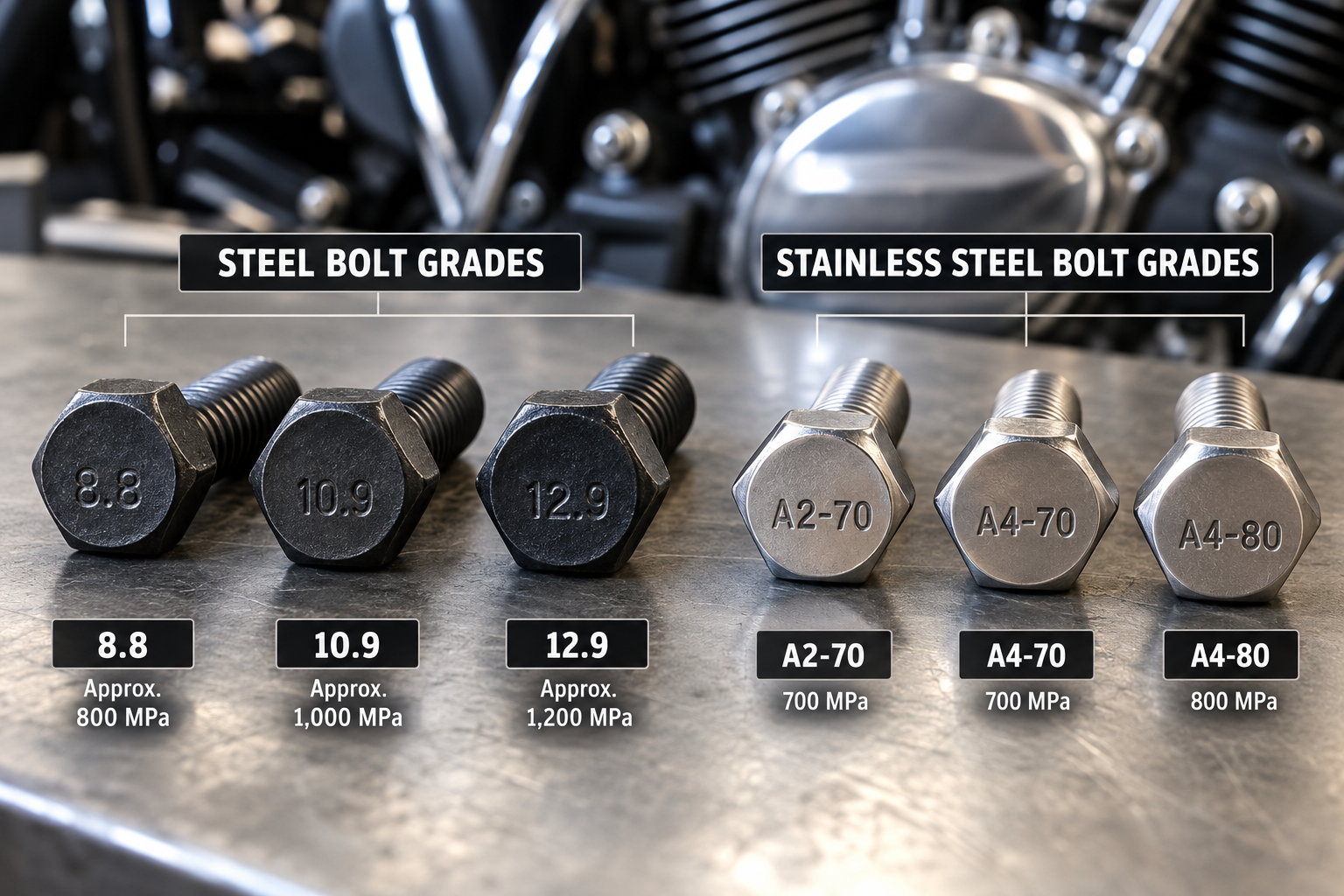
Common metric steel bolt markings include 8.8, 10.9 and 12.9, while stainless fasteners may use markings such as A2-70or A4-70.
These markings do not all mean the same thing, and they should not be compared by appearance alone.
A bolt can have the correct diameter, thread pitch and length but still be unsuitable if its mechanical properties do not match the application.
For safety-critical or highly loaded motorcycle fasteners, the manufacturer’s specification should always take priority.
Why Do Motorcycle Bolt Strength Grades Matter?
A bolt does more than hold two parts together.
When tightened correctly, it creates clamping force within the joint. The fastener must be capable of handling the loads placed on it without stretching excessively, deforming or failing.
The required properties depend on the application.
A lightly loaded bodywork fastener does not necessarily need the same mechanical properties as a bolt used in a suspension, steering, braking or structural assembly.
This is why understanding motorcycle bolt strength grades can matter when identifying or replacing an original fastener.
If you are choosing a replacement fastener, see our How to Choose the Correct Replacement Motorcycle Bolt guide.
What Does a Bolt Grade Such as 8.8 Mean?
Metric carbon and alloy-steel fasteners commonly use property classes such as:
- 8.8
- 10.9
- 12.9
These numbers are part of a standardised system used to describe specified mechanical properties.
In simple terms, a higher property class generally indicates higher required tensile and proof or yield-related strength.
That does not mean the highest number is automatically the best bolt for every position.
The correct fastener is the one specified for the application.
What Is an 8.8 Bolt?
An 8.8 bolt is a common high-strength metric steel fastener.
Under the property-class system, 8.8 fasteners have specified minimum mechanical properties that make them suitable for a wide range of engineering and automotive applications.
They are substantially different from low-strength general-purpose steel fasteners.
On a motorcycle, an 8.8 marking can indicate that the original bolt was selected with particular mechanical requirements in mind.
If an OEM bolt is marked 8.8, do not assume that an unmarked stainless bolt of the same dimensions is automatically an equivalent replacement.
What Is a 10.9 Bolt?
A 10.9 bolt has higher specified mechanical properties than an 8.8 bolt of the same size.
This property class is commonly used where higher strength is required.
Motorcycle manufacturers may use 10.9 fasteners in more demanding assemblies, although the grade used depends entirely on the particular design.
A replacement bolt should not be chosen simply because another material looks more corrosion resistant or more attractive.
If the original fastener is marked 10.9, the required mechanical specification should be established before changing it.
What Is a 12.9 Bolt?
A 12.9 bolt has still higher specified mechanical properties than 10.9 within the standard metric steel fastener system.
These fasteners can be used where high strength is required.
However, fitting a 12.9 bolt in place of a lower grade does not automatically improve a motorcycle assembly.
Fastener grade forms part of the design of the joint.
Factors such as:
- Bolt stiffness.
- Clamp load.
- Thread strength.
- Component material.
- Tightening procedure.
- Joint design.
all matter.
The correct approach is to use the grade specified for the application, not simply the highest grade available.
Does a Higher Bolt Grade Always Mean Better?
No.
A higher property class means the fastener meets higher specified mechanical-property requirements, but that does not make it the best choice for every joint.
Motorcycle assemblies are designed as systems.
The bolt works together with:
- The threaded component.
- Nut or insert where applicable.
- Washers.
- Spacers.
- Joint surfaces.
- Tightening method.
- Specified torque or tightening procedure.
Changing one part of that system without understanding the design can cause problems.
For example, a stronger bolt does not strengthen weak aluminium threads.
Steel Bolt Strength Grades Compared
| Steel Property Class | Minimum Tensile Strength | General Meaning |
|---|---|---|
| 8.8 | Approx. 800 MPa | High-strength general engineering fastener. |
| 10.9 | Approx. 1,000 MPa | Higher-strength fastener for more demanding applications. |
| 12.9 | Approx. 1,200 MPa | Very high-strength fastener for highly demanding applications. |
These figures are useful for understanding the classification system, but they should not be used as a substitute for the motorcycle manufacturer’s specified fastener requirements.
What Do the Two Numbers Mean?
For standard metric steel bolts, the first number relates to the fastener’s nominal minimum tensile-strength level.
The second number helps define the relationship between tensile strength and the specified yield-related property.
This is why:
- 8.8
- 10.9
- 12.9
represent progressively higher mechanical property classes.
The numbers are not simply model numbers or quality ratings.
They describe defined fastener properties.
Where Can You Find the Bolt Grade?
On many metric steel bolts, the property class is marked on the bolt head.
You may see markings such as:
8.8
10.9
or:
12.9
The exact marking arrangement can vary depending on bolt size, head style and applicable standard.
Small fasteners may not always carry markings that are easy to see.
Do not identify the grade purely from colour or surface finish.
Two bolts can have very similar finishes while having different mechanical properties.
Stainless Steel Uses a Different Marking System
Stainless steel fasteners are commonly described using markings such as:
A2-70
or:
A4-70
This is different from the 8.8, 10.9 and 12.9 system used for carbon and alloy-steel fasteners.
The marking combines information about the stainless material family and the mechanical property class.
For example:
- A2 generally refers to an austenitic stainless fastener family associated with 304-type stainless.
- A4 generally refers to an austenitic stainless fastener family associated with 316-type stainless.
- 70 identifies a specified property class.
For more on the material differences, see our Motorcycle Bolt Materials Explained: 304 Stainless, 316 Stainless, Titanium & High-Tensile Steel guide.
What Does A2-70 Mean?
An A2-70 fastener combines:
- A2 stainless material classification.
- 70 property class.
The 70 property class specifies a minimum tensile strength of 700 MPa for relevant austenitic stainless fasteners.
This does not mean an A2-70 bolt is equivalent to a steel 8.8 bolt.
The marking systems are different and the mechanical properties are not identical.
Suitability still depends on the application.
What Does A4-70 Mean?
An A4-70 fastener combines:
- A4 stainless material classification.
- 70 property class.
A4 is generally associated with 316-type stainless fasteners, while the 70 property class defines specified mechanical properties.
Like A2-70, an A4-70 fastener should not automatically be treated as equivalent to a steel 8.8, 10.9 or 12.9 fastener.
Corrosion resistance and mechanical strength are different characteristics.
Are A2-70 and A4-70 the Same Strength?
Within the same 70 property class, the minimum tensile-strength requirement is based on the property class rather than simply whether the fastener is A2 or A4.
That is why the 70 matters when discussing mechanical strength.
The A2 or A4 portion identifies the stainless material family.
This is also why saying “316 is stronger than 304” can be misleading when discussing fasteners.
The actual property class needs to be considered.
Stainless Steel Property Classes
Common austenitic stainless fastener property classes include:
- 50
- 70
- 80
Depending on the grade and applicable standard, higher classes can also exist.
A simplified comparison is:
| Stainless Property Class | Minimum Tensile Strength | Material Context |
|---|---|---|
| 50 | 500 MPa | Austenitic stainless in the annealed condition. |
| 70 | 700 MPa | Common cold-worked property class, including A2-70 and A4-70. |
| 80 | 800 MPa | Higher-strength cold-worked stainless property class, such as A4-80. |
The fastener’s complete designation is important.
For example:
A4-80
contains more useful information than simply describing the fastener as “316 stainless”.
Is A4-80 Stronger Than A4-70?
In terms of the specified tensile property class, yes.
An A4-80 fastener has higher minimum mechanical-property requirements than an A4-70 fastener.
However, that still does not mean A4-80 is automatically the correct replacement for every A4-70 or steel fastener.
The motorcycle joint may have been designed around a particular specification.
Always establish what the manufacturer requires.
Can Stainless Steel Replace an 8.8 Bolt?
Sometimes it may be suitable, but not automatically.
An 8.8 steel bolt and an A2-70 or A4-70 stainless bolt have different specified mechanical properties.
The fact that both bolts have the same:
- Diameter.
- Thread pitch.
- Length.
- Head type.
does not make them equivalent.
Before replacing an 8.8 steel fastener with stainless steel, confirm that the replacement has suitable mechanical properties for the application.
For safety-critical or highly loaded fasteners, use the manufacturer-specified fastener unless an appropriate substitute has been properly established.
Can Stainless Steel Replace a 10.9 or 12.9 Bolt?
This requires even greater caution.
Standard A2-70 or A4-70 stainless fasteners should not be assumed to replace 10.9 or 12.9 high-strength steel fasteners.
The mechanical-property requirements are substantially different.
If the original motorcycle bolt is marked 10.9 or 12.9, do not replace it with an ordinary stainless fastener simply to improve appearance or corrosion resistance.
Use the manufacturer-specified part or an alternative whose suitability has been properly established.
Material and Strength Grade Are Different Things
This is one of the most important points to understand.
Material describes what the fastener is made from.
Examples include:
- 304 stainless.
- 316 stainless.
- Alloy steel.
- Titanium.
Property class describes specified mechanical properties.
Examples include:
- 8.8.
- 10.9.
- 12.9.
-
-
A material name by itself does not tell you the complete fastener specification.
If you have not already read it, our Motorcycle Bolt Materials Explained: 304 Stainless, 316 Stainless, Titanium & High-Tensile Steel guide explains the material side of this in more detail.
Bolt Strength Is Not the Same as Tightening Torque
A stronger bolt does not mean you should automatically tighten it to a higher torque.
Correct tightening depends on the complete joint and the manufacturer’s specification.
Factors can include:
- Bolt diameter.
- Thread pitch.
- Bolt property class.
- Nut or internal-thread material.
- Surface finish.
- Lubrication.
- Anti-seize.
- Threadlocker.
- Joint design.
Lubrication and thread treatments can significantly affect friction and therefore the relationship between tightening torque and clamp load.
For more detail, see our Stainless Steel Motorcycle Bolt Torque, Anti-Seize & Galling Guide.
Aluminium Threads Can Be the Limiting Factor
Many motorcycle fasteners screw into aluminium engine cases, covers, brackets and other components.
A stronger bolt does not make the aluminium thread stronger.
Excessive tightening can damage the female thread even if the bolt itself is capable of carrying a much higher load.
This is another reason to follow the motorcycle manufacturer’s specified torque and installation procedure rather than relying on the maximum capability of the bolt.
A future Biker Bling guide will cover motorcycle bolts into aluminium and how to avoid damaged or stripped threads in more detail.
Head Markings Are Useful — But Not the Whole Story
Head markings can provide valuable information, but they should be considered alongside:
- OEM part number.
- Bolt dimensions.
- Thread pitch.
- Shoulder or plain-shank dimensions.
- Material.
- Head type.
- Application.
If you need help identifying the rest of the fastener, see our How to Measure Motorcycle Bolts guide.
For bolts with a significant unthreaded section, our Motorcycle Shoulder Bolts Explained guide explains why matching the thread alone may not be enough.
Never Choose a Replacement by Grade Alone
Finding a bolt marked with the correct property class does not automatically make it a suitable replacement.
You must still check:
- Diameter.
- Thread pitch.
- Length.
- Threaded length.
- Shoulder dimensions.
- Head dimensions.
- Seating surface.
- Material or coating.
- Associated washers or spacers.
- Intended application.
Our How to Choose the Correct Replacement Motorcycle Bolt guide covers the full identification process.
Important Safety Information
Motorcycle bolts can form part of safety-critical assemblies.
This guide explains general fastener property-class markings and should not be used to determine the correct fastener specification for every motorcycle application.
Always follow the motorcycle manufacturer’s workshop manual, parts information and specified fastener requirements.
Take particular care with bolts associated with:
- Brakes.
- Steering.
- Suspension.
- Wheels.
- Axles.
- Structural mountings.
- Engine internals.
- Other highly loaded assemblies.
Do not substitute fastener grades or materials unless suitability has been properly established.
If the required specification cannot be confirmed, use the manufacturer-specified fastener or obtain advice from a competent motorcycle technician.
Motorcycle Bolt Strength Grades: The Simple Rule
Understanding motorcycle bolt strength grades makes it easier to recognise why two bolts of the same size may not be mechanically equivalent.
The key points are:
- 8.8, 10.9 and 12.9 are metric steel fastener property classes.
- Higher numbers generally represent higher specified mechanical properties.
- A2-70 and A4-70 use a different stainless fastener designation system.
- A2 and A4 identify stainless material families.
- 70 or 80 identifies the stainless fastener property class.
- Material and mechanical strength are not the same thing.
- A bolt with matching dimensions is not automatically an equivalent replacement.
- The motorcycle manufacturer’s specification should take priority.
When replacing a motorcycle bolt, match the complete fastener specification, not just the thread size or appearance.
Shop Stainless Steel Motorcycle Bolt Kits
Looking for replacement stainless steel fasteners for your motorcycle?
Biker Bling supplies stainless steel motorcycle bolt kits for a range of makes, models and applications.
Shop Stainless Steel Motorcycle Bolt Kits →
Always check the individual product description, intended fitment and fasteners supplied before ordering.