
Motorcycle Fairing Well Nuts, Clips & Washers Explained
Motorcycle fairing well nuts, clips and washers are commonly used alongside bolts to secure windscreens, fairings and other motorcycle bodywork.
Behind the visible fastener you may also find spring clips, clip nuts, rubber grommets, collars, plastic washers or other small components that help hold and protect the bodywork.
These parts can control how tightly a panel is clamped, isolate vibration and prevent the bolt head from damaging painted or plastic surfaces.
Leaving out a small washer, fitting the wrong clip or over-tightening a well nut can damage an otherwise perfectly good fairing panel.
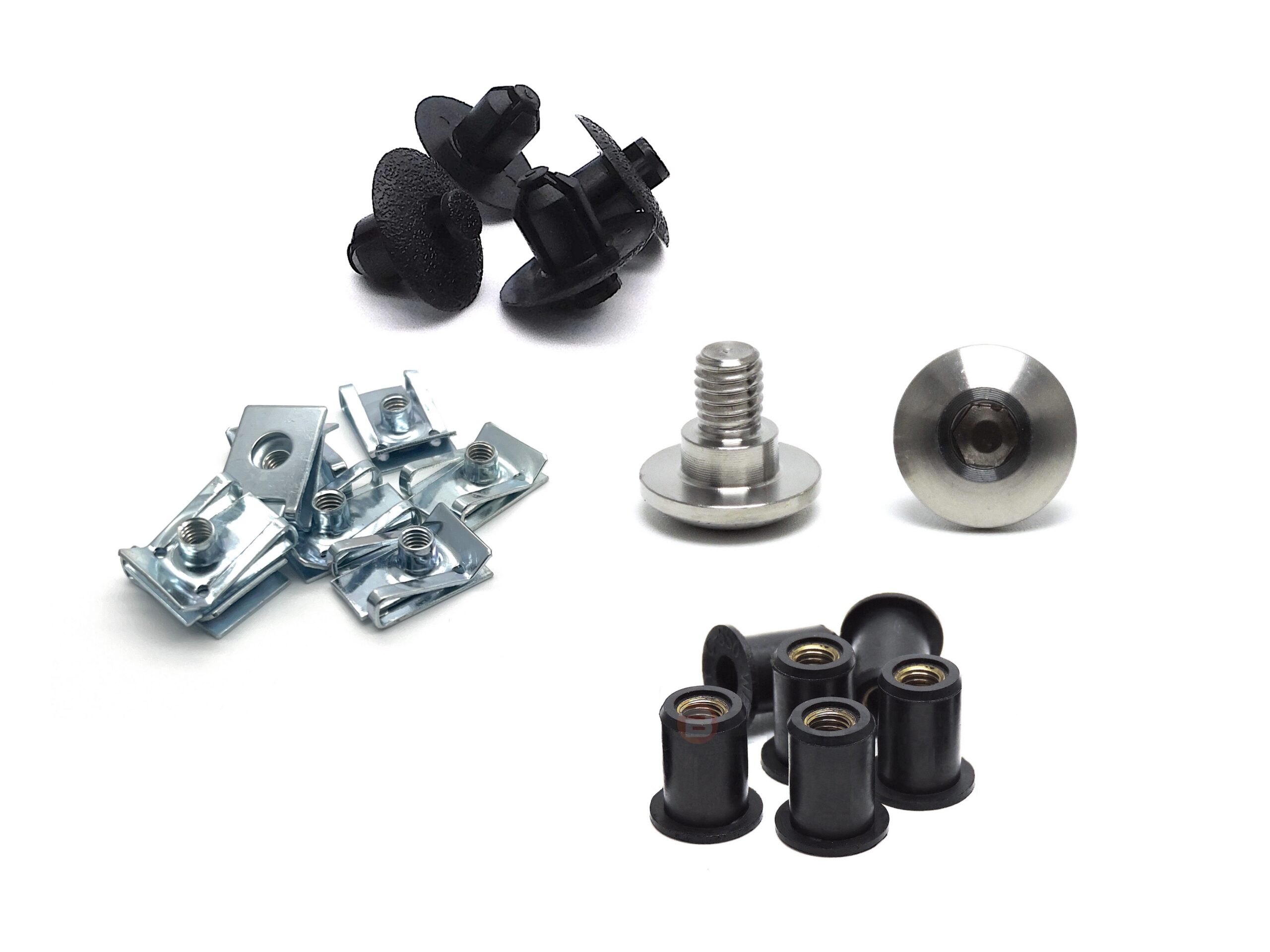
What Are Motorcycle Fairing Well Nuts?
Motorcycle fairing well nuts are expandable threaded fasteners commonly used to secure screens, fairings and other lightweight panels.
A typical well nut consists of:
- An elastomer or rubber-like outer body.
- A flange that sits against the visible side of the mounting hole.
- A threaded metal insert inside the body.
As the bolt is tightened, the threaded insert is drawn towards the front of the well nut.
This compresses and expands the flexible body behind the panel or mounting bracket, helping secure the assembly.
Because the fixing expands behind the mounting hole, a well nut can often be used where there is no practical access for a conventional nut.
Where Are Well Nuts Used on Motorcycles?
Depending on the motorcycle, well nuts may be used for:
- Windscreens.
- Fairing panels.
- Nose cones.
- Cockpit panels.
- Inner fairings.
- Small trim panels.
- Light covers.
- Other lightweight bodywork.
The exact application varies between manufacturers and models.
Do not assume that every fairing fixing uses a well nut simply because another mounting point on the same motorcycle does.
How Does a Fairing Well Nut Work?
When the correct bolt is threaded into the insert and tightened, the flexible section of the well nut compresses.
This creates an expanded section behind the mounting surface.
The well nut can therefore provide both:
- A threaded fixing point.
- A degree of vibration isolation between the fastener and the panel.
The bolt should not simply be tightened as hard as possible.
The aim is to secure the assembly using the intended fixing method without excessively crushing the well nut or the surrounding bodywork.
Why Well Nuts Are Useful on Plastic Fairings
Plastic motorcycle bodywork can crack or distort if concentrated clamping force is applied directly around a mounting hole.
A well nut can help reduce this problem by creating a more compliant connection.
Depending on the design, it may help:
- Isolate vibration.
- Reduce direct metal-to-plastic contact.
- Spread some of the mounting load.
- Provide a captive threaded fixing.
- Allow minor movement between the panel and mounting point.
However, the well nut must still be the correct size for the hole and bolt.
Motorcycle Fairing Well Nuts Are Not All the Same
Two well nuts can look almost identical while having different:
- Thread diameters.
- Thread pitches.
- Overall lengths.
- Body diameters.
- Flange diameters.
- Grip ranges.
- Insert materials.
- Elastomer dimensions.
For this reason, choosing a replacement purely because it fits through the hole is not enough.
The bolt must also match the threaded insert correctly.
Our Motorcycle Metric Thread Pitch Reference Chart explains why matching both thread diameter and pitch matters.
Check the Mounting-Hole Size
The outside diameter of the well nut needs to suit the mounting hole.
If the well nut is too small, it may:
- Fit loosely.
- Rotate when the bolt is tightened.
- Pull through the panel.
- Fail to clamp the assembly properly.
If it is too large, forcing it into the hole can damage the well nut or surrounding bodywork.
Do not enlarge a fairing mounting hole simply to make an incorrect replacement well nut fit.
What Is Well-Nut Grip Range?
The flexible body of a well nut needs to work with the thickness of the material or assembly it passes through.
This is sometimes described as its grip range.
A well nut intended for a thin screen or panel may not necessarily work correctly in a much thicker mounting arrangement.
When replacing one, check the original dimensions and intended application rather than relying on thread size alone.
Why Well Nuts Sometimes Spin
A common problem is a well nut rotating in the mounting hole when the bolt is tightened or removed.
Possible causes include:
- A damaged or hardened rubber body.
- An incorrect well-nut diameter.
- A worn or enlarged mounting hole.
- Corroded bolt threads.
- A seized threaded insert.
- Excessive tightening.
- The insert no longer gripping correctly within the well nut.
If the well nut spins continuously, applying more force may make the problem worse.
Inspect the fixing before damaging the surrounding panel.
Do Not Over-Tighten Motorcycle Fairing Well Nuts
Over-tightening is one of the easiest ways to damage a fairing fixing.
Too much tightening can:
- Excessively deform the well nut.
- Damage the threaded insert.
- Pull the fixing through the panel.
- Distort the fairing.
- Crack the plastic around the mounting hole.
- Make future removal difficult.
There is no universal tightening torque for every motorcycle fairing well nut.
Use the motorcycle manufacturer’s procedure or the fixing manufacturer’s specification where one is available.
For general information about tightening and friction, see our Stainless Steel Motorcycle Bolt Torque, Anti-Seize & Galling Guide.
Should You Use Threadlocker on Well Nuts?
Do not apply threadlocker automatically.
Some threadlocking products may be unsuitable for certain plastics, elastomers or surrounding materials, and excessive product can make later servicing more difficult.
Threadlocker can also alter how a threaded connection behaves during assembly.
If the manufacturer specifies a locking product, follow that procedure.
Otherwise, do not assume every fairing bolt needs it.
See our Threadlocker vs Anti-Seize on Motorcycle Bolts guide for more information.
What Are Motorcycle Fairing Clips?
The term fairing clip can describe several different types of bodywork fixing.
Common examples can include:
- Clip nuts.
- U-nuts.
- Spring clips.
- Speed nuts.
- Push clips.
- Plastic rivets.
- Panel clips.
They do not all work in the same way.
Some provide a threaded metal fixing for a bolt or screw.
Others simply snap into a hole and retain two panels together.
Always identify the type before ordering a replacement.
What Is a Fairing Clip Nut?
A clip nut is a shaped metal fixing that clips over the edge of a panel, bracket or mounting tab.
It normally provides a threaded or formed fixing point for a screw or bolt.
Depending on the design, these may also be called:
- U-nuts.
- Speed nuts.
- Spring nuts.
- Spire clips.
- Panel nuts.
Terminology varies, and some of these designs are mechanically different despite similar names.
The important point is to match the original style, thread and mounting arrangement.
Why Fairing Clip Nuts Move
Some clip nuts are intentionally able to move slightly on the mounting tab.
This can help accommodate small differences in panel alignment.
A small amount of movement does not automatically mean the clip is faulty.
However, a clip that is:
- Cracked.
- Heavily corroded.
- Distorted.
- Missing part of its retaining shape.
- Unable to stay on the mounting tab.
- No longer holding its threaded position.
may require replacement.
Check the Thread in Metal Fairing Clips
A fairing clip may contain a metal thread or formed screw thread.
Do not force a bolt that feels incorrect.
The replacement bolt must match the fixing.
Check:
- Thread diameter.
- Thread pitch.
- Bolt length.
- Head type.
- Intended mounting position.
A bolt with the wrong thread can damage the clip and may also make later panel removal difficult.
See our How to Choose the Correct Replacement Motorcycle Bolt guide.
Plastic Push Rivets and Fairing Clips
Many motorcycles also use reusable or semi-reusable plastic push fasteners.
These may use:
- A central pin.
- Expanding legs.
- A push-to-lock design.
- A screw-type centre.
- A removable plastic rivet.
Removal methods vary.
Trying to pry out the wrong part of the clip can break it.
If the centre pin or retaining legs are damaged, replacement is often simpler than attempting to reuse a clip that no longer locks securely.
Do Not Replace Plastic Clips With Random Screws
A plastic push clip and a threaded screw do not perform the same function.
Installing a screw through a hole designed for a plastic clip can:
- Damage the panel.
- Enlarge the mounting hole.
- Apply excessive local clamping force.
- Interfere with the component behind the panel.
- Make future removal more difficult.
Use the correct style of bodywork fixing wherever possible.
What Are Fairing Washers Used for?
Fairing washers may sit between the bolt head and the visible surface of the panel.
Depending on the design, they can:
- Spread the load.
- Protect painted surfaces.
- Protect plastic.
- Improve appearance.
- Support a rubber washer or grommet.
- Form part of a model-specific fixing assembly.
Washers used on motorcycle bodywork may be metal, plastic, nylon, rubber or another suitable material.
They are not all interchangeable.
Plastic and Nylon Fairing Washers
Plastic or nylon washers are often used where separating the metal bolt head from painted or plastic bodywork is desirable.
They may reduce direct contact between the two surfaces.
However, the thickness of the washer still matters.
Changing the washer thickness can alter:
- Bolt engagement.
- Panel spacing.
- Head position.
- Clearance around adjacent parts.
Do not add several washers simply to compensate for an incorrect bolt length.
Rubber Fairing Washers
Rubber washers may provide vibration isolation or surface protection.
They are normally intended to deform to some degree.
Excessive tightening can crush the washer and defeat the reason it was fitted.
If the rubber has become:
- Split.
- Brittle.
- Permanently flattened.
- Torn.
- Hardened.
- Contaminated or swollen.
replacement may be appropriate.
Metal Fairing Washers
Metal washers can spread clamping load and may also form part of the visual finish of a fairing bolt kit.
Their:
- Outside diameter.
- Inside diameter.
- Thickness.
- Shape.
should still suit the mounting point.
A large washer is not automatically better because excessive diameter can interfere with shaped or recessed fairing surfaces.
Our Motorcycle Washers, Spacers & Collars Explained guide covers washer function in more detail.
Fairing Collars and Sleeves
Some bodywork fittings use a metal or plastic collar passing through a rubber grommet.
The collar can control how far the bolt compresses the rubber.
Without the collar, tightening the fastener may:
- Crush the rubber.
- Distort the panel.
- Pull the bolt too deeply into the fixing.
- Alter panel alignment.
Do not discard a small collar because it appears unnecessary.
It may be controlling the entire clamping distance of the assembly.
Fairing Spacers
Spacers may be used between the fairing and:
- Frame.
- Bracket.
- Headlight assembly.
- Fuel tank.
- Mudguard.
- Cockpit structure.
- Other bodywork.
They maintain the designed distance between the components.
Replacing a spacer with stacked washers may alter alignment or create an unstable mounting surface.
Use the correct spacer wherever practical.
Fairing Bolt Head Type Matters
Motorcycle fairing bolts often use low-profile heads because appearance and clearance matter.
Depending on the motorcycle, you may encounter:
- Button heads.
- Pan heads.
- Countersunk heads.
- Special shoulder screws.
- Socket-cap heads.
- Other model-specific fasteners.
Changing the head type can affect:
- Appearance.
- Tool clearance.
- Bearing area.
- Washer fit.
- Panel seating.
Our Motorcycle Bolt Head Types guide explains the main head and drive styles.
Why Button-Head Bolts Are Common on Bodywork
Button-head bolts have a low, rounded profile.
This can make them useful for visible motorcycle bodywork where a tall bolt head would look intrusive or create a clearance problem.
However, a button-head bolt is not automatically interchangeable with another bolt simply because the thread matches.
Head diameter, length and the complete washer or spacer arrangement still matter.
Check Fairing Bolt Length Carefully
Fairing bolts can be surprisingly sensitive to length.
A bolt that is too short may not engage the threaded fixing properly.
A bolt that is too long may:
- Bottom out.
- Contact a hidden component.
- Pass too far through a clip nut.
- Damage surrounding bodywork.
- Compress a well nut incorrectly.
Measure the original fastener correctly before selecting a replacement.
Our How to Measure Motorcycle Bolts guide explains the correct measuring points for different head types.
Shoulder Screws Used in Fairings
Some fairing fasteners have an unthreaded shoulder.
This shoulder may locate the panel or control how tightly the bodywork can be clamped.
Replacing a shoulder fastener with a fully threaded screw can change the way the panel is supported.
See our Motorcycle Shoulder Bolts Explained guide before replacing a specialised shoulder fixing.
Model-Specific Fairing Fixings
Two motorcycles can use completely different fixing arrangements even when both use apparently similar M5 or M6 bolts.
A model-specific kit may contain combinations of:
- Bolts.
- Well nuts.
- Clip nuts.
- Washers.
- Collars.
- Spacers.
- Plastic clips.
- Rubber fittings.
This is why replacing an entire motorcycle fairing assembly from a generic box of bolts can create fitment problems.
Our Generic Motorcycle Bolt Kits vs Model-Specific Kits guide explains the difference.
Can You Reuse Motorcycle Fairing Well Nuts?
Sometimes.
A well nut may remain serviceable if:
- The flexible body remains supple.
- The flange is undamaged.
- The threaded insert is secure.
- The internal thread is undamaged.
- The body has not split or permanently deformed.
Replace a well nut if it is:
- Cracked.
- Brittle.
- Torn.
- Severely distorted.
- Spinning around its insert.
- No longer gripping the mounting hole.
- Corroded internally to the point the bolt will not operate correctly.
If in doubt, compare it with a known correct replacement.
Old and Hardened Rubber Well Nuts
Rubber-like materials can change with age, heat, chemicals and environmental exposure.
An old well nut may become harder and less able to expand or isolate vibration as intended.
A well nut that has visibly deteriorated should not be kept solely because the thread still accepts the bolt.
Corroded Fairing Clips
Metal clip nuts and spring clips can corrode, particularly where water and road contamination collect behind panels.
Light surface discolouration does not necessarily make a clip unusable.
However, replace clips showing:
- Severe corrosion.
- Heavy pitting.
- Lost spring tension.
- Cracking.
- Distortion.
- Damaged threads.
A corroded clip that seizes onto the bolt can make future fairing removal unnecessarily difficult.
If a fastener is already seized, our How to Remove Seized, Stuck & Rounded Motorcycle Bolts guide explains general removal principles.
Inspect Fairing Bolts Before Reuse
Before refitting bodywork, inspect the bolts as well as the clips and well nuts.
Look for:
- Damaged threads.
- Rounded Allen or Torx recesses.
- Corrosion.
- Bent fasteners.
- Damaged heads.
- Worn shoulders.
- Damaged decorative surfaces.
Our When Should Motorcycle Bolts Be Replaced? guide covers fastener inspection in more detail.
Motorcycle Fairing Well Nuts: Common Problems
Common motorcycle fairing well nuts problems include:
- Spinning in the mounting hole.
- Hardened or cracked rubber.
- Corroded threaded inserts.
- Incorrect bolt thread.
- Excessive compression.
- Being pulled through the panel.
- Wrong body diameter.
- Incorrect length or grip range.
Replacing the bolt alone will not fix a worn or incorrectly sized well nut.
Fairing Clips and Washers: Common Problems
Common issues include:
- Missing clips.
- Clips fitted to the wrong mounting tab.
- Corroded clip nuts.
- Stripped threads.
- Missing protective washers.
- Crushed rubber washers.
- Lost collars.
- Incorrect spacer thickness.
- Plastic clips with broken retaining legs.
Where possible, identify the original arrangement before ordering replacements.
Do Not Tighten Fairing Bolts Until Everything Is Aligned
When several fairing bolts hold the same panel, it can help to start the fasteners before fully tightening them.
This allows the panel and mounting points to settle into their intended positions.
Forcing one bolt fully tight while another hole is badly misaligned can put unwanted stress into the plastic.
Never use the bolts to pull a badly misaligned fairing into position without first finding the cause.
A future Biker Bling guide will cover how to fit motorcycle fairing bolts without damaging plastic panels in more detail.
Motorcycle Fairing Well Nuts, Clips & Washers: The Simple Rule
When dealing with motorcycle fairing well nuts, clips and washers, treat the small fixing components as part of the complete bodywork assembly.
Check:
- Correct bolt.
- Correct thread.
- Correct well nut.
- Correct clip or nut.
- Correct washer.
- Any required collar or spacer.
- Mounting-hole condition.
- Panel alignment.
- Condition of rubber or plastic components.
Do not assume the bolt is the only part that matters.
A perfectly correct bolt can still damage or fail to secure a fairing if the supporting well nut, clip, washer or spacer is wrong.
Important Safety Information
Motorcycle fairing fixings are generally different from highly loaded structural fasteners, but incorrect bodywork installation can still create hazards.
Loose panels or screens may:
- Vibrate.
- Interfere with steering.
- Contact moving components.
- Detach while riding.
- Obstruct lights or controls.
Always follow the motorcycle manufacturer’s parts information and fitting procedure where available.
Do not substitute bodywork fasteners into structural, brake, steering, suspension or other safety-critical applications.
If a fairing mounting point, bracket or surrounding component is damaged, repair the underlying problem rather than relying on a larger bolt or excessive tightening.
Shop Motorcycle Fairing Bolts & Fasteners
Looking for replacement stainless steel motorcycle fairing bolts and model-specific fastener kits?
Biker Bling supplies motorcycle bolt kits and stainless steel fasteners for a range of makes, models and applications.
Shop Motorcycle Fasteners at Biker Bling →
Always check the individual product description, intended fitment and components supplied before ordering.