
Motorcycle Metric Thread Pitch Reference Chart
Metric thread pitch is one of the most important measurements to check when identifying a motorcycle bolt.
Two bolts can have the same diameter but use different thread pitches, which means they are not interchangeable.
For example, an M10 bolt could use a 1.5 mm, 1.25 mm or 1.0 mm pitch depending on the application.
Using the wrong pitch can damage the bolt, the mating thread or both.
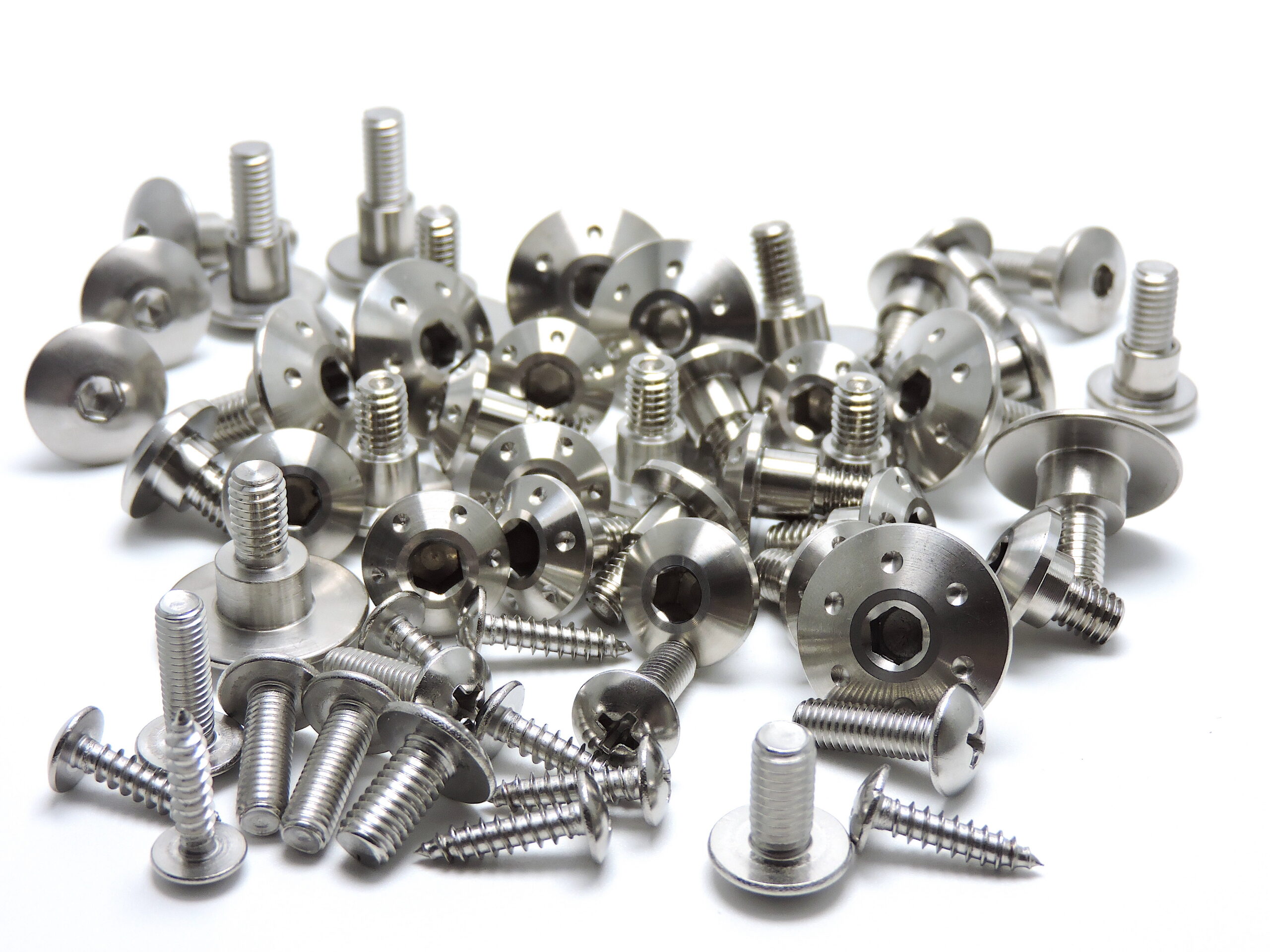
What Is Metric Thread Pitch?
Metric thread pitch is the distance from one thread crest to the next, measured in millimetres.
For example:
- M6 × 1.0 means a nominal 6 mm thread diameter with a 1.0 mm pitch.
- M8 × 1.25 means a nominal 8 mm thread diameter with a 1.25 mm pitch.
- M10 × 1.25 means a nominal 10 mm thread diameter with a 1.25 mm pitch.
The smaller the pitch number, the finer the thread.
A 1.0 mm pitch therefore has threads closer together than a 1.5 mm pitch.
If you need help measuring the diameter and length as well as the pitch, see our How to Measure Motorcycle Boltsguide.
Motorcycle Metric Thread Pitch Reference Chart
The table below shows common metric coarse pitches and commonly encountered finer alternatives.
| Thread Size | Standard Coarse Pitch | Common Fine Pitch | Other Fine / JIS-Type Pitch |
|---|---|---|---|
| M4 | 0.70 mm | — | — |
| M5 | 0.80 mm | — | — |
| M6 | 1.00 mm | 0.75 mm | — |
| M7 | 1.00 mm | — | — |
| M8 | 1.25 mm | 1.00 mm | — |
| M10 | 1.50 mm | 1.25 mm | 1.00 mm |
| M12 | 1.75 mm | 1.50 mm | 1.25 mm |
| M14 | 2.00 mm | 1.50 mm | — |
| M16 | 2.00 mm | 1.50 mm | — |
| M18 | 2.50 mm | 1.50 mm / 2.00 mm | — |
| M20 | 2.50 mm | 1.50 mm | — |
These values are reference sizes only.
A motorcycle manufacturer may use a coarse, fine or other specified pitch depending on the application, so never choose a replacement based on diameter alone.
The ISO coarse values above match standard metric thread geometry, while recognised fine-thread alternatives include sizes such as M8 × 1.0, M10 × 1.25, M12 × 1.25 and M14 × 1.5. TR Fastenings
What Does M10 × 1.25 Mean?
An M10 × 1.25 thread has:
- A nominal thread diameter of 10 mm.
- A pitch of 1.25 mm.
That means the distance from one thread crest to the next is 1.25 mm.
It is different from:
- M10 × 1.50.
- M10 × 1.00.
Although all three are nominally M10 threads, they will not correctly engage with one another.
Why Do Motorcycles Use Different Thread Pitches?
Motorcycle manufacturers may use different thread pitches depending on the component and design requirements.
Fine threads can offer different characteristics from coarse threads, including a different relationship between axial movement and rotation, as well as different thread geometry and engagement characteristics.
However, the important practical point for replacement work is simple:
Use the pitch specified for the original application.
Do not assume that a fine pitch is automatically stronger, better or more suitable.
Coarse Thread vs Fine Thread
A coarse thread has a larger distance between adjacent thread crests.
A fine thread has a smaller distance between them.
For example:
- M10 × 1.50 is coarser.
- M10 × 1.25 is finer.
- M10 × 1.00 is finer again.
The thread diameter remains nominally 10 mm in each case.
That is why measuring diameter alone is not enough when choosing a replacement bolt.
Our How to Choose the Correct Replacement Motorcycle Bolt guide explains the other dimensions and features that also need to be checked.
Are Japanese Motorcycle Thread Pitches Different?
Sometimes.
Japanese motorcycles still use metric threads, but some applications may use finer pitches that differ from the standard ISO coarse pitch for that diameter.
For example, reference tables commonly list:
- M10 × 1.25.
- M12 × 1.25.
- M14 × 1.50.
- M16 × 1.50.
as JIS-style or commonly encountered fine-pitch alternatives. Bolt Depot
That does not mean every Japanese motorcycle uses these pitches.
Always identify the actual fastener or consult the motorcycle manufacturer’s parts or workshop information where necessary.
How Do You Measure Motorcycle Thread Pitch?
The best tool is a metric thread-pitch gauge.
A thread-pitch gauge contains leaves or blades shaped to match specific pitches.
To use one:
- Choose a pitch blade.
- Place it against the bolt threads.
- Check whether the teeth sit cleanly into the thread profile.
- Try adjacent sizes if there is any gap or mismatch.
- Confirm the result against the bolt diameter.
Do not force the gauge into the threads.
If the pitch is correct, the profile should align naturally.
Can You Measure Thread Pitch Without a Gauge?
Yes, but a gauge is usually easier and more reliable.
One alternative is to measure across several thread crests with a ruler or vernier caliper and divide by the number of thread intervals.
For example, if five thread intervals cover 5 mm, the pitch is approximately 1.0 mm.
Measuring several intervals rather than just one can reduce the effect of small measuring errors.
However, where accurate identification matters, a proper metric thread-pitch gauge is preferable.
Compare Against a Known Bolt
Another useful method is to compare the unknown bolt with a known bolt of the same diameter.
Hold the threaded sections together side by side.
If the pitches match, the thread crests should mesh evenly along their length.
If they gradually move out of alignment, the pitches are different.
This can be a useful workshop check, but it should not replace proper identification where the fastener is safety-critical.
Never Force a Bolt With the Wrong Pitch
A wrong-pitch bolt may sometimes start threading into a hole.
That does not mean it is correct.
If resistance increases unexpectedly, stop.
Continuing with a spanner, ratchet or power tool can:
- Cross-thread the fastener.
- Damage the internal thread.
- Strip aluminium threads.
- Damage the replacement bolt.
- Make future removal more difficult.
This is especially important with aluminium engine cases, brackets and other threaded motorcycle components.
If a bolt does not engage normally by hand when it reasonably should, check both the diameter and pitch before applying more force.
Thread Pitch and Aluminium Motorcycle Components
Aluminium components can be easier to damage than steel threads if the wrong fastener is forced into them.
A mismatched pitch can remove or deform the female thread rather than simply stopping the bolt.
The cost of repairing an aluminium thread can be much greater than the cost of taking a few extra minutes to identify the correct bolt.
A dedicated Biker Bling guide on motorcycle bolts into aluminium will cover this area in more detail later in the technical library.
Thread Pitch Does Not Tell You the Bolt Strength
Thread pitch and fastener strength are separate characteristics.
Two M10 × 1.25 bolts could have different:
- Materials.
- Property classes.
- Head designs.
- Shoulder dimensions.
- Finishes.
- Mechanical properties.
Knowing the thread pitch therefore does not establish whether a replacement is mechanically suitable.
See our Motorcycle Bolt Strength Grades Explained guide for more information about 8.8, 10.9, 12.9 and stainless property classes.
Our Motorcycle Bolt Materials Explained guide also explains the difference between 304 stainless, 316 stainless, titanium and high-tensile steel.
Thread Pitch Does Not Determine Tightening Torque
Do not choose a tightening torque simply from the thread size and pitch.
Correct tightening depends on the complete joint, including factors such as:
- Fastener material.
- Property class.
- Thread condition.
- Mating material.
- Surface finish.
- Lubrication.
- Anti-seize.
- Threadlocker.
- Joint design.
The motorcycle manufacturer’s specified tightening procedure should take priority.
For more information, see our Stainless Steel Motorcycle Bolt Torque, Anti-Seize & Galling Guide.
What If the Original Bolt Is Missing?
If the original bolt is missing, avoid guessing from the hole diameter alone.
Useful information may come from:
- The motorcycle manufacturer’s parts catalogue.
- The OEM part number.
- The workshop manual.
- Another identical fastener in the same assembly, where appropriate.
- Reliable model-specific parts information.
Do not assume that a bolt which appears to screw into the hole is automatically correct.
The diameter, pitch, length, head form, strength and other dimensions may all matter.
Our How to Choose the Correct Replacement Motorcycle Bolt guide covers this identification process in more detail.
Metric Threads vs Imperial Threads
Metric and imperial threads are different systems.
A thread that appears visually similar may still have a different:
- Diameter.
- Pitch.
- Thread angle.
- Profile.
Metric and UNC/UNF fasteners should not be treated as interchangeable simply because their outside diameters appear close.
Thread-conversion tables are useful for identifying approximate equivalents, but manufacturers specifically warn that similar metric and imperial sizes are not directly interchangeable because the pitches and thread forms differ. TR Fastenings
Important Safety Information
This reference chart provides general information about common metric thread pitches.
It does not establish the correct fastener specification for every motorcycle or application.
Always follow the motorcycle manufacturer’s workshop manual, parts information and specified fastener requirements.
Take particular care with fasteners associated with:
- Brakes.
- Steering.
- Suspension.
- Wheels and axles.
- Structural mountings.
- Engine internals.
- Other highly loaded assemblies.
Do not force a fastener that does not engage normally.
If the correct pitch or fastener specification cannot be positively identified, use the manufacturer-specified part or obtain advice from a competent motorcycle technician.
Motorcycle Metric Thread Pitch: The Simple Rule
The thread diameter and thread pitch must both match.
For example:
M10 × 1.50 is not the same thread as M10 × 1.25.
The safest process is:
- Identify the thread diameter.
- Measure the thread pitch.
- Check the bolt length.
- Check any shoulder or plain-shank dimensions.
- Confirm the material and strength specification.
- Compare with the motorcycle manufacturer’s requirements.
Once all of those details are known, selecting the correct fastener becomes much more reliable.
Shop Stainless Steel Motorcycle Bolt Kits
Looking for replacement stainless steel fasteners for your motorcycle?
Biker Bling supplies stainless steel motorcycle bolt kits for a range of makes, models and applications.
Shop Stainless Steel Motorcycle Bolt Kits →
Always check the individual product description, intended fitment and fasteners supplied before ordering.