
Generic Motorcycle Bolt Kits vs Model-Specific Kits: What’s the Difference?
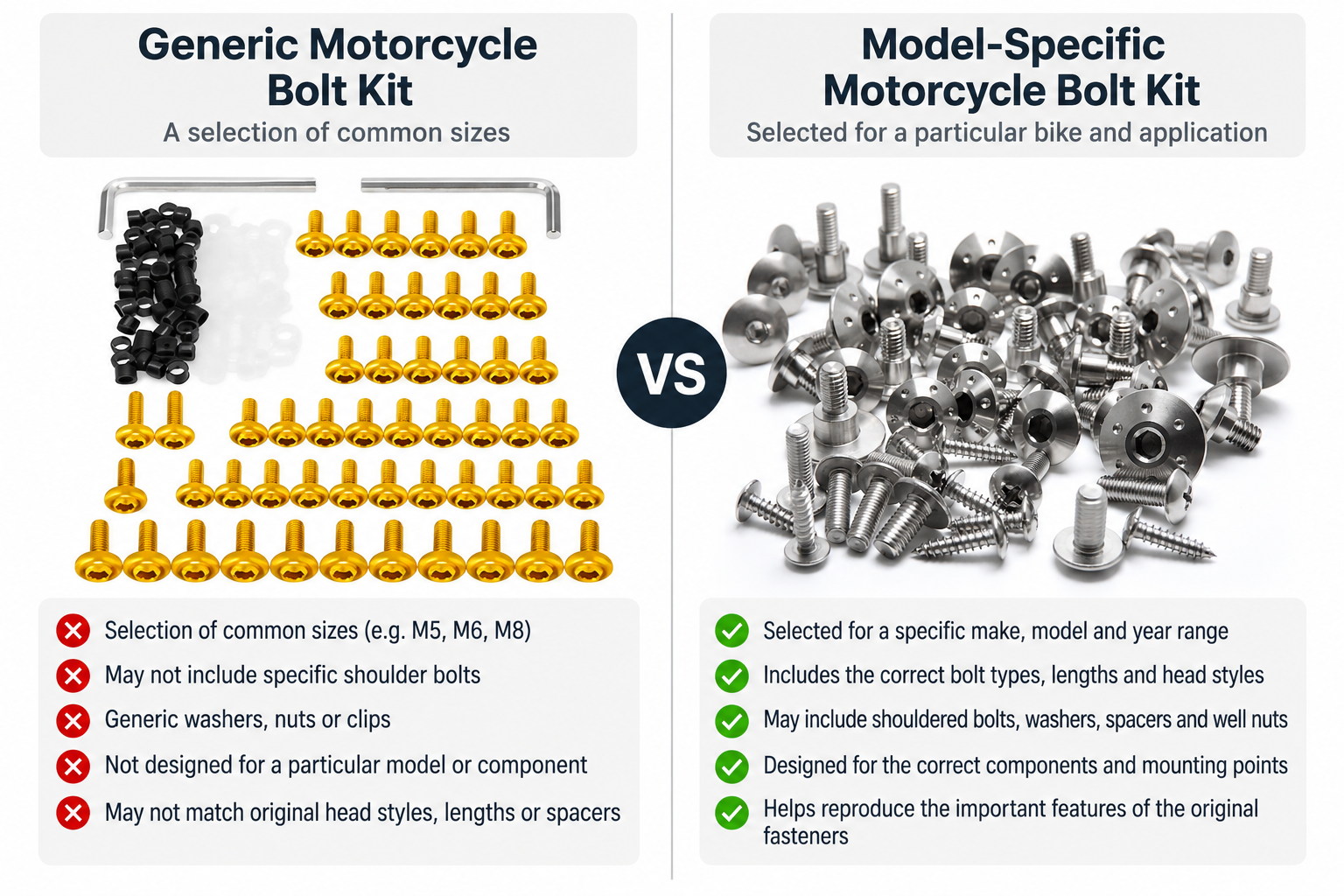
Model specific motorcycle bolt kits are selected for a particular motorcycle, component or model/year range, while generic motorcycle bolt kits usually contain common fastener sizes intended to suit many different applications.
When replacing motorcycle fasteners, it can be tempting to assume that any bolt with the correct diameter, thread pitch and length will do the same job.
Sometimes that is true. A standard fully threaded bolt can be perfectly suitable where the original motorcycle uses the same type and specification of fastener.
However, motorcycle manufacturers can also use fasteners with specific shoulders, head sizes, threaded lengths, washers, spacers and other features. In these applications, a bolt that simply screws into the same hole is not necessarily an equivalent replacement.
This is one of the main differences between a generic motorcycle bolt kit and a properly selected model-specific kit.
The Short Answer
A generic motorcycle bolt kit normally contains a selection of commonly used bolt sizes intended to cover many different motorcycles and applications.
A model-specific motorcycle bolt kit is selected for a particular motorcycle, component or model/year range.
The important difference is not simply the number of bolts in the kit. It is whether the replacement fasteners have the features required for the particular application.
These can include:
- Thread diameter
- Thread pitch
- Bolt length
- Threaded length
- Shoulder diameter and length
- Head diameter and profile
- Washers
- Spacers and collars
- Well nuts and clips
- Fastener material
- Strength or property-class requirements
A replacement motorcycle bolt therefore needs to be considered as a complete fastener — not simply as an M5, M6, M8 or M10 bolt.
Important Information Before Choosing Replacement Fasteners
This guide explains general differences between generic and model-specific motorcycle bolt kits.
It does not mean that every generic fastener is unsuitable, or that every fastener described as model-specific will automatically be suitable for every application.
Always check the individual product description and, where appropriate, the motorcycle manufacturer’s workshop manual, parts information and component-specific instructions.
Particular care should be taken with braking, steering, wheels, suspension and other safety-critical components.
Where the motorcycle manufacturer specifies a particular high-strength, property-class or special-purpose fastener, that requirement takes priority over general replacement advice.
What Is a Generic Motorcycle Bolt Kit?
A generic motorcycle bolt kit usually contains a selection of common metric fasteners such as:
- M5 bolts
- M6 bolts
- M8 bolts
- Washers
- Nuts
- Sometimes clips or other general-purpose hardware
Generic fasteners can be perfectly useful in the right application.
For example, if the original fastener is a conventional M6 bolt and the replacement correctly matches its thread pitch, length, head requirements, material and required strength, there may be no need for a specially shaped fastener.
Problems can arise when a generic bolt is selected because it looks approximately right, rather than because the important dimensions and requirements have been checked.
What Is a Model-Specific Motorcycle Bolt Kit?
A model-specific motorcycle bolt kit is put together for a particular motorcycle or component rather than being a general collection of fasteners.
Depending on the application, this can allow the kit to account for details such as:
- Different bolt lengths around the motorcycle
- Different head styles and head diameters
- Shouldered and non-shouldered fasteners
- Washers
- Spacers and collars
- Fairing and screen hardware
- Rubber well nuts
- Clips and other associated fittings
The individual product listing should still be checked for the exact motorcycle, year range and hardware supplied.
Model-specific does not necessarily mean that every replacement fastener must look identical to the original.
For example, a suitable replacement could use a different drive style while retaining the dimensions and other features required by the application.
What matters is identifying which features of the original fastener are important.
Same Thread Size Does Not Mean the Same Fastener
This is one of the most important things to understand when choosing replacement motorcycle bolts.
Imagine two bolts are both described as:
M6 × 1.0 × 25 mm
They may share the same basic:
- 6 mm nominal thread diameter
- 1.0 mm thread pitch
- 25 mm length
At first glance they may appear interchangeable.
However, one could be almost fully threaded while the other has a smooth shoulder beneath the head.
Their head diameters could be considerably different.
One could require a washer.
One could be designed to work with a spacer, collar, bush or rubber mounting component.
Their material or strength requirements could also be different.
So although both bolts may screw into the same M6 × 1.0 threaded hole, that does not automatically mean they perform the same job once installed.
Why Shoulder Bolts Are a Good Example
A shouldered motorcycle bolt has a smooth, unthreaded section between the bolt head and the threaded portion.
Depending on the particular application, that shoulder may perform an important function such as:
- Locating a component
- Maintaining the intended spacing
- Providing a smooth surface through a bush or mounting point
- Supporting or aligning a component
- Controlling how parts fit together
- Keeping threads away from an area intended to contact a smooth surface
The purpose of the shoulder depends on the original design.
This is why replacing an original shouldered bolt with a fully threaded bolt of similar overall dimensions should not automatically be assumed to provide an equivalent replacement.
For a more detailed explanation of shoulder diameter, shoulder length and why a fully threaded bolt may not be equivalent, read our Motorcycle Shoulder Bolts Explained guide.
Why the Smooth Part of a Bolt Can Matter
It is easy to assume that the threads are the only important part of a motorcycle bolt.
They are not.
The smooth section of a fastener can also be part of how the assembly is located, supported or spaced.
On some applications, a bush, spacer, panel or component may be designed to sit around a smooth section of the fastener rather than against the threads.
That does not mean every smooth section or shoulder performs exactly the same function.
The important principle is:
Do not assume that an unthreaded or shouldered section is unnecessary simply because another bolt can physically screw into the same threaded hole.
Head Size and Shape Can Matter Too
Two motorcycle bolts can have the same thread diameter, thread pitch and length while having very different head sizes and profiles.
Some generic motorcycle bolt kits may use the same common button-head or socket-head style across a wide range of mounting positions.
In some applications, the head diameter can be considerably smaller than the original fastener or the type selected for a model-specific kit.
That difference can matter.
A wider original-style head may have been chosen to provide the required contact area against a washer, fairing panel, bracket or other component.
A considerably smaller head may contact a smaller area and can also look noticeably different once installed.
Common motorcycle bolt head styles include:
- Button head
- Pan head
- Socket cap
- Hex head
- Flanged head
- Countersunk head
The correct head style and diameter depend on the particular application.
A larger head is not automatically better, and a smaller head is not automatically unsuitable.
The important point is that head diameter and head profile are part of the fastener specification and should not be ignored simply because the thread diameter, pitch and length match.
Washers, Spacers, Collars and Well Nuts Are Part of the Assembly
Sometimes the bolt itself is only one part of the fixing.
A motorcycle assembly may also use:
- Metal washers
- Nylon washers
- Rubber washers
- Spacers
- Collars
- Rubber well nuts
- Spring clips
- Plastic clips
- Grommets
These components can affect spacing, alignment, load distribution and how a panel or component is supported.
Leaving out a spacer, collar or washer can therefore change the installation even if the bolt itself appears to be the correct size.
This is particularly important around motorcycle bodywork, where plastic panels and rubber-mounted components should not simply be treated like solid metal parts.
Why Fairing Bolts Deserve Particular Attention
Motorcycle fairings are a good example of why application-specific hardware can matter.
Some fairing mounting points use straightforward bolts and washers.
Others may use combinations such as:
shouldered bolt → washer → fairing panel → spacer or rubber fitting → mounting point
In an arrangement like this, replacing the original hardware with a generic fully threaded bolt may change how the panel is located or clamped.
Depending on the original design, that may contribute to issues such as:
- Incorrect spacing
- Excessive compression of a rubber mounting
- Threads contacting an area intended for a smooth shoulder
- Panel movement or rattling
- Additional stress around a mounting hole
It would not be accurate to say that a generic bolt will automatically cause these problems.
The important point is that the original fastener arrangement should be understood before substituting a different type of bolt.
Thread Pitch Must Also Match
An M6 bolt is not completely identified by saying that it is M6.
The thread pitch matters too.
For example:
M6 × 1.0
means a nominal 6 mm thread diameter with a 1.0 mm thread pitch.
Different bolt diameters can also be available with more than one thread pitch.
A bolt with an incorrect pitch may appear close enough to begin entering a threaded hole, but forcing it can damage the mating thread.
Never rely on appearance alone.
If the thread specification is uncertain, measure the original fastener with an appropriate thread-pitch gauge or confirm the specification using reliable manufacturer information.
Material and Strength Are Separate Questions
Correct dimensions are only part of choosing a suitable replacement motorcycle bolt.
Material and strength requirements also matter.
A stainless steel bolt should not automatically replace a high-strength or special-purpose original fastener simply because its dimensions match.
Likewise, matching the diameter, thread pitch and length does not prove that two fasteners have the same mechanical properties.
Where the motorcycle manufacturer specifies a particular property class, material or special-purpose fastener, use a replacement that has been specifically confirmed as suitable for that application.
Generic Motorcycle Bolt Kits Are Not Automatically Wrong
This is worth making clear.
There is nothing inherently wrong with a generic fastener.
If a mounting point genuinely uses a conventional bolt and the replacement correctly matches the required:
- Diameter
- Thread pitch
- Length
- Head requirements
- Material
- Strength
- Installation requirements
then a standard replacement fastener may be completely appropriate.
The problem is assuming that every motorcycle fastener can be identified by diameter and length alone.
Some applications are straightforward.
Others use fasteners with additional features that matter.
That is why checking the original fastener and its particular application is important.
What Makes a Good Model-Specific Motorcycle Bolt Kit?
A useful model-specific kit should make it easier for the rider to obtain the fasteners required for a particular motorcycle or component.
Depending on the application, that can mean accounting for:
- Different bolt lengths
- Different head styles and diameters
- Shouldered fasteners
- Washers
- Spacers and collars
- Fairing hardware
- Well nuts
- Clips
- Different mounting positions
The product description should also make clear what hardware is supplied and which motorcycle models or year ranges the kit is intended for.
How Biker Bling Approaches Model-Specific Motorcycle Bolt Kits
Biker Bling supplies 304 stainless steel motorcycle fasteners and bolt kits listed for particular makes, models, year ranges and applications.
Rather than treating every mounting point as suitable for the same generic bolt, our kits are selected around the hardware required for the listed application.
Where a particular Biker Bling kit includes features such as shouldered bolts, different head sizes, washers, well nuts, spacers or other associated hardware, these are identified in the individual product listing.
We also believe it is important to make clear exactly what a kit contains rather than assuming that every replacement fastener is identical to the original in every respect.
Always check the individual product listing for exact model/year fitment and the hardware supplied.
What Should You Check Before Buying a Motorcycle Bolt Kit?
Before ordering replacement motorcycle fasteners, check as much of the following as reasonably possible:
- Motorcycle make and model
- Model year
- Component or mounting location
- Thread diameter
- Thread pitch
- Bolt length
- Whether the original has a shoulder
- Shoulder length and diameter where relevant
- Head style
- Head diameter
- Required washers, spacers, collars or well nuts
- Fastener material and strength requirements
- Any manufacturer-specific installation requirements
If something important is unclear, investigate it before fitting the replacement rather than assuming that a bolt is correct simply because it screws into the hole.
Correct Selection Is Only Half the Job
Even the correct replacement fastener needs to be installed properly.
Threads should be checked before assembly, bolts should start correctly without being forced, and the motorcycle manufacturer’s tightening and thread-treatment requirements should be followed.
🛠️ Related Workshop Guides
- First time fitting stainless? Read our complete How to Fit Stainless Steel Motorcycle Bolts: Step-by-Step Guide.
- Learn how thread friction, lubrication and anti-seize can affect installation in our Stainless Steel Motorcycle Bolt Torque, Anti-Seize & Galling Guide.
- For a practical guide to checking thread diameter, thread pitch, bolt length, shoulder dimensions and head size, read our How to Measure Motorcycle Bolts guide.
Find Model-Specific Stainless Steel Bolt Kits for Your Motorcycle
Looking to replace old, corroded or damaged motorcycle fasteners?
Browse the Biker Bling range of 304 stainless steel motorcycle bolt kits, with model-specific products available for a wide range of motorcycles and applications.
Shop Stainless Steel Motorcycle Bolt Kits →
Always check the individual product listing for exact fitment, year coverage and the hardware supplied.
Technical Information Disclaimer
The information on this page is provided as general educational guidance about motorcycle fasteners and replacement bolt kits.
It does not provide model-specific mechanical specifications and is not intended to replace the motorcycle manufacturer’s workshop manual, parts information, component manufacturer’s instructions or advice from a suitably qualified motorcycle technician.
Motorcycles and fastener applications vary. A replacement that appears to have the same basic dimensions as the original may differ in geometry, material, strength or intended function.
Always confirm that a replacement fastener is suitable for the specific motorcycle and mounting position before installation.
Where the motorcycle or component manufacturer specifies a particular fastener type, material, strength, property class, locking method or installation procedure, follow those requirements.
Particular care should be taken with braking, steering, wheels, suspension and other safety-critical components.
If you cannot establish the correct fastener specification or suitability, stop and obtain appropriate professional advice.
Nothing on this page is intended to affect your statutory rights or to exclude or restrict any responsibility that cannot lawfully be excluded or restricted.