
Threadlocker vs Anti-Seize on Motorcycle Bolts
Threadlocker and anti-seize are both used on motorcycle fasteners, but they do very different jobs.
Threadlocker is generally used to help resist loosening caused by vibration or movement.
Anti-seize is generally used to reduce friction, help prevent thread galling and make future disassembly easier.
They are not interchangeable, and neither should be applied automatically to every motorcycle bolt.
The correct choice depends on the fastener, the materials involved, the manufacturer’s instructions and the function of the joint.
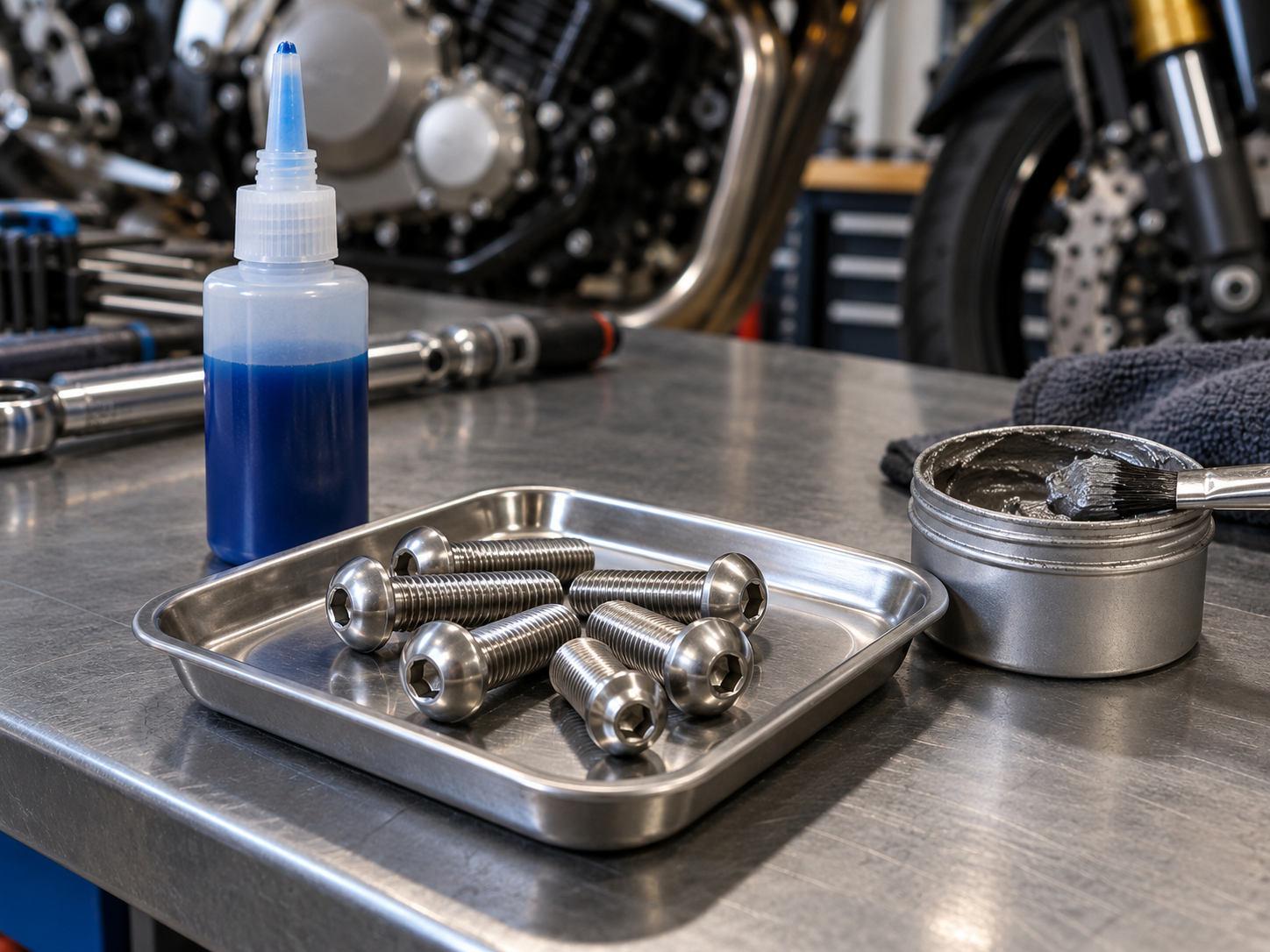
What Is Threadlocker?
Threadlocker is a liquid product designed to cure in the small gaps between mating threads.
Once cured, it can help resist unwanted loosening caused by:
- Vibration.
- Repeated movement.
- Shock.
- Thermal cycling.
- Other conditions that can encourage threaded fasteners to move.
Different threadlockers are available in different strengths.
Some are intended to allow normal hand-tool removal, while stronger grades may require much more force or heat before removal.
That is why the manufacturer’s instructions matter.
What Is Anti-Seize?
Anti-seize is a lubricant-containing compound applied to threaded fasteners.
Its purpose can include:
- Reducing friction.
- Helping prevent galling.
- Reducing the risk of threads seizing together.
- Making future disassembly easier.
- Providing some protection against corrosion or contamination.
Anti-seize is particularly relevant to stainless-steel threads because stainless fasteners can be susceptible to galling under certain conditions.
For more detail on this, see our Stainless Steel Motorcycle Bolt Torque, Anti-Seize & Galling Guide.
Threadlocker vs Anti-Seize: The Main Difference
The easiest way to understand the difference is:
Threadlocker helps resist loosening.
Anti-seize helps reduce friction and seizure.
Understanding threadlocker vs anti-seize is important because the two products are designed to solve different fastening problems.
That means they normally serve opposite mechanical purposes.
Threadlocker is intended to help keep a threaded joint from moving.
Anti-seize is intended to make the threaded surfaces move more freely and reduce the risk of them sticking together.
Because of this, using the wrong product can change how the joint behaves.
Can You Use Threadlocker and Anti-Seize Together?
Usually, this should not be treated as a normal combination.
Threadlocker needs suitable contact between the mating threads in order to cure and work correctly.
Anti-seize is a lubricant and barrier compound.
Applying both to the same thread can interfere with the expected behaviour of either product.
If a component manufacturer specifies a particular combination or procedure, follow that specification.
Otherwise, do not assume the two products should be mixed simply because both are used on threaded fasteners.
Does Threadlocker Affect Tightening Torque?
It can.
Any product applied to the threads can affect friction.
That matters because tightening torque is only an indirect way of creating clamp load.
If friction changes, the same torque value can produce a different clamp load.
This is why you should not automatically apply threadlocker to a dry-thread torque specification unless the motorcycle or component manufacturer allows for it.
The same warning applies to lubricants and anti-seize.
Our Stainless Steel Motorcycle Bolt Torque, Anti-Seize & Galling Guide explains this relationship in more detail.
Does Anti-Seize Affect Tightening Torque?
Yes, it can.
Anti-seize reduces friction between the mating threads and under the fastener head.
That means a torque value intended for dry threads may create a different clamp load if anti-seize is added.
For that reason, we do not recommend applying a universal torque-reduction percentage.
There is no single reduction factor that is correct for every:
- Bolt size.
- Fastener material.
- Anti-seize product.
- Surface finish.
- Joint design.
- Thread condition.
- Mating material.
Always follow the motorcycle manufacturer’s or component manufacturer’s instructions.
When Might Threadlocker Be Used on a Motorcycle?
Threadlocker may be specified where the manufacturer wants additional resistance to loosening.
Examples can include some:
- Engine fasteners.
- Brake-related fasteners.
- Sprocket or drivetrain fasteners.
- Structural fasteners.
- Small screws exposed to vibration.
- Retaining fasteners on brackets or assemblies.
However, this does not mean every bolt in these areas requires threadlocker.
The correct procedure depends on the motorcycle and component.
Never add threadlocker just because a bolt is safety-critical.
Follow the specified installation procedure.
When Might Anti-Seize Be Used on a Motorcycle?
Anti-seize may be useful where thread galling or seizure is a concern, particularly with stainless-steel fasteners.
It can also help in applications where future removal is important and where the manufacturer allows a lubricated thread condition.
However, it should not be treated as a universal coating for every motorcycle bolt.
The thread treatment must still suit the application.
For stainless fasteners, see our How to Fit Stainless Steel Motorcycle Bolts guide.
Stainless Steel and Galling
Stainless steel threads can sometimes gall.
Galling is a form of adhesive wear where thread surfaces can grab, tear and potentially seize during tightening.
Factors that can increase the risk include:
- High friction.
- Dirty threads.
- Damaged threads.
- Rapid tightening.
- Excessive tightening.
- Similar stainless mating surfaces.
- Poor alignment.
A suitable anti-seize product can help reduce galling risk where its use is appropriate.
However, because anti-seize changes friction, it must still be considered alongside the correct tightening procedure.
Can Threadlocker Prevent Galling?
Threadlocker is not a substitute for anti-seize where galling control is the main concern.
Some threadlocking products may influence friction, but their purpose is different.
If galling is the main risk, use the installation method recommended for the fastener and application.
For stainless motorcycle bolts, correct alignment, clean threads and controlled tightening are important regardless of whether a thread treatment is used.
Can Anti-Seize Stop a Bolt From Loosening?
Anti-seize should not be relied upon to prevent loosening.
Its lubricating effect can reduce friction in the joint.
That does not automatically mean the bolt will loosen, because joint security depends on clamp load, joint design and other factors.
But anti-seize is not a locking product.
If the manufacturer specifies threadlocker, a locking washer, mechanical locking feature or another retention method, use that specified method.
What About Copper Anti-Seize?
Copper-based anti-seize is commonly used in automotive and motorcycle work.
It contains metallic particles in a lubricant carrier.
It can be useful in some high-temperature and corrosion-prone applications.
However, it is not appropriate for every material or location.
Consider:
- The surrounding materials.
- Temperature.
- Electrical conductivity.
- Manufacturer recommendations.
- Whether galvanic interaction could be a concern.
Do not apply copper-based anti-seize indiscriminately, especially around sensitive electrical or dissimilar-metal assemblies.
What About Ceramic Anti-Seize?
Ceramic anti-seize products use non-metallic solids rather than copper or other metallic particles.
They are often chosen where:
- High temperature is involved.
- Electrical conductivity is undesirable.
- Metallic contamination is a concern.
However, “ceramic” does not automatically mean it is suitable for every motorcycle fastener.
As with any thread treatment, the specific product and application matter.
What About Aluminium-Based Anti-Seize?
Aluminium-based anti-seize is another common type.
It may contain aluminium particles and other solid lubricants.
Again, suitability depends on the fastener, mating material, temperature and manufacturer guidance.
The key point is that anti-seize is not one single universal product.
Different compounds have different formulations and intended uses.
Threadlocker Strength Colours
Threadlockers are often identified by colour, but colour conventions are not reliable enough to use on their own.
Different manufacturers may use colour systems differently.
Always check the actual product label and technical information.
Do not assume:
- Blue always means medium strength.
- Red always means permanent.
- Green always means penetrating.
Those conventions are common, but the exact specification should come from the product manufacturer.
Removable vs High-Strength Threadlocker
A removable threadlocker is generally intended to allow normal service removal with hand tools.
A high-strength threadlocker may require:
- Greater removal torque.
- Controlled heating.
- Additional preparation.
Using an excessively strong product on a small motorcycle fastener can make future removal unnecessarily difficult and can increase the risk of damaging the bolt head or surrounding component.
Choose the product based on the manufacturer’s specification, not simply on the assumption that “stronger is better”.
Should Threads Be Clean Before Applying Threadlocker?
Usually, yes.
Threadlocker generally performs best on clean threads.
Oil, grease, anti-seize, dirt and corrosion can affect how well it bonds and cures.
Follow the threadlocker manufacturer’s preparation instructions.
Do not assume a visibly clean bolt is chemically clean enough for every product.
Should Threads Be Clean Before Applying Anti-Seize?
Yes, the threads should normally be clean and in good condition.
Anti-seize should not be used to hide:
- Damaged threads.
- Cross-threading.
- Corrosion damage.
- Debris.
- Poor alignment.
If the bolt does not thread smoothly by hand when it reasonably should, stop and inspect the fastener before applying more force.
If you are unsure whether the replacement bolt itself is correct, see our How to Choose the Correct Replacement Motorcycle Bolt guide.
Threadlocker and Aluminium Threads
Many motorcycle bolts screw into aluminium components.
That means care is required.
A strong threadlocker can make future removal more difficult.
Excessive removal torque can increase the risk of damaging the aluminium female thread.
Likewise, lubricated threads can produce different clamp loads from the same applied torque.
A future Biker Bling guide will cover motorcycle bolts into aluminium in more detail.
Threadlocker on Stainless Steel
Threadlocker can be used with stainless steel in suitable applications, but curing behaviour can vary depending on the product and the metals involved.
Some threadlockers cure more slowly on passive metals such as stainless steel.
Certain manufacturers recommend an activator or primer in some applications.
Always follow the threadlocker manufacturer’s instructions rather than assuming the same cure behaviour on every material.
Anti-Seize on Stainless Steel
Anti-seize is commonly associated with stainless fasteners because of the risk of galling.
However, it is still not mandatory in every stainless-steel application.
The motorcycle manufacturer may specify:
- Dry threads.
- Lubricated threads.
- Anti-seize.
- Threadlocker.
- Another treatment.
Follow that specification.
Do not automatically coat every stainless motorcycle bolt.
Thread Treatment and Bolt Strength
Threadlocker and anti-seize do not change the property class of the bolt.
An 8.8, 10.9, 12.9, A2-70 or A4-70 fastener retains its mechanical classification regardless of which thread treatment is applied.
However, thread treatment can affect how the fastener behaves during tightening.
For more on property classes, see our Motorcycle Bolt Strength Grades Explained guide.
For material differences, see our Motorcycle Bolt Materials Explained guide.
Threadlocker, Anti-Seize and Thread Pitch
Correct thread treatment cannot compensate for the wrong thread pitch.
If the diameter or pitch is wrong, stop.
Do not use lubricant or threadlocker to force a mismatched bolt into place.
Our Motorcycle Metric Thread Pitch Reference Chart explains common metric thread pitches.
What If the Original Bolt Has Old Threadlocker on It?
Old threadlocker residue should not simply be ignored.
Depending on the product and application, the threads may need to be cleaned before the fastener is reused.
Check:
- Bolt condition.
- Thread condition.
- Manufacturer instructions.
- Whether the fastener is intended to be reused.
- Whether new threadlocker is required.
If the original fastener is damaged, replace it with the correct specification.
What If the Bolt Is Already Seized?
Do not add more force without understanding why the fastener is stuck.
A seized fastener may be affected by:
- Corrosion.
- Galling.
- Old threadlocker.
- Cross-threading.
- Over-tightening.
- Damaged threads.
If you are dealing with a seized or rounded fastener, see our How to Remove Seized, Stuck & Rounded Motorcycle Bolts guide.
Threadlocker vs Anti-Seize: Quick Comparison
| Feature | Threadlocker | Anti-Seize |
|---|---|---|
| Main purpose | Resist loosening. | Reduce friction and seizure. |
| Typical use | Retaining threaded joints. | Preventing galling and aiding future removal. |
| Effect on friction | Can alter friction. | Reduces friction. |
| Helps prevent galling | Not its main purpose. | Can help where appropriate. |
| Helps prevent loosening | Yes, when correctly specified. | No, not as a locking method. |
| Can affect tightening torque | Yes. | Yes. |
| Should be used automatically | No. | No. |
Important Safety Information
Thread treatments can affect tightening behaviour and clamp load.
This guide provides general information only and does not specify the correct treatment for every motorcycle fastener.
Always follow:
- The motorcycle manufacturer’s workshop manual.
- The component manufacturer’s instructions.
- The thread-treatment manufacturer’s instructions.
Take particular care with fasteners associated with:
- Brakes.
- Steering.
- Suspension.
- Wheels and axles.
- Structural mountings.
- Engine internals.
- Other highly loaded assemblies.
Do not substitute threadlocker for anti-seize or anti-seize for threadlocker simply because both products are used on threads.
If the correct treatment is unclear, use the manufacturer-specified procedure or obtain competent technical advice.
Threadlocker vs Anti-Seize: The Simple Rule
The simplest way to remember the difference is:
Threadlocker helps resist unwanted loosening.
Anti-seize helps reduce friction, galling and seizure.
The key to choosing between threadlocker vs anti-seize is understanding whether the joint needs resistance to loosening or protection against friction, galling and seizure.
Neither product should be applied automatically.
Use the treatment specified for the fastener and application, and remember that any change in thread condition can affect tightening behaviour.
Shop Stainless Steel Motorcycle Bolt Kits
Looking for replacement stainless steel fasteners for your motorcycle?
Biker Bling supplies stainless steel motorcycle bolt kits for a range of makes, models and applications.
Shop Stainless Steel Motorcycle Bolt Kits →
Always check the individual product description, intended fitment and fasteners supplied before ordering.