
Why Motorcycle Shoulder Bolts Matter: When You Should Match the OEM Fastener
Motorcycle shoulder bolts are different from ordinary fully threaded bolts because they have a smooth, unthreaded section between the bolt head and the threaded portion.
On some motorcycles, that smooth shoulder is an important part of how the fastener works.
It may help locate a component, maintain spacing, provide a smooth surface through a bush or mounting point, or control how parts fit together.
For that reason, replacing an original shouldered fastener with a fully threaded bolt of the same basic diameter and length does not automatically make it an equivalent replacement.
The Short Answer
If the original motorcycle fastener has a shoulder, do not assume the shoulder is unnecessary.
Depending on the application, the shoulder may be used to:
- Locate a component
- Maintain a specific spacing
- Support a bush, collar or mounting point
- Provide a smooth contact surface
- Keep threads away from a component designed to sit against a smooth section
- Control how far parts can be clamped together
- Help maintain the intended geometry of the assembly
The exact purpose depends on the motorcycle and mounting position.
That is why the shoulder diameter and shoulder length can be just as important as the thread diameter, pitch and overall bolt length.
Important Information Before Replacing a Shoulder Bolt
This guide provides general information about motorcycle shoulder bolts.
It does not mean that every shouldered fastener performs the same mechanical function, or that every replacement must be visually identical to the original bolt.
Always check the particular motorcycle, mounting position and manufacturer’s requirements before substituting a different fastener.
Particular care is required with braking, steering, wheels, suspension and other safety-critical components.
Where the motorcycle manufacturer specifies a particular high-strength, property-class or special-purpose fastener, that requirement takes priority over general information on this page.
What Is a Motorcycle Shoulder Bolt?
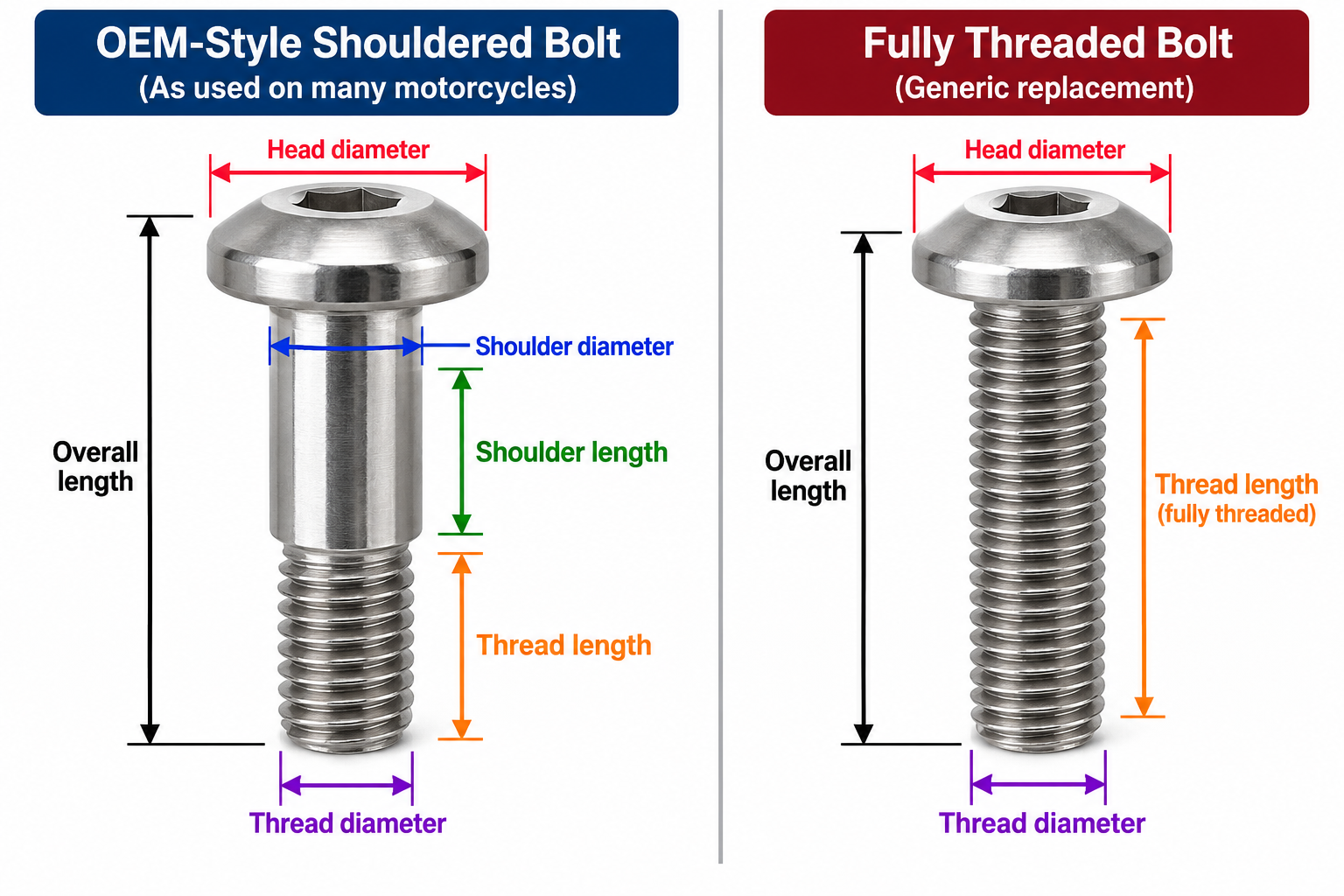
A shoulder bolt normally has three main sections:
Bolt head → smooth shoulder → threaded section
The smooth shoulder is usually larger in diameter than the threaded portion.
On a conventional fully threaded bolt, threads extend much further towards the head.
That difference can change how the fastener interacts with the component around it.
The shoulder may pass through:
- A fairing panel
- A rubber mounting
- A bush
- A spacer
- A collar
- A bracket
- A screen mounting point
- Another component designed around a smooth fastener surface
This means a shoulder bolt should not be identified only by the size of its threaded end.
Shoulder Diameter Matters
The diameter of the shoulder determines how the smooth part of the bolt fits through the component around it.
A shoulder that is considerably smaller than the original may provide more clearance than the original design intended.
A shoulder that is too large may not fit through the mounting point at all.
Depending on the design, the correct shoulder diameter may help with:
- Location
- Alignment
- Support
- Clearance
- Movement around a bush or fitting
This is why measuring only the threaded portion of an original shoulder bolt can miss an important part of the fastener specification.
Shoulder Length Matters Too
The length of the smooth shoulder can be equally important.
Depending on the application, the shoulder may pass through a panel, bush, spacer or combination of components before the threaded section begins.
If the replacement shoulder is too short, threads may sit where the original design used a smooth surface.
If the shoulder is too long, the bolt may not seat or clamp the assembly as intended.
The important point is:
The shoulder length should be considered as a functional dimension of the fastener, not simply an unthreaded section that can be ignored.
Why a Fully Threaded Bolt May Not Be Equivalent
Consider two bolts that both have:
M6 thread diameter
1.0 mm thread pitch
25 mm overall length
One is fully threaded.
The other has a smooth shoulder beneath the head.
Both may screw into the same threaded hole.
But they may not interact with the surrounding component in the same way.
With the fully threaded bolt:
threads may occupy the area where the original fastener used a smooth shoulder.
Depending on the mounting design, that may change:
- How a bush sits on the fastener
- How a panel is located
- How a spacer is supported
- Where the threaded portion begins
- How the assembly is clamped or spaced
So:
A bolt fitting the threaded hole does not automatically mean it reproduces the function of the original fastener.
Can I Replace a Shouldered Motorcycle Bolt With a Fully Threaded Bolt?
Sometimes, but not automatically.
A fully threaded bolt may have the same thread diameter, thread pitch and overall length as the original shouldered fastener, and it may even screw into the same mounting point. That does not necessarily mean it is an equivalent replacement.
If the original motorcycle fastener has a shoulder, that smooth section may perform an important function within the assembly.
Depending on the application, the shoulder may help to:
- Locate or align a component
- Maintain a particular spacing
- Support a bush, collar or mounting point
- Provide a smooth contact surface
- Keep the threaded section away from an area designed to sit against a smooth surface
- Control how components are positioned or clamped together
Before replacing a shouldered bolt with a fully threaded bolt, check the original shoulder diameter, shoulder length and surrounding mounting arrangement, as well as any relevant motorcycle manufacturer requirements.
If you cannot establish whether the shoulder performs an important function in that particular application, do not assume it can simply be removed from the fastener design. Use a correctly specified replacement or obtain appropriate technical advice.
Shoulder Bolts and Motorcycle Fairings
Fairing and screen mounting points are a particularly good example.
Some motorcycles use shouldered bolts around body panels, windscreens and related fittings.
The assembly may contain several parts, for example:
bolt head → washer → fairing or screen → rubber mounting or spacer → mounting point
In an arrangement like this, the smooth shoulder may form part of how the components are positioned or supported.
Replacing the original with a generic fully threaded bolt may therefore change the way the assembly sits.
Depending on the original design, this may contribute to problems such as:
- Incorrect spacing
- A panel sitting differently
- Excessive compression of a rubber fitting
- Threads contacting an area intended for a smooth surface
- Movement or rattling
- Additional stress around a mounting hole
This does not mean that every fully threaded replacement will damage a fairing.
The correct conclusion is simply that the original fastener arrangement should be understood before replacing a shouldered bolt with a different design.
Can a Shoulder Help Prevent Excessive Clamping?
In some assemblies, yes.
Where the shoulder is designed to seat against the mounting point, its length can help establish the spacing between components.
Once the shoulder reaches its intended seating position, continuing to tighten the fastener should not be treated as a way to force the surrounding panel or rubber component further together.
However, this depends entirely on the design of the particular assembly.
A shoulder bolt should not be treated as a universal protection against overtightening.
The motorcycle manufacturer’s installation and tightening requirements still take priority.
Why Threads Against a Bush or Mounting Surface May Matter
Threads are designed primarily to engage with a matching threaded component.
They are not necessarily the surface an adjacent bush, collar or mounting hole was designed to sit against.
A smooth shoulder provides a different contact surface from a threaded section.
Where the original manufacturer has designed a component around that smooth section, substituting a fully threaded bolt changes the surface passing through the component.
This is another reason why the position at which the threads begin can matter.
Shoulder Bolts Can Have Different Purposes
It is important not to assume that every shoulder bolt on a motorcycle performs exactly the same job.
Depending on the application, a shoulder can be used for:
- Spacing
- Alignment
- Location
- Supporting a bush
- Acting as a smooth bearing surface
- Controlling component clearance
- Providing an unthreaded section through part of an assembly
- Other application-specific purposes
In some engineering applications, keeping the smooth shank rather than the threaded section through a loaded joint can also affect how shear loads are carried. However, that should not be assumed to be the purpose of every motorcycle shoulder bolt. Fastenal
The correct interpretation comes from the design of the particular motorcycle component.
Shoulder Bolts Are More Than Just Thread Size
When identifying a replacement shouldered motorcycle bolt, consider:
- Thread diameter
- Thread pitch
- Thread length
- Overall bolt length
- Shoulder diameter
- Shoulder length
- Head diameter
- Head profile
- Drive type
- Washers, collars or spacers used with the bolt
- Fastener material
- Required strength or property class
- The component and mounting position
This is why describing a shoulder bolt simply as:
“M6 × 25 mm”
may not provide enough information to identify an equivalent replacement.
Head Size Still Matters
The presence of a correct shoulder does not mean the rest of the bolt can be ignored.
Head diameter and profile may also be important.
For example, some original motorcycle fairing bolts use relatively wide heads.
A generic replacement with the same thread and shoulder but a considerably smaller head may contact a smaller area or look noticeably different once installed.
Likewise, the drive style may differ.
An original bolt might use a Phillips-style head while a replacement uses an Allen socket.
A different drive does not automatically make the replacement unsuitable.
The important question is whether the features that matter to the actual mounting application have been retained.
OEM Does Not Always Mean Every Detail Must Look Identical
OEM means Original Equipment Manufacturer.
When discussing replacement motorcycle fasteners, it is useful to separate:
functional dimensions
from:
appearance or drive-style differences
For example, a replacement shoulder bolt may retain the required:
- Thread
- Length
- Shoulder diameter
- Shoulder length
- Head diameter
while using an Allen-key drive instead of the original Phillips-style drive.
If the different drive does not affect the function required by the mounting point, it may still be a suitable replacement.
The important thing is to understand which features matter for that particular application.
How Biker Bling Approaches Shouldered Motorcycle Bolts
Biker Bling supplies model-specific motorcycle fasteners, including shouldered bolts for applications where the original motorcycle uses shouldered hardware.
For some of our shoulder-bolt products, the shoulder diameter and shoulder length are matched to the corresponding original fastener, while any differences in features such as head diameter or drive type are identified in the individual product description.
For example, some current Honda shoulder-bolt listings specify that the shoulder length and diameter match the OEM fastener while also clearly stating that the Biker Bling head is slightly different in diameter or uses an Allen-key fitting instead of the original Phillips drive. Biker Bling
Other Biker Bling shoulder-bolt applications are listed with the shoulder and head dimensions matching the corresponding OEM fastener. Biker Bling
This is an important distinction.
We do not believe that every replacement needs to look identical purely for appearance.
What matters is identifying the dimensions and features required for the particular mounting position and clearly explaining what the replacement product supplies.
Always check the individual Biker Bling product listing for exact fitment, model/year coverage and hardware supplied.
Why Generic Motorcycle Bolt Kits Can Miss the Shoulder
A generic motorcycle bolt kit is designed to provide a useful selection of common fastener sizes.
That can work perfectly well for mounting points that genuinely use standard fasteners.
However, a generic kit cannot automatically reproduce every model-specific shoulder length, shoulder diameter, head size, spacer arrangement or other specialised feature used across different motorcycles.
This is one of the clearest examples of why:
same thread size does not always mean same fastener.
For a broader explanation, read our:
Generic Motorcycle Bolt Kits vs Model-Specific Kits: What’s the Difference?
Should You Replace an OEM Shoulder Bolt With a Fully Threaded Bolt?
There is no universal yes-or-no answer for every motorcycle application.
If the original shoulder serves a functional purpose, replacing it with a fully threaded bolt may not reproduce the original arrangement.
If the smooth section is simply incidental to the particular original fastener and performs no relevant function in that mounting position, another correctly specified fastener may potentially be suitable.
The safe approach is:
Do not assume. Check the application.
Where possible, compare the replacement against the original fastener and check the motorcycle manufacturer’s parts information or workshop manual.
If you cannot establish whether the shoulder is important, obtain appropriate technical advice before fitting a substantially different fastener.
What Should You Measure on an Original Shoulder Bolt?
If you have the original fastener available, useful dimensions to record include:
- Thread diameter
- Thread pitch
- Thread length
- Shoulder diameter
- Shoulder length
- Overall length
- Head diameter
- Head height
Also note:
- Drive style
- Washers
- Spacers
- Collars
- Rubber fittings
- Any unusual shape or feature
Do not assume that measuring only the thread gives you enough information.
We will cover the measuring process in detail in our forthcoming How to Measure Motorcycle Bolts: Metric Bolt Size, Length & Thread Pitch Guide.
Correct Bolt Selection Is Only Part of the Job
Once the correct fastener has been identified, it still needs to be fitted correctly.
Threads should be inspected, the bolt should start by hand without being forced, and the motorcycle manufacturer’s tightening and thread-treatment requirements should be followed.
🛠️ Related Workshop Guides
- Learn why application-specific hardware can matter in our Generic Motorcycle Bolt Kits vs Model-Specific Kits: What’s the Difference?.
- For practical installation guidance, read How to Fit Stainless Steel Motorcycle Bolts: Step-by-Step Guide.
- Learn about tightening torque, lubrication and thread treatments in our Stainless Steel Motorcycle Bolt Torque, Anti-Seize & Galling Guide.
Find Stainless Steel Motorcycle Bolt Kits
Looking to replace old, corroded or damaged motorcycle fasteners?
Browse the Biker Bling range of 304 stainless steel motorcycle bolt kits, including model-specific hardware for a wide range of makes, models and applications.
Shop Stainless Steel Motorcycle Bolt Kits →
Always check each product listing for exact fitment, model/year coverage and the hardware supplied.
Technical Information Disclaimer
The information on this page is provided as general educational guidance about motorcycle shoulder bolts and replacement fasteners.
It does not provide model-specific mechanical specifications and is not intended to replace the motorcycle manufacturer’s workshop manual, parts information, component manufacturer’s instructions or advice from a suitably qualified motorcycle technician.
The purpose and dimensions of a shouldered fastener can vary between motorcycles and applications.
A replacement fastener that appears to have the same thread diameter, pitch or overall length as the original may differ in shoulder dimensions, geometry, material, strength or intended function.
Always confirm that the replacement fastener is suitable for the specific motorcycle and mounting position before installation.
Where the motorcycle or component manufacturer specifies a particular fastener type, material, strength, property class, locking method or installation procedure, follow those requirements.
Particular care should be taken with braking, steering, wheels, suspension and other safety-critical components.
If you cannot establish the purpose of the original shoulder or the suitability of a replacement fastener, stop and obtain appropriate professional advice.
Nothing on this page is intended to affect your statutory rights or to exclude or restrict any responsibility that cannot lawfully be excluded or restricted.