Motorcycle Bolt Head Types: Allen, Hex, Torx, Button, Flange & Pan Head Guide
Motorcycle bolts come with many different head shapes and drive styles.
Common examples include Allen, hex, Torx, button head, flange head, pan head and countersunk bolts.
These terms are often used interchangeably, but they do not all describe the same part of the fastener.
Some describe the shape of the bolt head, while others describe the tool or drive used to turn it.
Understanding the difference can help when identifying a replacement motorcycle bolt and avoiding problems with clearance, seating or appearance.
Motorcycle Bolt Head Type vs Drive Type
A bolt has two separate features that riders often group together:
- The head type describes the shape of the bolt head.
- The drive type describes the recess or external shape used by the tool.
For example, a bolt may have:
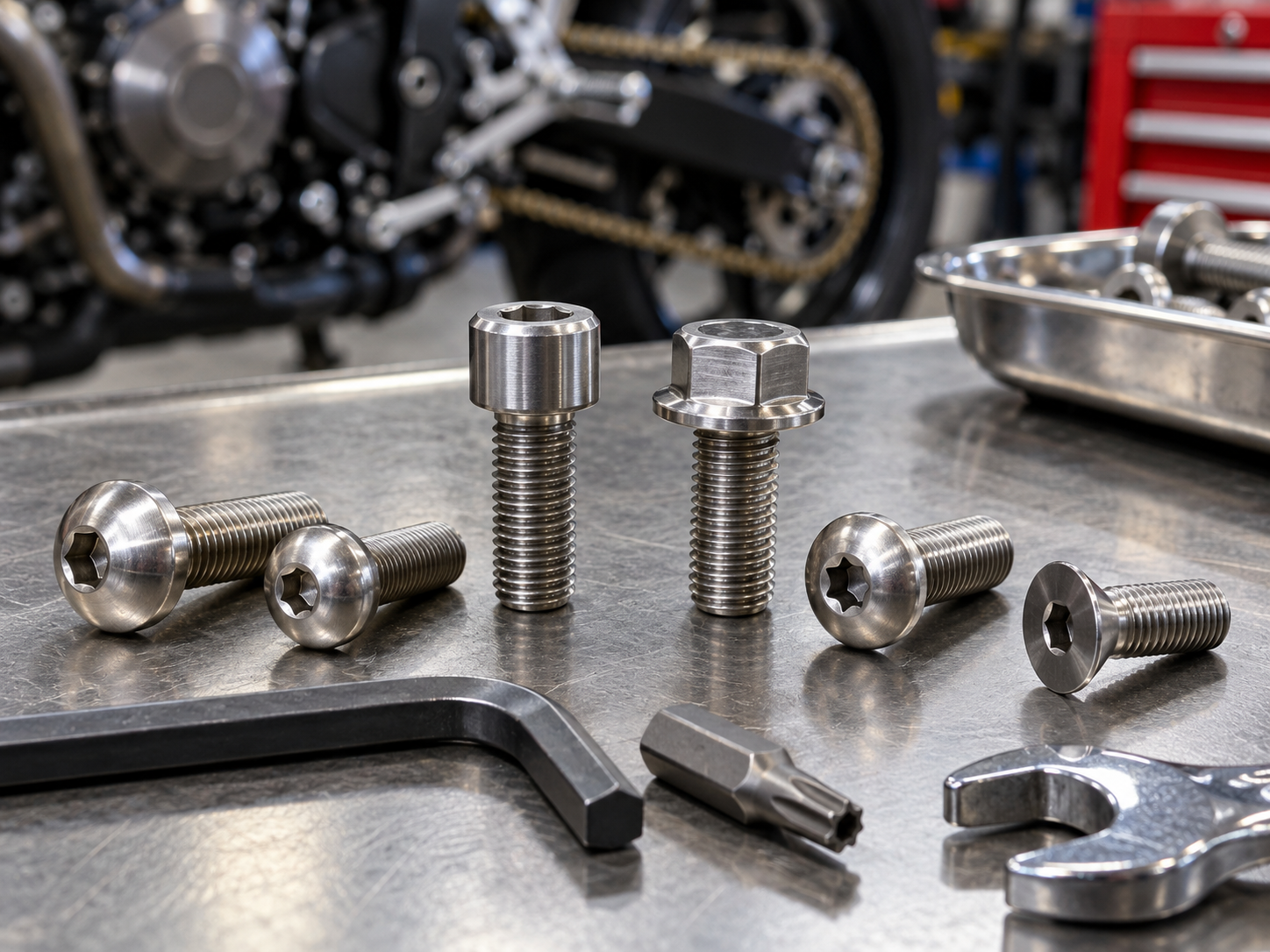
- A button head with an Allen/hex-socket drive.
- A socket-cap head with an Allen/hex-socket drive.
- A flange head with an external hex drive.
- A pan head with a Torx drive.
So describing a bolt simply as an “Allen bolt” or “Torx bolt” does not always tell you its complete head shape.
If you are identifying a replacement fastener, see our How to Choose the Correct Replacement Motorcycle Bolt guide.
Common Motorcycle Bolt Head and Drive Types
| Common Name | What It Describes | Typical Feature |
|---|---|---|
| Allen / Hex Socket | Drive type | Internal hexagonal recess for an Allen key or hex bit. |
| External Hex | Head and drive form | Six external flats for a spanner or socket. |
| Torx | Drive type | Six-lobed internal drive recess. |
| Socket Cap | Head type | Cylindrical head, commonly with an internal hex drive. |
| Button Head | Head type | Low, rounded head with a broad curved profile. |
| Flange Head | Head type | Head incorporates a wider bearing flange. |
| Pan Head | Head type | Rounded upper profile with a relatively flat underside. |
| Countersunk | Head type | Tapered underside designed to sit flush in a countersunk recess. |
The exact dimensions and proportions can vary depending on the fastener standard and application.
What Is an Allen Bolt?
“Allen bolt” is a common name for a fastener with an internal hexagonal drive.
The tool fits into the recess in the centre of the head.
You may also see these described as:
- Hex-socket bolts.
- Socket screws.
- Allen-head bolts.
- Socket-head bolts.
However, the internal hex drive does not determine the outer shape of the bolt head.
Both a socket-cap bolt and a button-head bolt can use an Allen-style internal hex drive.
This is why identifying only the drive type is not enough when ordering a replacement.
What Is a Socket Cap Bolt?
A socket-cap bolt has a relatively tall cylindrical head, normally with an internal hexagonal drive.
It is commonly used where:
- A compact tool-access arrangement is useful.
- A strong, relatively small-diameter head is required.
- The fastener sits within a recess or confined area.
Socket-cap bolts are common across motorcycles and general engineering.
The head height and diameter can be important where surrounding components limit clearance.
Do not assume a button-head bolt is interchangeable simply because both use the same Allen key.
What Is a Button-Head Bolt?
A button-head bolt has a low, rounded profile.
Many button-head bolts use an internal hex drive, although other drive styles can exist.
The rounded head can make them useful where:
- A lower-profile head is desirable.
- Appearance matters.
- Clearance above the head is limited.
- A smooth external finish is preferred.
Button-head fasteners are commonly seen on motorcycle bodywork, brackets and other visible fittings.
However, a button head normally has different head dimensions from a socket-cap bolt.
The two should not automatically be treated as interchangeable.
Why Head Shape Matters
The bolt head does more than provide somewhere to place a tool.
Its dimensions and underside can affect:
- Bearing area.
- Seating against the component.
- Clearance.
- Position relative to surrounding parts.
- Appearance.
- Washer requirements.
- Access for installation or removal.
A replacement with a head that is too wide may interfere with another component.
One that is too tall may contact bodywork or moving parts.
A head with the wrong underside shape may also seat differently from the original fastener.
This is why our How to Measure Motorcycle Bolts guide recommends looking at more than just thread diameter and length.
What Is an External Hex-Head Bolt?
A traditional hex-head bolt has six external flats.
It is normally tightened using:
- A socket.
- A ring spanner.
- An open-ended spanner.
Hex-head bolts are common where there is enough external access around the fastener.
The distance across the flats determines the spanner or socket size.
Do not assume the spanner size tells you the thread diameter.
Two fasteners with different thread sizes can sometimes use similar head dimensions, and manufacturers may use different head standards.
What Is a Flange-Head Bolt?
A flange-head bolt incorporates a wider section beneath the main head.
This flange increases the bearing area against the component.
Depending on the design, the flange can sometimes reduce the need for a separate washer, although that should never be assumed when replacing an OEM fastener.
Motorcycle flange bolts are often used where the manufacturer wants a broad seating surface while keeping the washer function integrated into the fastener.
The flange diameter and underside shape can therefore form an important part of the original specification.
Replacing a flange bolt with a standard hex bolt of the same thread and length may alter how the load is distributed into the component.
Serrated Flange Bolts
Some flange bolts have serrations beneath the flange.
These features can affect how the fastener interacts with the mating surface and how it resists rotation.
A serrated flange bolt should not automatically be replaced with a smooth-flange bolt purely because the thread dimensions match.
If the original fastener has a special underside feature, treat that feature as part of the fastener specification.
What Is a Torx Bolt?
Torx describes a six-lobed drive system, not a single head shape.
A Torx recess can be used in different head forms.
Compared with a conventional internal hex drive, the tool engages with a different geometry.
When working on a motorcycle, use the correct Torx bit rather than trying to substitute an Allen key or another tool.
Using the wrong tool can damage the recess and make future removal more difficult.
If the fastener is already damaged or rounded, see our How to Remove Seized, Stuck & Rounded Motorcycle Boltsguide.
Internal Torx and External Torx
Most riders are familiar with internal Torx recesses, but external Torx fasteners also exist.
An external Torx head uses a matching external star-shaped profile and requires the correct socket.
These are sometimes referred to as E-Torx fasteners.
Again, the correct tool matters.
A poor-fitting substitute can damage the fastener.
What Is a Pan-Head Bolt or Screw?
A pan head has a rounded upper profile and a relatively broad bearing surface underneath.
Pan-head fasteners are commonly associated with smaller screws and lighter-duty applications.
On motorcycles, they may appear around:
- Bodywork.
- Electrical components.
- Brackets.
- Covers.
- Trim.
- Other lightly loaded fittings.
The drive may be Phillips, Pozidriv, Torx, internal hex or another design depending on the fastener.
Do not assume every pan-head fastener has the same drive.
What Is a Countersunk Bolt?
A countersunk fastener has a tapered underside designed to fit into a matching countersunk recess.
When correctly matched to the component, the head can sit flush or nearly flush with the surrounding surface.
Countersunk fasteners require particular attention because their length is normally measured differently from most projecting-head bolts.
For a typical bolt with a head sitting above the surface, length is measured from beneath the head.
For a countersunk bolt, the head forms part of the installed length, so the measurement normally includes the head.
Our How to Measure Motorcycle Bolts guide explains this difference in more detail.
What About Shoulder Bolts?
Head type and shoulder design are separate features.
A motorcycle fastener may have a specific head form while also having an important unthreaded shoulder or plain-shank section.
That shoulder may:
- Locate a component.
- Pass through a bush.
- Maintain alignment.
- Provide a bearing surface.
- Keep threads out of a loaded section.
Replacing a shouldered fastener with a fully threaded bolt purely because the head looks correct can therefore create problems.
See our Motorcycle Shoulder Bolts Explained guide for more detail.
Does Head Type Tell You the Thread Size?
No.
You cannot reliably determine a bolt’s thread diameter or pitch simply from its head shape.
For example, two socket-cap bolts could look very similar from above while having different:
- Thread diameters.
- Thread pitches.
- Lengths.
- Strength grades.
- Materials.
Measure the actual thread rather than guessing from the head.
Our Motorcycle Metric Thread Pitch Reference Chart explains common coarse and fine metric pitches.
Does Head Type Tell You the Bolt Strength?
No.
Head form does not determine the bolt’s property class.
A socket-cap bolt, hex bolt or flange bolt may be manufactured from different materials and to different strength specifications.
If the original bolt carries markings such as:
- 8.8.
- 10.9.
- 12.9.
- A2-70.
- A4-70.
- A4-80.
those markings can provide additional information about the fastener.
See our Motorcycle Bolt Strength Grades Explained guide.
For the differences between stainless, titanium and high-tensile steel, see our Motorcycle Bolt Materials Explainedguide.
Does Changing the Bolt Head Type Matter?
It can.
Even if the thread diameter, pitch and length are correct, changing the head style can affect:
- Tool access.
- Clearance.
- Seating.
- Bearing area.
- Washer requirements.
- Appearance.
- Interaction with surrounding parts.
For a lightly loaded cosmetic fitting, there may sometimes be more flexibility.
For structural, highly loaded or safety-critical applications, the original specification should take priority.
Do not change the head form simply because another bolt looks better or is easier to obtain if the function of the original design is not understood.
Check the Drive Size as Well
Even when the head style is correct, the tool size may differ.
A poorly fitting Allen key, Torx bit or socket can damage the fastener.
Before applying significant force:
- Clean debris from the drive recess.
- Use the correct tool type.
- Check that the tool fits fully into the recess.
- Avoid worn or rounded tools.
- Keep the tool aligned with the fastener.
Correct tool fit is particularly important when removing tight or corroded fasteners.
Motorcycle Bodywork and Fairing Bolts
Bodywork fasteners often use low-profile head styles because clearance and appearance matter.
These may include:
- Button heads.
- Pan heads.
- Countersunk fasteners.
- Special shoulder fasteners.
- Bolts used with washers or well nuts.
However, motorcycle bodywork systems vary considerably.
A future Biker Bling guide will cover motorcycle fairing fasteners and another will explain how to fit motorcycle fairing bolts without damaging plastic panels.
Those pages will eventually link directly from this section.
Head Type, Washers and Spacers
A bolt should not always be considered in isolation.
The original assembly may use:
- Flat washers.
- Special washers.
- Collars.
- Sleeves.
- Spacers.
- Rubber components.
- Captive washers.
Changing the bolt head may also change how these parts fit or how load is transferred into the component.
A dedicated Motorcycle Washers, Spacers & Collars Explained guide will cover this in more detail later in the Biker Bling technical library.
Never Identify a Replacement From the Head Alone
A matching head shape is only one part of identifying the correct fastener.
Before fitting a replacement, check:
- Thread diameter.
- Thread pitch.
- Overall length.
- Threaded length.
- Shoulder dimensions where applicable.
- Head type.
- Head dimensions.
- Drive type and size.
- Material.
- Property class or strength specification.
- Washers, collars or spacers.
- Intended application.
Our How to Choose the Correct Replacement Motorcycle Bolt guide brings these checks together in one place.
Important Safety Information
This guide explains common motorcycle bolt head and drive types.
It does not establish that a particular head style or replacement fastener is suitable for every motorcycle application.
Always follow the motorcycle manufacturer’s workshop manual, parts information and specified fastener requirements.
Take particular care with fasteners associated with:
- Brakes.
- Steering.
- Suspension.
- Wheels and axles.
- Structural mountings.
- Engine internals.
- Other highly loaded assemblies.
Do not substitute head forms, materials or fastener specifications in safety-critical applications unless suitability has been properly established.
If the required fastener cannot be positively identified, use the manufacturer-specified part or obtain advice from a competent motorcycle technician.
Motorcycle Bolt Head Types: The Simple Rule
Understanding motorcycle bolt head types makes it easier to identify the correct fastener and choose the right tool for installation or removal.
The most important distinction is:
Head type describes the shape of the head. Drive type describes how the tool engages with it.
So:
- Allen / internal hex is a drive type.
- Torx is a drive type.
- Socket cap is a head type.
- Button head is a head type.
- Flange head is a head type.
- Pan head is a head type.
- Countersunk is a head type.
When replacing a motorcycle bolt, match the complete fastener specification rather than selecting one because its head looks similar.
Shop Stainless Steel Motorcycle Bolt Kits
Looking for replacement stainless steel fasteners for your motorcycle?
Biker Bling supplies stainless steel motorcycle bolt kits for a range of makes, models and applications.
Shop Stainless Steel Motorcycle Bolt Kits →
Always check the individual product description, intended fitment and fasteners supplied before ordering.