
Motorcycle Bolts Into Aluminium: How to Avoid Damaged & Stripped Threads
Motorcycle bolts into aluminium need extra care because the softer female threads can be damaged by cross-threading, over-tightening, incorrect thread pitch or the wrong installation method.
Engine casings, brake components, fork parts, brackets, covers and other assemblies may all use threaded aluminium.
When fitting motorcycle bolts into aluminium, the most important rules are to use the correct fastener, start the thread carefully, avoid forcing it and follow the manufacturer’s tightening instructions.
A bolt that feels wrong should never simply be tightened harder.
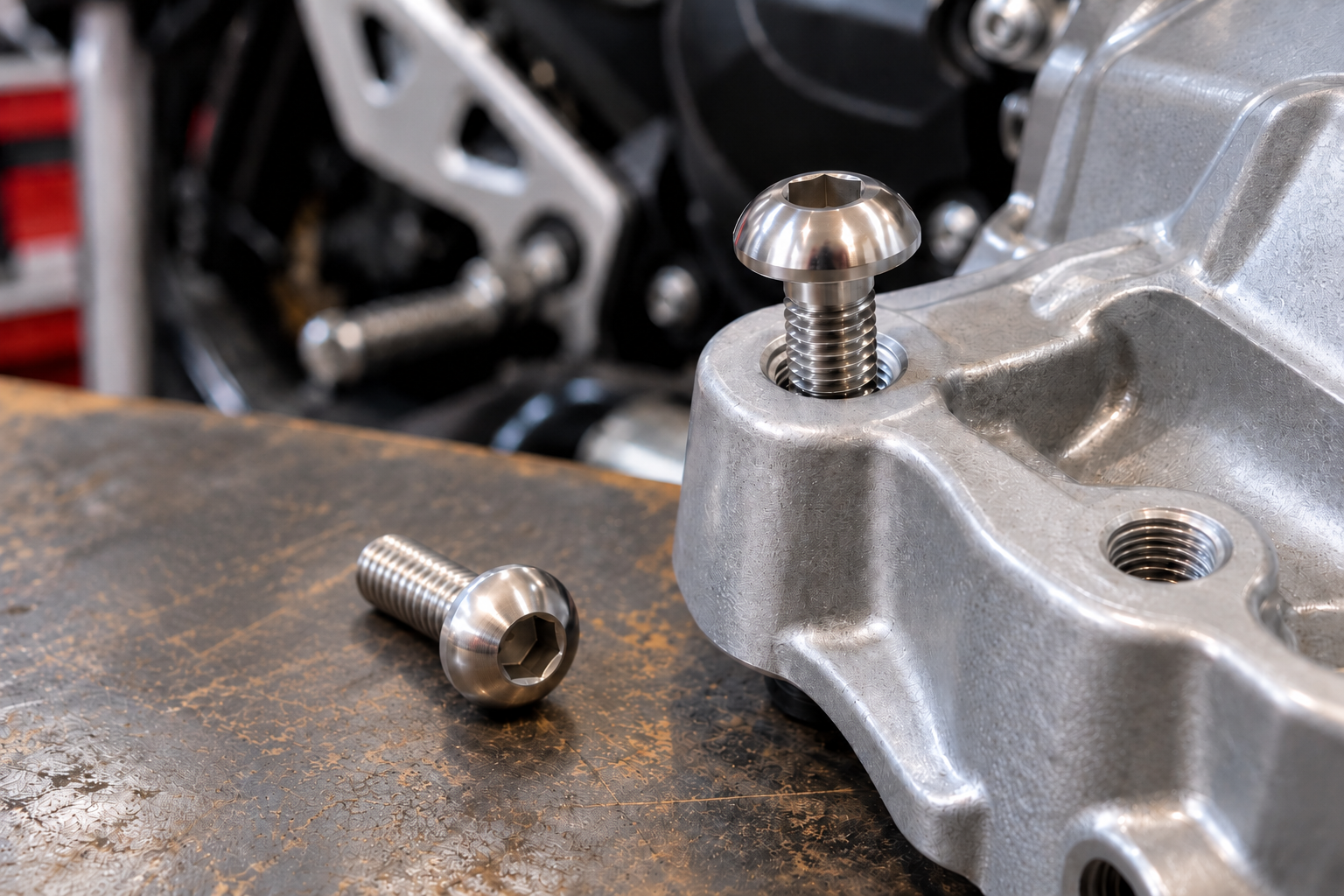
Why Aluminium Threads Need Extra Care
Aluminium is widely used on motorcycles because it can provide useful strength while keeping weight down.
However, aluminium threads are generally more vulnerable to damage than steel threads.
Problems can occur through:
- Cross-threading.
- Over-tightening.
- Incorrect thread pitch.
- Using a bolt that is too long.
- Dirty or damaged threads.
- Repeated removal and installation.
- Corrosion.
- Galling or seizure.
- Applying an unsuitable lubricant or thread treatment.
- Forcing a fastener that does not turn freely.
Once an aluminium thread is damaged, the bolt may no longer tighten correctly or provide the intended clamp load.
Starting Motorcycle Bolts Into Aluminium
One of the simplest ways to avoid thread damage is to start the bolt carefully by hand.
Where access allows, the bolt should normally engage several turns without significant resistance before a spanner, socket or Allen key is used.
If the bolt immediately feels tight, rough or uneven, stop.
Do not use a tool to force it into the hole.
Possible causes include:
- Incorrect thread pitch.
- Cross-threading.
- Dirt or corrosion.
- Damaged male threads.
- Damaged female threads.
- Incorrect bolt diameter.
- Poor alignment between the components.
If you are unsure whether the bolt is correct, see our How to Choose the Correct Replacement Motorcycle Bolt guide.
Cross-Threading Aluminium Motorcycle Threads
Cross-threading happens when the bolt enters the female thread at the wrong angle or fails to follow the existing thread correctly.
Because aluminium is relatively soft, a steel or stainless-steel bolt may damage the female thread if it is forced.
Warning signs can include:
- The bolt becoming tight after only a small amount of rotation.
- A bolt sitting at an angle.
- Rough or jerky movement.
- Metal debris appearing around the thread.
- A bolt that previously fitted easily becoming difficult to turn.
If any of these occur, stop and inspect the thread.
Continuing to tighten can turn a minor problem into a stripped thread.
Check the Thread Pitch Before Installation
A bolt can appear to have the correct diameter while still having the wrong thread pitch.
For example, two M10 bolts can have different pitches.
Trying to install the wrong pitch into aluminium can quickly damage the female thread.
Never rely only on the bolt diameter or the appearance of the head.
Check:
- Thread diameter.
- Thread pitch.
- Bolt length.
- Threaded length.
- Shoulder dimensions where applicable.
- Head and drive type.
- Material and strength specification.
- Intended application.
Our Motorcycle Metric Thread Pitch Reference Chart explains common coarse and fine metric pitches.
Bolt Length Matters in Aluminium Threads
Using a replacement bolt that is too long can create several problems.
It may:
- Bottom out in a blind hole.
- Contact an internal component.
- Give the false impression that the joint is fully tightened.
- Damage the bottom of the threaded hole.
- Prevent the components from clamping correctly.
A bolt that is too short may not engage enough thread.
For this reason, replacement fasteners should be matched to the original specification rather than chosen solely because the diameter and pitch appear correct.
See our How to Measure Motorcycle Bolts guide for help identifying bolt length correctly.
Why You Should Not Force a Tight Bolt
If a bolt becomes unexpectedly tight before the joint has seated, there is usually a reason.
Applying more torque is not the solution.
Forcing motorcycle bolts into aluminium can damage the female thread before there is any obvious external sign of a problem.
Stop and investigate.
Check that:
- The bolt is correct.
- The thread pitch matches.
- The bolt is entering straight.
- The threads are clean.
- The hole is not obstructed.
- The bolt is not bottoming out.
- Neither thread is already damaged.
A correctly matched fastener should not need to be forced through an undamaged thread.
Tightening Torque and Aluminium Threads
Correct tightening matters whenever a bolt screws into aluminium.
Too little clamp load may allow the joint to move.
Too much can damage the bolt, the component or the aluminium thread.
The correct torque depends on the actual motorcycle, fastener and joint.
There is no single safe torque figure for all bolts of a particular diameter.
For example, two M6 bolts can require very different tightening procedures depending on their:
- Application.
- Bolt material.
- Property class.
- Thread engagement.
- Mating material.
- Surface condition.
- Lubrication.
- Thread treatment.
Always use the motorcycle manufacturer’s workshop information or the relevant component manufacturer’s specification.
Lubrication Can Change Tightening Behaviour
Lubricating a thread reduces friction.
That means the same applied torque can produce a different clamp load compared with a dry thread.
This is particularly important when fitting motorcycle bolts into aluminium, because excess clamp load may damage the softer female thread.
Do not automatically apply oil, grease or anti-seize to a bolt simply because it screws into aluminium.
Follow the specified installation condition.
Our Stainless Steel Motorcycle Bolt Torque, Anti-Seize & Galling Guide explains why friction and thread treatment matter.
Should You Use Anti-Seize on Bolts Into Aluminium?
Sometimes anti-seize may be appropriate, but it should not be treated as a universal requirement.
Anti-seize can:
- Reduce friction.
- Help reduce galling.
- Help prevent seizure.
- Make future disassembly easier.
However, because it changes friction, it may also change the relationship between tightening torque and clamp load.
That means a torque value intended for a dry thread should not automatically be used with anti-seize.
Take extra care with blind threaded holes.
If too much anti-seize, oil or another incompressible material is trapped at the bottom of a closed hole, the bolt can compress the trapped material as it is tightened.
This can create hydraulic pressure, interfere with correct seating and preload and, in some cases, damage the surrounding component.
Do not pack a blind hole with anti-seize, and always follow the product and motorcycle manufacturer’s application instructions.
For a detailed comparison, see our Threadlocker vs Anti-Seize on Motorcycle Bolts guide.
Should You Use Threadlocker in Aluminium Threads?
Threadlocker may be specified for some fasteners that screw into aluminium.
However, it should not be added automatically.
Different products have different strengths and curing characteristics.
Strong threadlocker can also make future removal more difficult.
That matters because excessive removal force can damage an aluminium female thread.
If the motorcycle or component manufacturer specifies threadlocker, use the specified product or an appropriate equivalent and follow its instructions.
Do not assume stronger threadlocker is safer.
Stainless Steel Bolts Into Aluminium
Stainless steel bolts are often fitted into aluminium motorcycle components.
The combination can work well where the fastener is suitable for the application, but several factors still need to be considered.
These include:
- Correct thread size and pitch.
- Correct bolt strength.
- Correct tightening procedure.
- Thread treatment.
- Corrosion conditions.
- Future removal.
Stainless steel and aluminium are dissimilar metals.
Where moisture, road salt or another electrolyte is present, galvanic corrosion may occur under suitable conditions.
This does not mean stainless steel can never be used with aluminium.
It means material compatibility, environmental exposure and the original design should be considered rather than assuming every stainless bolt is suitable everywhere.
For more information on stainless and other fastener materials, see our Motorcycle Bolt Materials Explained guide.
Does 304 Stainless Steel Cause Aluminium Corrosion?
304 stainless steel and aluminium can form a galvanic couple when they are electrically connected and exposed to an electrolyte such as salt water.
The actual risk depends on factors including:
- Moisture exposure.
- Road salt.
- Surface area.
- Protective coatings.
- Joint design.
- Drainage.
- Environmental conditions.
The presence of stainless steel does not mean corrosion will automatically occur.
However, motorcycles exposed to winter road salt or persistent moisture may require additional care.
Our 304 Stainless Steel Motorcycle Bolts: Corrosion Resistance, Cleaning & Care guide explains stainless-steel corrosion and maintenance in more detail.
Threadlocker on Stainless Steel
Threadlocker can be used with stainless steel in suitable applications, but curing behaviour can differ from ordinary steel.
Most conventional liquid threadlockers are anaerobic adhesives.
They cure when air is excluded between the mating threads and the adhesive is exposed to suitable active metal ions.
Metals such as plain steel, iron, brass and copper are generally considered more chemically active for anaerobic curing.
Stainless steel is a passive metal, so some anaerobic threadlockers may cure more slowly on stainless fasteners.
Aluminium and some plated or coated surfaces can also behave as passive or inactive surfaces depending on their condition.
For this reason, some threadlocker manufacturers recommend an activator or primer where cure speed on passive metals is too slow.
Other products are formulated to perform without a separate primer in suitable applications.
Always check the technical data for the specific threadlocker being used rather than assuming every product will cure at the same rate on stainless steel.
Bolt Strength Still Matters
Changing from the original bolt to another material or appearance does not automatically mean the replacement is suitable.
The head shape, thread diameter and length may all match while the mechanical specification is different.
This is especially important on:
- Brake components.
- Suspension.
- Steering.
- Wheels and axles.
- Engine mountings.
- Structural joints.
- Highly loaded assemblies.
Our Motorcycle Bolt Strength Grades Explained guide explains common steel and stainless fastener markings.
Clean Threads Before Assembly
Dirty threads can make a correctly sized bolt feel tight.
Before installing a bolt, check for:
- Dirt.
- Old threadlocker.
- Corrosion.
- Metal debris.
- Damaged thread crests.
- Paint or coating inside the hole.
Do not use increased tightening force to overcome contamination.
Cleaning methods should suit the component and must not damage the existing thread.
If the thread condition is uncertain, inspect it before fitting the replacement fastener.
Be Careful When Cleaning Aluminium Threads
Aluminium threads can be damaged by aggressive cleaning.
Avoid treating a threaded hole as though it were a piece of hardened steel.
A tool used incorrectly can remove material rather than simply cleaning the thread.
If a tap is used to repair or clean a thread, it must be the correct size and pitch and should be used with appropriate care.
If you are unsure whether the thread requires cleaning, chasing or repair, obtaining professional assistance may prevent further damage.
What Is a Stripped Aluminium Thread?
A stripped thread has lost enough of its thread form that it can no longer properly hold the fastener.
Signs can include:
- The bolt continues turning without tightening.
- The specified tightening torque cannot be achieved.
- Aluminium material comes out with the bolt.
- The bolt pulls out under relatively low load.
- The female thread is visibly damaged.
A stripped thread should not simply be hidden with a longer bolt, larger bolt or stronger threadlocker.
The correct repair depends on the component and application.
Can a Stripped Aluminium Thread Be Repaired?
Many damaged aluminium threads can be repaired.
Common professional repair methods can include:
- Thread inserts.
- Solid threaded inserts.
- Wire-type inserts.
- Re-machining where appropriate.
- Component replacement.
The correct repair depends on the location, available material, original thread specification and loads involved.
A repair suitable for a cosmetic cover screw may not be appropriate for a brake, suspension or structural fastener.
Safety-critical thread repairs should be assessed and carried out using a suitable approved method.
Do Not Fit a Bigger Bolt Without Checking
Drilling or tapping a damaged hole to accept a larger bolt is not automatically a suitable repair.
Doing so can alter:
- The amount of material around the thread.
- Bolt strength.
- Clamp area.
- Component geometry.
- Clearance.
- Alignment.
- Serviceability.
On some components there may not be enough surrounding material to safely enlarge the thread.
Do not improvise repairs on safety-critical motorcycle components.
What About Thread Inserts?
Thread inserts are widely used for repairing damaged threads and can provide a durable repair when correctly specified and installed.
However, there are different insert systems and installation methods.
The repair must maintain:
- Correct thread position.
- Correct alignment.
- Suitable engagement.
- Adequate surrounding material.
- Correct final thread size and pitch.
Poor installation can leave the repaired thread misaligned or mechanically unsuitable.
For important structural or safety-related applications, professional repair may be the safest option.
Removing a Seized Bolt From Aluminium
Seized fasteners require particular care when they are threaded into aluminium.
Excessive force can:
- Strip the aluminium thread.
- Break the bolt.
- Damage the component.
- Distort surrounding material.
If a bolt is difficult to remove, first consider why it may be stuck.
Possible causes include:
- Corrosion.
- Threadlocker.
- Galling.
- Contamination.
- Cross-threading.
- Previous over-tightening.
Our How to Remove Seized, Stuck & Rounded Motorcycle Bolts guide covers removal methods in more detail.
Repeated Removal and Refitting
Threads can deteriorate through repeated servicing, especially if bolts are repeatedly started incorrectly or over-tightened.
Each time a fastener is removed, check:
- Male thread condition.
- Female thread condition.
- Bolt head and drive condition.
- Any specified washers or spacers.
- Signs of corrosion.
- Signs of previous cross-threading.
Do not assume a fastener remains serviceable simply because it can still be screwed into the hole.
Motorcycle Bolts Into Aluminium: Common Mistakes
Common mistakes include:
- Starting the bolt with a power tool.
- Forcing a bolt that feels tight.
- Assuming the pitch is correct because the diameter matches.
- Using the wrong bolt length.
- Applying anti-seize automatically.
- Packing a blind hole with lubricant or anti-seize.
- Applying threadlocker automatically.
- Guessing a torque value.
- Reusing visibly damaged fasteners.
- Ignoring damaged female threads.
- Using a stronger bolt without checking suitability.
- Fitting a larger bolt as an improvised repair.
Avoiding these mistakes can significantly reduce the risk of damaging aluminium motorcycle components.
Should You Use a Power Tool?
A power tool can make thread damage happen very quickly.
Where practical, start bolts by hand.
This allows you to feel whether the thread is engaging correctly.
Power tools can be useful in professional servicing when used appropriately, but they should not be relied upon to start an uncertain fastener into a soft aluminium thread.
If resistance appears, stop immediately.
Motorcycle Bolts Into Aluminium: The Simple Rule
When fitting motorcycle bolts into aluminium, never use tightening force to compensate for uncertainty.
The bolt should be:
- The correct diameter.
- The correct pitch.
- The correct length.
- Correctly aligned.
- Suitable for the application.
- Installed using the specified thread condition.
- Tightened using the correct procedure.
If it does not feel right, stop and find out why before continuing.
Important Safety Information
This guide provides general information about motorcycle fasteners and aluminium threads.
It does not provide a universal installation or repair specification.
Always follow the motorcycle manufacturer’s workshop manual and any instructions supplied by the component or fastener manufacturer.
Take particular care with bolts associated with:
- Brakes.
- Steering.
- Suspension.
- Wheels and axles.
- Engine mountings.
- Structural components.
- Other highly loaded or safety-critical assemblies.
Do not rely on threadlocker, anti-seize, additional tightening force or an improvised repair to compensate for a damaged or unsuitable thread.
If an aluminium thread is damaged and the correct repair is uncertain, obtain advice from a competent motorcycle technician or engineering specialist.
Shop Stainless Steel Motorcycle Bolt Kits
Looking for replacement stainless steel fasteners for your motorcycle?
Biker Bling supplies stainless steel motorcycle bolt kits for a range of makes, models and applications.
Shop Stainless Steel Motorcycle Bolt Kits →
Always check the individual product description, intended fitment and fasteners supplied before ordering.