
How to Measure Motorcycle Bolts: Metric Bolt Size, Length & Thread Pitch Guide
Knowing how to measure motorcycle bolts correctly can help you identify a replacement fastener without relying on appearance alone.
Two bolts may look very similar but differ in thread diameter, thread pitch, length, shoulder dimensions or head size.
This guide explains how to measure the main features of a metric motorcycle bolt and what information you should record before choosing a replacement.
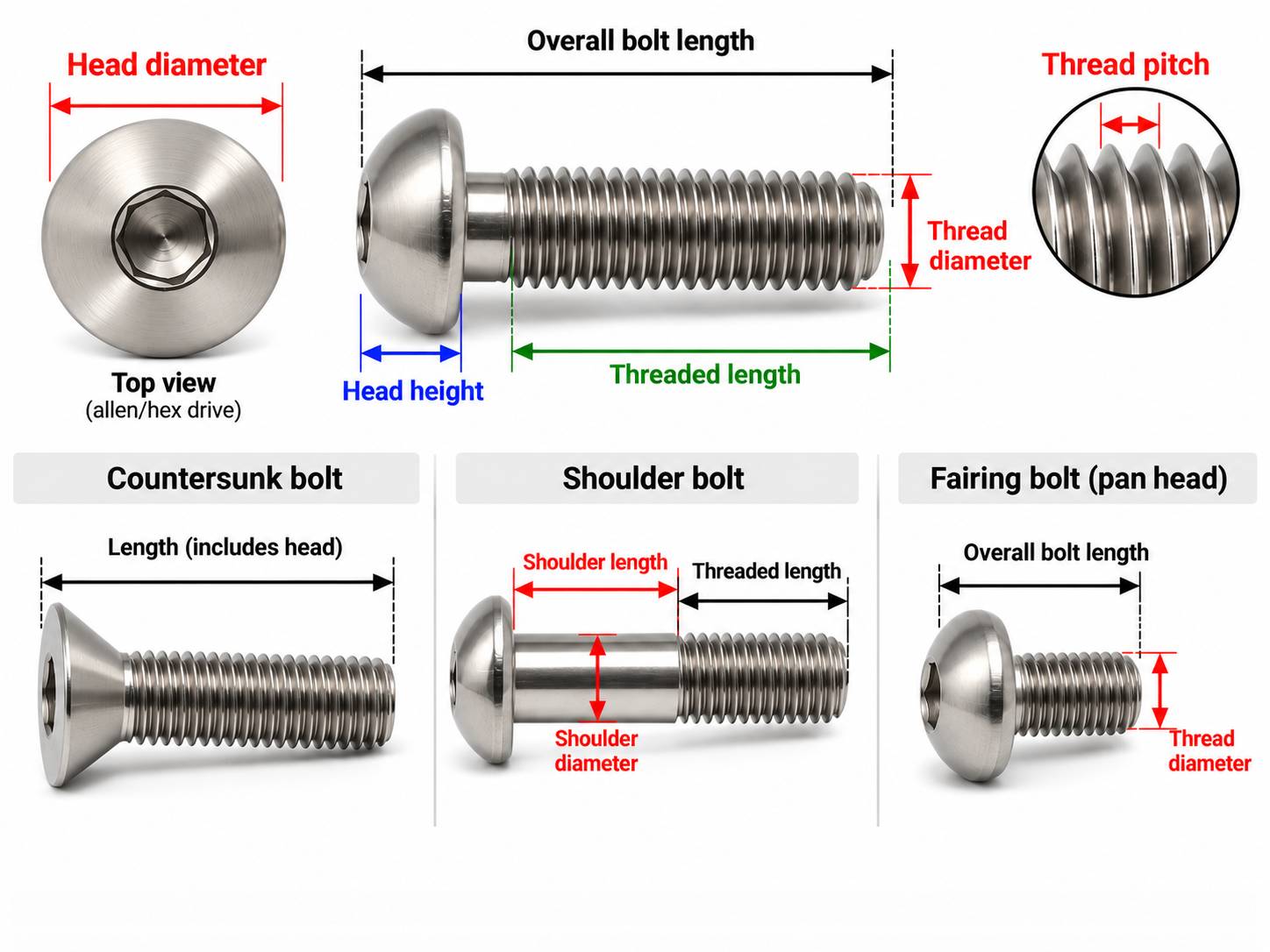
The Short Answer
To identify a metric motorcycle bolt, you will normally need to establish:
- Thread diameter
- Thread pitch
- Bolt length
- Threaded length
- Head type and diameter
- Shoulder diameter and length, where applicable
- Any washers, collars or spacers used with the original fastener
For example:
M6 × 1.0 × 25 mm
normally describes:
M6 = 6 mm nominal thread diameter
1.0 = 1.0 mm thread pitch
25 mm = bolt length
However, those three measurements do not always tell you everything required to identify an equivalent motorcycle fastener.
What Tools Do I Need to Measure a Motorcycle Bolt?
For most motorcycle fasteners, two simple measuring tools are particularly useful:
- Vernier or digital caliper — for checking thread diameter, bolt length, head diameter, shoulder dimensions and other measurements
- Metric thread pitch gauge — for identifying the distance between the threads
You may also find a steel rule useful for quick checks, but a caliper and thread pitch gauge will normally give more accurate results when identifying a replacement fastener.
You do not need specialist workshop equipment to make the basic measurements covered in this guide.
Important Information Before Measuring Motorcycle Bolts
This guide provides general information about measuring and identifying metric motorcycle fasteners.
Do not choose a replacement solely because the diameter, pitch and length appear to match.
Motorcycle fasteners may also differ in:
- Material
- Strength or property class
- Head type and dimensions
- Shoulder dimensions
- Threaded length
- Washers or spacers
- Locking features
- Intended function
Particular care should be taken with braking, steering, wheels, suspension and other safety-critical components.
Where the motorcycle manufacturer specifies a particular fastener type, material, strength or property class, that requirement takes priority over general measurements.
What Does M6 × 1.0 × 25 Mean?
Understanding metric bolt notation is a useful starting point when identifying motorcycle fasteners.
Take:
M6 × 1.0 × 25 mm
M6 — Thread Diameter
The M indicates a metric thread.
The 6 refers to the nominal thread diameter in millimetres.
So an M6 bolt has a nominal thread diameter of 6 mm.
1.0 — Thread Pitch
The 1.0 describes the distance between corresponding points on adjacent threads.
For an M6 × 1.0 bolt, the thread pitch is 1.0 mm.
25 mm — Bolt Length
The final figure describes the bolt length.
For most bolt-head styles that sit above the mounting surface, this is measured from underneath the bolt head to the end of the fastener.
Some head styles are measured differently, which we explain below.
1. How to Measure Motorcycle Bolt Diameter
Use a vernier or digital caliper to measure across the outside of the threaded section.
Open the caliper jaws and place them across the widest outside points of the threads.
Close the jaws gently until they contact the thread crests — the outermost points of the threads — without forcing the jaws down into the grooves.
Measure across the outside of the threads, not down inside the thread valleys.
Metric motorcycle fasteners commonly include sizes such as:
- M4
- M5
- M6
- M8
- M10
- M12
The measurement helps you establish the nominal thread diameter.
For example, a bolt measuring close to 6 mm across the outside of its threads will normally be identified as an M6fastener.
However, do not select a replacement from diameter alone.
Two bolts can have the same nominal diameter but different thread pitches.
2. How to Measure Motorcycle Bolt Thread Pitch
Thread pitch is particularly important.
Two bolts can have the same outside diameter but different thread pitches and will not correctly engage with the same threaded hole.
The most useful tool for checking metric thread pitch is a metric thread pitch gauge.
Select different leaves of the gauge until the teeth fit cleanly into the bolt threads.
The pitch marked on the matching gauge indicates the thread pitch in millimetres.
For example:
M6 × 1.0
means an M6 thread with a 1.0 mm pitch.
M10 × 1.25
means an M10 thread with a 1.25 mm pitch.
Can I Measure Motorcycle Bolt Thread Pitch With a Ruler?
You may be able to get an approximate indication, but a metric thread pitch gauge is more reliable.
Similar thread pitches can be difficult to distinguish accurately by eye.
For example, the difference between a:
1.25 mm pitch
and a:
1.5 mm pitch
may not be obvious without measuring properly.
If you regularly identify motorcycle fasteners, a metric thread pitch gauge and a vernier or digital caliper are useful tools to have.
Common Metric Thread Pitches
The following are useful general metric reference sizes:
- M4 — common coarse pitch: 0.7 mm
- M5 — common coarse pitch: 0.8 mm
- M6 — common coarse pitch: 1.0 mm
- M8 — common coarse pitch: 1.25 mm; 1.0 mm fine pitch also exists
- M10 — common coarse pitch: 1.5 mm; 1.25 mm and 1.0 mm finer pitches also exist
- M12 — common coarse pitch: 1.75 mm; 1.5 mm and 1.25 mm finer pitches also exist
This is a general metric thread reference, not a motorcycle fitment chart.
Do not assume that a particular motorcycle component uses the common coarse pitch simply because you know the thread diameter.
Always check the actual fastener, manufacturer information or other reliable specification for the particular motorcycle and mounting position.
Can Two M10 Motorcycle Bolts Have Different Thread Pitches?
Yes.
For example, one M10 fastener may use:
M10 × 1.5
while another may use:
M10 × 1.25
They have the same nominal thread diameter but different spacing between the threads.
A bolt with the wrong thread pitch should not be forced into a threaded component.
Doing so can damage both the fastener and the female thread, particularly where the threaded component is aluminium.
3. How to Measure Motorcycle Bolt Length
For most bolt-head styles that sit above the mounting surface, measure from the underside of the bolt head to the end of the bolt.
Examples can include:
- Button-head bolts
- Socket-cap bolts
- Pan-head bolts
- Hex-head bolts
The head itself is normally not included in the length because it remains above the mounting surface.
So if the distance from underneath the head to the end of the bolt is 25 mm, it would normally be described as a 25 mm long bolt.
Does the Bolt Head Count as Part of the Length?
Usually not, but the head design matters.
With most bolt heads that sit above the mounting surface, the length is measured from underneath the head.
Countersunk Bolts Are Different
A countersunk fastener is designed so that its head sits into the component rather than remaining above the surface.
For a countersunk fastener, the length normally includes the head.
This means a 20 mm countersunk fastener and a 20 mm button-head fastener are not measured from exactly the same physical point.
4. Measure the Threaded Length Too
Overall bolt length does not necessarily tell you how much of the fastener is threaded.
Two bolts can have the same total length but different threaded portions.
For example:
Bolt A: almost fully threaded
Bolt B: partly threaded with a long smooth section
Depending on the mounting position, that difference may matter.
Record where the threaded section begins as well as the overall fastener length.
5. How to Measure a Motorcycle Shoulder Bolt
If the original bolt has a smooth shoulder, record the shoulder separately.
Measure:
- Shoulder diameter
- Shoulder length
- Thread diameter
- Thread pitch
- Threaded length
- Bolt length
- Head diameter
Do not measure only the threaded section and assume that a fully threaded bolt with the same basic size will perform the same job.
Depending on the application, the smooth shoulder may help locate, space, support or align another component.
For a detailed explanation, read our Motorcycle Shoulder Bolts Explained guide.
6. Measure the Bolt Head
The bolt head can also form part of the replacement specification.
Useful measurements and details include:
- Head diameter
- Head height
- Head profile
- Drive type
- Any flange or captive washer
Common motorcycle fastener head types can include:
- Button head
- Socket cap
- Pan head
- Hex head
- Flanged head
- Countersunk head
Two bolts with identical threads and lengths can still have considerably different head dimensions.
That can affect how the fastener sits against a washer, panel, bracket or other component.
Why Can Motorcycle Bolt Head Diameter Matter?
Consider two bolts that are both:
M6 × 1.0 × 20 mm
One may have a relatively wide head.
The other may have a considerably smaller head.
The smaller head will contact a smaller area of the washer, panel or component beneath it.
This does not automatically mean that one fastener is suitable and the other is unsuitable.
It means that head diameter and profile should be considered as part of the complete fastener specification rather than ignored.
7. Check Washers, Collars and Spacers
Before putting the original fastener aside, also record any associated hardware.
This could include:
- Metal washers
- Nylon washers
- Rubber washers
- Collars
- Spacers
- Rubber well nuts
- Clips
- Grommets
These components may form part of the way the original assembly is positioned, supported or secured.
Do not assume that they are optional simply because they are separate from the bolt.
8. Compare the Replacement Bolt With the Original
Where you still have the original fastener, place the original and replacement side by side.
Compare:
- Thread diameter
- Thread pitch
- Bolt length
- Threaded length
- Shoulder dimensions
- Head diameter
- Head profile
- Drive style
- Associated washers or spacers
This can help identify obvious differences before attempting installation.
However, visual comparison and dimensional measurement alone do not establish the fastener’s material, strength or suitability for a particular application.
Can I Identify a Motorcycle Bolt Just by Looking at It?
No.
Two bolts can look almost identical while having different thread pitches, mechanical properties or intended applications.
Likewise, two fasteners that look slightly different may still be suitable where the important functional specifications match.
Use measurements together with the motorcycle manufacturer’s information and the replacement product specification.
9. Do Not Force a Bolt That Does Not Thread In Correctly
A correctly selected bolt should engage normally in an undamaged matching thread.
Where access permits, start the fastener carefully by hand.
If it becomes unexpectedly difficult to turn, stop and check:
- Thread diameter
- Thread pitch
- Alignment
- Thread condition
- Whether the correct bolt is being used
Do not use additional force to make an apparently similar bolt fit.
An incorrect thread pitch or cross-threading can damage the female thread.
For practical installation guidance, read How to Fit Stainless Steel Motorcycle Bolts: Step-by-Step Guide.
What If the Original Motorcycle Bolt Is Seized or Damaged?
If the original fastener cannot be removed cleanly enough to measure, avoid repeatedly applying increasing force.
Seized, rounded or broken hardware may require a different approach.
Read our How to Remove Seized, Stuck & Rounded Motorcycle Bolts guide before proceeding.
Does the Same Bolt Size Mean the Same Motorcycle Fastener?
No.
This is one of the most important points in this guide.
Two fasteners can both be described as:
M6 × 1.0 × 25 mm
but still differ in:
- Shoulder dimensions
- Threaded length
- Head diameter
- Head profile
- Washers or spacers
- Material
- Strength
- Intended mounting position
The nominal bolt size provides useful information, but it does not describe every feature or requirement of the fastener.
This is one reason model-specific bolt kits can differ from boxes of general-purpose fasteners.
Read Generic Motorcycle Bolt Kits vs Model-Specific Kits: What’s the Difference? for a fuller explanation.
Before Ordering a Replacement Motorcycle Bolt
A useful measurement checklist is:
- Thread diameter
- Thread pitch
- Bolt length
- Threaded length
- Shoulder diameter, if present
- Shoulder length, if present
- Head diameter
- Head height
- Head type
- Drive type
- Washers, collars and spacers
- Required material or strength specification
- Exact mounting position
If you are buying a model-specific kit, also confirm:
- Motorcycle make
- Model
- Year range
- Application
- Hardware supplied
🛠️ Related Workshop Guides
- Want to understand why the smooth section of a fastener can matter? Read Motorcycle Shoulder Bolts Explained.
- Learn why apparently similar fasteners are not always equivalent in Generic Motorcycle Bolt Kits vs Model-Specific Kits.
- Once you have identified the correct fastener, read How to Fit Stainless Steel Motorcycle Bolts: Step-by-Step Guide.
Find Model-Specific Stainless Steel Motorcycle Bolt Kits
Looking for replacement motorcycle fasteners?
Browse the Biker Bling range of 304 stainless steel motorcycle bolt kits, with products listed for particular makes, models, year ranges and applications.
Shop Stainless Steel Motorcycle Bolt Kits →
Always check the individual product listing for exact fitment, year coverage and the hardware supplied.
Technical Information Disclaimer
The information on this page is provided as general educational guidance about measuring and identifying motorcycle fasteners.
It does not provide model-specific fastener specifications and is not intended to replace the motorcycle manufacturer’s workshop manual, parts information, component manufacturer’s instructions or advice from a suitably qualified motorcycle technician.
A fastener that matches the original thread diameter, pitch and length may still differ in shoulder dimensions, head geometry, material, strength, property class or intended function.
Always confirm that a replacement fastener is suitable for the particular motorcycle and mounting position before installation.
Where the motorcycle or component manufacturer specifies a particular fastener type, material, strength, property class, locking method or installation procedure, those requirements take priority.
Particular care should be taken with braking, steering, wheels, suspension and other safety-critical components.
If you cannot establish the correct fastener specification or suitability of a replacement, stop and obtain appropriate technical advice.
Nothing on this page is intended to affect your statutory rights or to exclude or restrict any responsibility that cannot lawfully be excluded or restricted.