
Motorcycle Bolt Materials Explained: 304 Stainless, 316 Stainless, Titanium & High-Tensile Steel
Motorcycle bolts are made from different materials because different applications require different combinations of corrosion resistance, strength, weight, appearance and cost.
The most common materials riders encounter include 304 stainless steel, 316 stainless steel, titanium and high-tensile steel.
None of these materials is automatically the “best” choice for every motorcycle bolt.
A suitable replacement needs to match the requirements of the original fastener and the job it performs on the motorcycle. For highly loaded or safety-critical applications, the motorcycle manufacturer’s specification should always take priority.
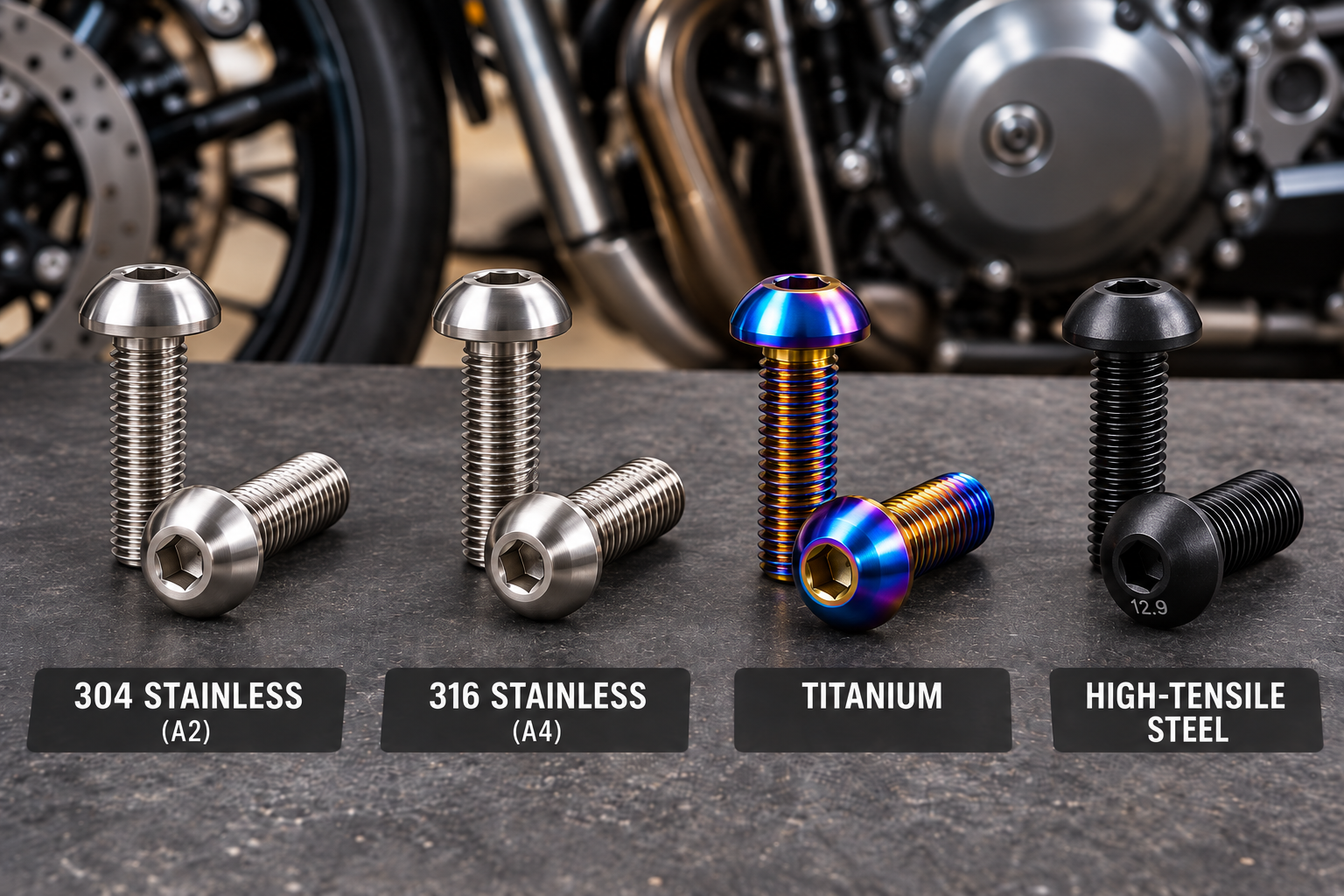
Why Does Motorcycle Bolt Material Matter?
Bolt material can affect:
- Corrosion resistance.
- Mechanical strength.
- Weight.
- Appearance.
- Resistance to particular environments.
- Thread behaviour.
- Cost.
- Suitability for a particular application.
Two bolts can have exactly the same diameter, thread pitch and length but very different mechanical properties.
That is why matching dimensions alone does not prove that one material is a suitable replacement for another.
If you are choosing a replacement fastener, see our How to Choose the Correct Replacement Motorcycle Bolt guide.
304 Stainless Steel Motorcycle Bolts
304 is one of the most widely used austenitic stainless steels.
It contains chromium and nickel, which help provide the corrosion resistance associated with stainless steel.
For fasteners, material designations do not always use the familiar 304 name. A2 stainless fasteners are generally associated with the 304 family of stainless steels.
304/A2 stainless is widely used where a combination of corrosion resistance, appearance and general-purpose performance is required.
On motorcycles, suitable applications can include many non-critical external fasteners where the required mechanical specification allows stainless steel to be used.
However, 304 stainless should not be treated as a universal replacement for every original motorcycle bolt.
What Does A2 Stainless Mean?
You may see stainless fasteners marked with designations such as:
A2-70
The first part identifies the stainless-steel group or composition category, while the second part identifies the fastener’s property class.
So A2 and 70 do not mean the same thing.
In simple terms:
- A2 identifies an austenitic stainless fastener family generally associated with 304-type stainless.
- 70 indicates a specified mechanical property class.
This is important because describing a bolt simply as “stainless steel” does not tell you everything about its mechanical properties.
316 Stainless Steel Motorcycle Bolts
316 is another austenitic stainless steel, but it contains molybdenum in addition to chromium and nickel.
The addition of molybdenum improves resistance to localised corrosion, particularly in environments where chlorides such as salt are present.
This is why 316 stainless is often selected for harsher environments where improved corrosion resistance is desirable.
For motorcycles exposed to wet weather, road contamination or salty environments, that additional corrosion resistance can be useful.
However, 316 stainless is not corrosion-proof.
Surface condition, contamination, trapped moisture, road salt, cleaning frequency and the surrounding materials can all influence how a fastener performs over time.
What Does A4 Stainless Mean?
For stainless fasteners, A4 is generally associated with the 316 family.
You may therefore encounter markings such as:
A4-70
Again, the two parts describe different things:
- A4 identifies the stainless material family.
- 70 identifies the fastener property class.
This distinction matters.
An A4 fastener should not automatically be described as stronger than an A2 fastener simply because 316 generally offers better corrosion resistance than 304.
Corrosion resistance and mechanical strength are separate properties.
304 Stainless vs 316 Stainless Motorcycle Bolts
The main practical difference for many motorcycle owners is corrosion resistance.
316 stainless generally offers improved resistance to chloride-related and localised corrosion because of its molybdenum content.
That can make it attractive for motorcycles exposed to:
- Road salt.
- Wet winter conditions.
- Coastal environments.
- Frequent road spray.
- Harsh outdoor storage conditions.
304 stainless still provides useful corrosion resistance in many applications, but 316 can offer an advantage where environmental exposure is more severe.
That does not mean every 304 bolt should automatically be replaced with 316.
The bolt still needs to have the correct dimensions, head form, mechanical properties and suitability for the application.
If you are unsure about dimensions or features such as shoulders, our How to Measure Motorcycle Bolts and Motorcycle Shoulder Bolts Explained guides explain what to check.
Is 316 Stainless Stronger Than 304 Stainless?
Not necessarily.
This is an important distinction.
The corrosion-resistance advantage of 316 does not automatically mean that every 316 fastener is mechanically stronger than every 304 fastener.
Fastener strength depends on factors including:
- Material specification.
- Property class.
- Manufacturing process.
- Work hardening.
- Fastener dimensions.
- Applicable fastener standard.
For that reason, the material name alone should not be used to determine whether a bolt is suitable for a loaded application.
A dedicated guide to motorcycle bolt strength grades and stainless property classes will cover this subject in more detail later in the Biker Bling technical library.
What Are High-Tensile Steel Motorcycle Bolts?
The term high-tensile steel is commonly used for steel fasteners manufactured to higher mechanical property classes.
Metric steel fasteners are often marked with property classes such as:
- 8.8.
- 10.9.
- 12.9.
These numbers relate to specified mechanical properties of the fastener.
As the property class increases, the required tensile and yield/proof characteristics generally increase as well.
This is one reason high-strength steel fasteners are commonly found in demanding automotive and motorcycle applications.
A steel bolt marked 10.9, for example, should not be assumed to be interchangeable with a stainless bolt of the same dimensions.
The dimensions may match while the mechanical specification does not.
Where Might High-Tensile Steel Be Used on a Motorcycle?
Manufacturers may specify high-strength steel fasteners where substantial loads or particular mechanical characteristics are required.
Examples can include fasteners associated with:
- Suspension.
- Steering.
- Wheels and axles.
- Brake assemblies.
- Structural mountings.
- Engine components.
- Highly loaded joints.
This does not mean every bolt in these areas will use the same grade.
Always use the motorcycle manufacturer’s specification for the particular fastener.
Do not replace an original 8.8, 10.9 or 12.9 fastener with stainless steel merely because the stainless replacement has the same thread and length.
What About Corrosion on High-Tensile Steel Bolts?
Unlike stainless steel, carbon and alloy-steel fasteners commonly rely on their surface finish or coating for additional corrosion protection.
Depending on the original fastener, this might include plating, coating, black finishes or other treatments.
If that protective finish becomes damaged or deteriorates, corrosion can develop.
However, improved corrosion resistance alone is not a valid reason to replace a high-strength OEM steel fastener with stainless steel.
The required mechanical properties must come first.
Titanium Motorcycle Bolts
Titanium fasteners are popular with some motorcycle owners because titanium can combine good corrosion resistance with lower weight than steel.
It can also provide a distinctive appearance.
However, “titanium” describes a family of materials rather than one single fastener specification.
Different titanium grades and alloys have different mechanical properties.
A titanium bolt should therefore not be selected simply because titanium is associated with lightweight, high-performance components.
Its actual grade, fastener specification and suitability for the application still matter.
Are Titanium Bolts Stronger Than Steel?
There is no useful universal answer.
Some titanium alloys have an excellent strength-to-weight ratio, but that does not mean every titanium bolt is stronger than every steel or stainless-steel bolt.
A comparison needs to consider the actual materials and fastener specifications involved.
For example, comparing an unspecified titanium bolt with a known 10.9 steel bolt tells you very little.
The correct question is not simply:
“Which material is strongest?”
It is:
“Does this particular fastener meet the mechanical and dimensional requirements of this application?”
Titanium vs Stainless Steel Motorcycle Bolts
Titanium and stainless steel are both used where corrosion resistance and appearance can be important, but they are different materials with different properties.
Titanium may offer a significant weight advantage.
Stainless steel is widely available, corrosion resistant and available in established fastener material and property classifications.
Which is preferable depends on the particular application rather than the material name alone.
For cosmetic or lightly loaded applications, riders may have more flexibility.
For safety-critical or highly loaded locations, suitability needs to be established from the required specification rather than appearance or weight saving.
Material Does Not Replace Correct Fitment
Whatever bolt material you choose, the fastener still needs to have the correct:
- Diameter.
- Thread pitch.
- Length.
- Threaded length.
- Shoulder dimensions where applicable.
- Head type.
- Seating arrangement.
- Washers, collars or spacers.
- Mechanical specification.
For help identifying these features, see our How to Choose the Correct Replacement Motorcycle Bolt guide.
If a model-specific kit is available, our Generic Motorcycle Bolt Kits vs Model-Specific Kits: What’s the Difference?guide explains why identifying the intended motorcycle application can be just as important as identifying the bolt itself.
Stainless Steel, Aluminium and Dissimilar Metals
Motorcycles commonly contain aluminium components, while replacement fasteners may be stainless steel.
Whenever different metals are placed together in the presence of an electrolyte such as salty water, galvanic interaction can become a consideration.
The real-world risk depends on factors including:
- The metals involved.
- Exposure to moisture and salt.
- Surface area.
- Protective finishes.
- Joint design.
- Maintenance and cleaning.
This is another reason not to treat bolt-material selection as a simple choice between “rusty steel” and “stainless steel”.
A future Biker Bling guide will look specifically at motorcycle bolts into aluminium and how to reduce the risk of damaged or stripped threads.
Thread Galling and Stainless Steel Bolts
Stainless fasteners can be susceptible to galling, where thread surfaces seize or damage during tightening.
Risk can be influenced by factors including thread condition, installation speed, contamination, friction and the particular materials involved.
Do not automatically apply lubricant or anti-seize to every stainless bolt, because changing thread friction can affect the relationship between tightening torque and clamp load.
For more detail, see our Stainless Steel Motorcycle Bolt Torque, Anti-Seize & Galling Guide.
Our How to Fit Stainless Steel Motorcycle Bolts guide also covers good installation practice before final tightening.
Motorcycle Bolt Materials Compared
| Material | Main Advantage | Important Consideration |
|---|---|---|
| 304 / A2 Stainless | Good general corrosion resistance. | Not automatically suitable for every OEM application. |
| 316 / A4 Stainless | Improved resistance to localised and chloride-related corrosion. | Better corrosion resistance does not automatically mean greater strength. |
| Titanium | Low weight and good corrosion resistance. | Grade and fastener specification must be known. |
| High-Tensile Steel | Can provide high mechanical strength. | Corrosion protection may depend on coating or finish. |
This table is a general comparison only.
The correct material for a particular motorcycle bolt depends on the manufacturer’s specification and the demands placed on that fastener.
Can I Replace Steel Motorcycle Bolts With Stainless Steel?
Sometimes, but not automatically.
For suitable non-critical applications, stainless steel can provide useful corrosion resistance and an attractive finish.
But an original high-strength steel fastener should not be replaced with stainless solely because the new bolt physically fits.
Before changing material, consider:
- Original bolt strength or property class.
- Required clamp load.
- Bolt dimensions.
- Shoulder or shank design.
- Temperature.
- Environment.
- Manufacturer specification.
- Safety importance of the joint.
If the original fastener specification cannot be established and the application is safety-critical, the safest approach is to use the manufacturer-specified fastener or obtain competent technical advice.
Important Safety Information
Motorcycle fasteners can form part of safety-critical assemblies.
This guide explains general differences between common motorcycle bolt materials. It does not establish that a particular material is suitable for every application.
Always follow the motorcycle manufacturer’s workshop manual, parts information and specified fastener requirements.
Do not substitute stainless steel, titanium or another material for an original high-strength or specially specified fastener unless suitability has been properly established.
Particular care is required for fasteners associated with braking, steering, suspension, wheels, axles, structural mountings and other highly loaded assemblies.
If you cannot establish the required fastener specification, use the manufacturer-specified part or obtain advice from a competent motorcycle technician.
Which Motorcycle Bolt Material Should You Choose?
There is no single best motorcycle bolt material.
For a suitable application:
- 304/A2 stainless can offer good general corrosion resistance.
- 316/A4 stainless can provide improved corrosion resistance, particularly where chloride exposure is a concern.
- Titanium can offer low weight and good corrosion resistance when the correct grade and specification are used.
- High-tensile steel can provide the higher mechanical properties required in many demanding applications.
The correct choice depends on the specific bolt, its mechanical requirements and the job it performs on the motorcycle.
Material should therefore be treated as one part of the fastener specification—not as a substitute for it.
Shop Stainless Steel Motorcycle Bolt Kits
Looking for replacement stainless steel fasteners for your motorcycle?
Biker Bling supplies stainless steel motorcycle bolt kits for a range of makes, models and applications.
Shop Stainless Steel Motorcycle Bolt Kits →
Always check the individual product description, intended fitment and fasteners supplied before ordering.