
Motorcycle Bolt Strength Grades Explained: 8.8, 10.9, 12.9 & Stainless Steel
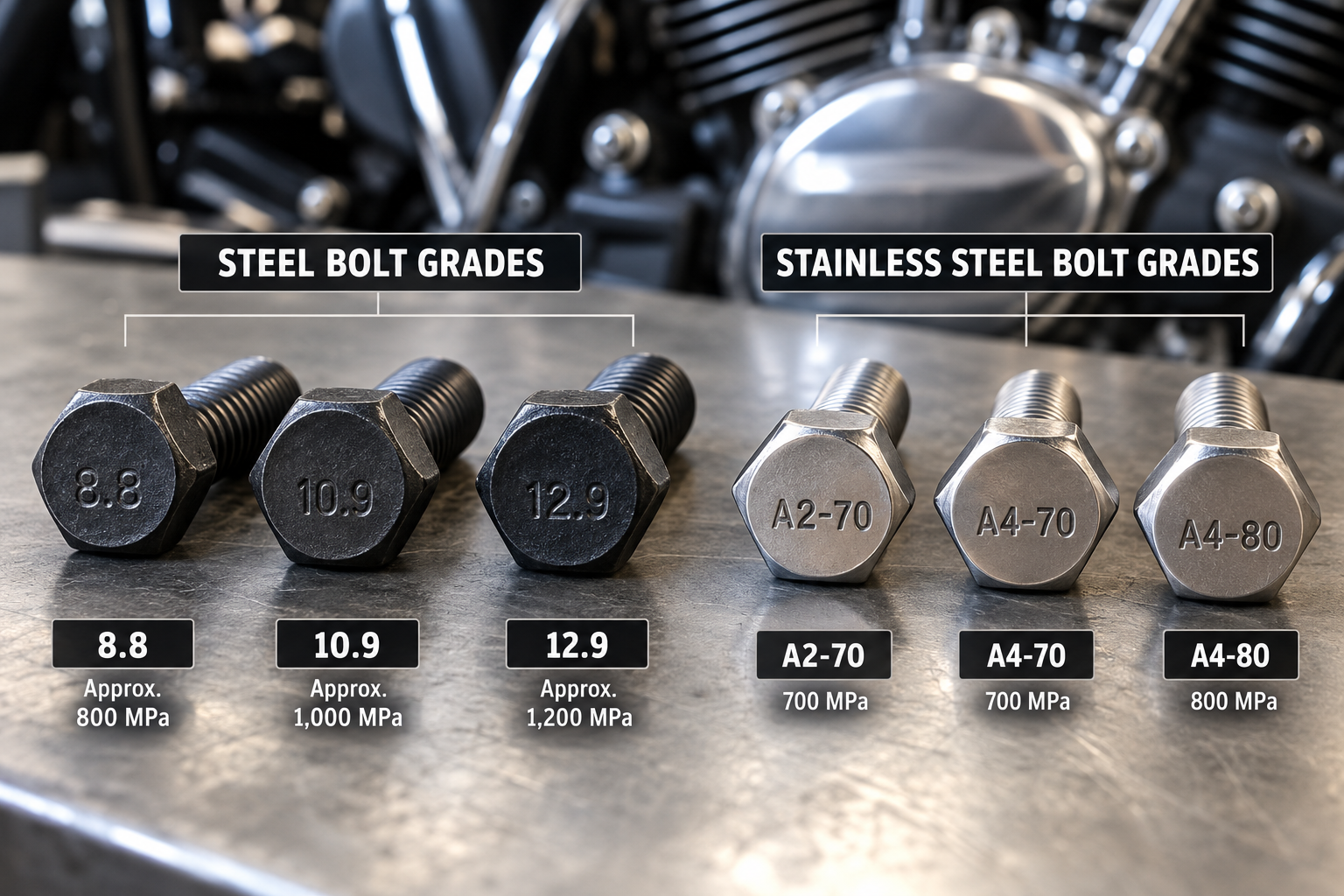
Motorcycle bolt strength grades help describe the mechanical properties a fastener has been manufactured to meet.
Common metric steel bolt markings include 8.8, 10.9 and 12.9, while stainless steel fasteners may carry markings such as A2-70 or A4-80.
These markings are important because two motorcycle bolts can have the same diameter, thread pitch and length while having very different mechanical properties.
The correct replacement therefore needs to match more than the physical dimensions of the original fastener.
Where the motorcycle manufacturer specifies a particular strength or property class, that requirement should take priority.
Motorcycle Bolt Strength Grades: The Short Answer
Common metric steel property classes include:
- 8.8 — high-strength general engineering fastener class.
- 10.9 — higher-strength fastener class.
- 12.9 — very high-strength fastener class used where the application requires it.
Stainless fasteners use a different marking system.
Examples include:
- A2-70
- A2-80
- A4-70
- A4-80
The two systems should not be treated as directly interchangeable.
A stainless steel bolt should not automatically replace an 8.8, 10.9 or 12.9 steel bolt simply because its dimensions match.
If you are selecting a replacement fastener, see our How to Choose the Correct Replacement Motorcycle Bolt guide.
Why Motorcycle Bolt Strength Grades Matter
A motorcycle fastener can be exposed to:
- Tensile loading.
- Clamp load.
- Shear loading.
- Vibration.
- Repeated loading.
- Heat.
- Corrosion.
- Combined loading from the surrounding assembly.
Different mounting points therefore place different demands on their fasteners.
For example, a visible bodywork bolt and a highly loaded suspension fastener may both use an M8 thread, but that does not mean they require the same mechanical properties.
This is why the manufacturer’s specified property class or fastener specification can be just as important as:
- Diameter.
- Thread pitch.
- Length.
- Head type.
- Shoulder dimensions.
Our How to Measure Motorcycle Bolts guide explains how to establish the dimensional side of the specification.
What Do 8.8, 10.9 & 12.9 Mean?
Metric carbon and alloy-steel fasteners commonly use a property-class marking made from two numbers separated by a decimal point.
Examples include:
8.8
10.9
12.9
The first number relates to the fastener’s nominal tensile-strength level.
The second number relates to the ratio between nominal yield strength and nominal tensile strength.
In simplified terms:
- 8.8 corresponds to a nominal tensile-strength level of about 800 MPa.
- 10.9 corresponds to about 1000 MPa.
- 12.9 corresponds to about 1200 MPa.
The second number gives the nominal yield-strength ratio.
This produces nominal values of approximately:
| Property Class | Nominal Tensile Strength | Nominal Yield Strength |
|---|---|---|
| 8.8 | 800 MPa | 640 MPa |
| 10.9 | 1000 MPa | 900 MPa |
| 12.9 | 1200 MPa | 1080 MPa |
These figures are useful for understanding the property-class system, but they should not be used as a substitute for the applicable fastener standard, manufacturer data or motorcycle specification.
Actual specified minimum mechanical properties can depend on factors including fastener diameter and the relevant standard.
What Is Tensile Strength?
Tensile strength describes the maximum tensile stress a material or fastener can withstand before fracture under a tensile test.
In simple terms, it relates to how much pulling stress the fastener can withstand before it breaks.
It is normally expressed in:
MPa — megapascals
However, tensile strength alone does not tell you whether a particular bolt is suitable for a motorcycle application.
The joint design, fastener dimensions, thread engagement, loading, material, tightening procedure and other factors also matter.
What Is Yield Strength?
Yield strength relates to the stress level at which permanent deformation begins.
Below this point, the fastener is intended to behave elastically within the limits of the specification.
If the fastener is loaded beyond its yield behaviour, it may become permanently stretched or deformed.
This distinction is important because a bolt does not need to snap to become unsuitable for continued service.
A fastener that has permanently stretched may no longer behave as intended.
For signs that a motorcycle bolt may require replacement, see When Should Motorcycle Bolts Be Replaced?.
What Is Proof Load?
Proof load is another important fastener term.
A proof-load test applies a specified tensile load to the fastener without causing unacceptable permanent deformation.
It provides a practical way of verifying that the bolt meets the mechanical requirements of its property class.
Proof load is not the same thing as:
- Tightening torque.
- Clamp load.
- Tensile strength.
- Yield strength.
These terms are related to fastener behaviour but describe different things.
What Does an 8.8 Bolt Mean?
An 8.8 bolt is a metric steel fastener manufactured to meet the mechanical requirements of property class 8.8.
The designation corresponds broadly to:
- Nominal tensile strength: approximately 800 MPa.
- Nominal yield-strength level: approximately 640 MPa.
Class 8.8 fasteners are widely used in engineering and vehicle applications.
That does not mean every motorcycle mounting point using an M6, M8 or M10 fastener requires an 8.8 bolt.
Likewise, it does not mean an 8.8 fastener can automatically replace any bolt of the same size.
The motorcycle manufacturer’s specification for the particular mounting point remains the important reference.
What Does a 10.9 Bolt Mean?
A 10.9 bolt is a higher-strength metric steel fastener.
Its property-class designation corresponds broadly to:
- Nominal tensile strength: approximately 1000 MPa.
- Nominal yield-strength level: approximately 900 MPa.
Motorcycle manufacturers may use fasteners of this type in applications where greater mechanical strength is required.
If an original bolt is marked 10.9, do not replace it with an ordinary stainless fastener simply because the replacement has the same:
- Diameter.
- Pitch.
- Length.
- Head size.
The mechanical specification also needs to be considered.
What Does a 12.9 Bolt Mean?
A 12.9 fastener is a very high-strength metric steel bolt.
Its property class corresponds broadly to:
- Nominal tensile strength: approximately 1200 MPa.
- Nominal yield-strength level: approximately 1080 MPa.
Fasteners of this class may be used where the design requires very high mechanical strength.
A 12.9 bolt should not be replaced with a lower-strength bolt without confirming that the substitution is appropriate for that exact application.
Is a Higher Bolt Grade Always Better?
No.
A higher property class is not automatically a better choice for every motorcycle mounting point.
The correct fastener is the one that meets the requirements of the joint.
Changing to a higher-strength fastener can alter characteristics including:
- Ductility.
- Tightening behaviour.
- Surface treatment.
- Compatibility with the component.
- Failure behaviour.
The motorcycle manufacturer may have selected a particular fastener specification for reasons beyond maximum tensile strength.
The correct approach is therefore:
Use the required property class rather than assuming that a higher number is automatically an upgrade.
Motorcycle Bolt Strength Grades & Stainless Steel
Stainless steel fasteners normally use a different designation system from carbon and alloy-steel bolts.
A marking such as:
A2-70
contains information about both the stainless material family and the fastener property class.
In simplified terms:
- A2 identifies an austenitic stainless family generally associated with 304-type stainless steel.
- 70 identifies the strength class.
Likewise:
A4-70
uses:
- A4 for an austenitic stainless family generally associated with 316-type stainless steel.
- 70 for the strength class.
For more information about the material side of these markings, see Motorcycle Bolt Materials Explained.
What Does A2-70 Mean?
A2-70 is a common stainless steel fastener designation.
In this marking:
A2 refers to the stainless material family.
70 identifies the strength class.
Within the relevant stainless-fastener standard and applicable size range, class 70 corresponds to a minimum tensile-strength level of approximately:
700 MPa
That does not mean an A2-70 fastener is directly equivalent to an 8.8 steel bolt.
The two designations come from different fastener classification systems and have different mechanical-property requirements.
What Does A2-80 Mean?
A2-80 uses the same A2 stainless material-family designation but a higher strength class.
Class 80 corresponds to a minimum tensile-strength level of approximately:
800 MPa
within the relevant standard and applicable size range.
However, this does not make A2-80 automatically equivalent to property class 8.8 steel.
The tensile-strength figure is only one part of the mechanical specification.
Proof stress, yield behaviour, ductility, material type and the complete fastener standard also matter.
What Does A4-70 Mean?
A4-70 identifies:
- A4-family austenitic stainless steel.
- Property class 70.
A4 is generally associated with the 316 family of stainless steels.
The class 70 designation corresponds to a minimum tensile-strength level of approximately 700 MPa within the applicable fastener standard and size range.
A4 stainless can provide improved resistance to localised and chloride-related corrosion compared with A2/304-family stainless.
That improved corrosion resistance does not automatically mean the fastener is mechanically stronger.
What Does A4-80 Mean?
A4-80 combines:
- A4-family stainless material.
- Strength class 80.
Class 80 corresponds to a minimum tensile-strength level of approximately 800 MPa within the applicable standard and size range.
Again, the material family and mechanical property class need to be considered separately.
A4-80 is not simply a “stronger version” of every other stainless or steel fastener for every application.
Stainless Strength Classes Compared
A simplified comparison is:
| Stainless Marking | Material Family | Approx. Minimum Tensile Strength Level* |
|---|---|---|
| A2-50 | A2 / 304-family | 500 MPa |
| A2-70 | A2 / 304-family | 700 MPa |
| A2-80 | A2 / 304-family | 800 MPa |
| A4-50 | A4 / 316-family | 500 MPa |
| A4-70 | A4 / 316-family | 700 MPa |
| A4-80 | A4 / 316-family | 800 MPa |
*These figures describe the general strength-class system. Applicable standards, diameter ranges and product specifications should be checked when exact mechanical requirements matter.
Is A2-70 the Same as 8.8?
No.
This is one of the most important points in this guide.
A2-70 stainless steel and property class 8.8 steel are classified using different systems.
An 8.8 steel bolt has a nominal tensile-strength level of around 800 MPa and a nominal yield-strength level around 640 MPa.
An A2-70 stainless fastener has a class designation corresponding to approximately 700 MPa minimum tensile strength within its applicable standard and size range.
Their material, proof/yield behaviour, ductility and corrosion properties also differ.
Therefore:
A2-70 should not automatically be used as a direct replacement for an 8.8 steel fastener.
The correct choice depends on the requirements of the actual motorcycle application.
Is A2-80 the Same as 8.8?
Not automatically.
Although the tensile-strength figures may appear closer, the classifications are still based on different standards and material systems.
Similar tensile-strength numbers do not prove equivalence.
A suitable replacement must satisfy the required overall fastener specification.
Strength Grade Is Not a Torque Setting
A property class such as 8.8, 10.9 or 12.9 does not tell you the correct tightening torque for every bolt carrying that marking.
Torque requirements also depend on:
- Thread diameter.
- Thread pitch.
- Joint design.
- Thread condition.
- Lubrication.
- Coatings.
- Washers.
- Material of the threaded component.
- Manufacturer requirements.
- Whether threadlocker is specified.
Do not use a generic torque chart simply because you know the bolt’s property class if the motorcycle manufacturer provides a specific procedure.
For more information, see our Stainless Steel Motorcycle Bolt Torque, Anti-Seize & Galling Guide.
Lubrication Can Change the Torque-to-Clamp Relationship
Applying oil, grease, anti-seize or another thread treatment changes friction in the threaded joint.
This can change the clamp load produced by a given torque.
For that reason, a torque value specified for dry threads should not automatically be used unchanged on lubricated threads.
Likewise, there is no universal percentage by which every motorcycle torque value should be reduced after applying anti-seize.
Follow the motorcycle manufacturer’s specified thread condition and tightening procedure.
Our Threadlocker vs Anti-Seize on Motorcycle Bolts guide explains these products in more detail.
Can Stainless Steel Replace High-Tensile Motorcycle Bolts?
Sometimes a stainless fastener may be suitable for a particular application, but it should never be assumed solely from matching dimensions.
Do not replace a manufacturer-specified high-strength or special-purpose fastener with a standard stainless steel bolt unless the replacement has been confirmed as suitable.
Particular caution is required around certain:
- Brake caliper mounting bolts.
- Brake-disc or rotor bolts.
- Wheel and axle fasteners.
- Steering components.
- Suspension fasteners.
- Structural mountings.
- Engine internal fasteners.
- Other highly loaded or safety-critical fixings.
This does not mean stainless steel is automatically unsuitable anywhere near brakes, wheels or suspension.
The correct answer depends on the specification for the exact motorcycle and mounting position.
Corrosion Resistance Is Not Mechanical Strength
A common mistake is to assume that a more corrosion-resistant material is automatically a stronger or better fastener.
That is not correct.
For example:
- 316/A4 stainless generally offers improved resistance to chloride-related corrosion compared with 304/A2.
- That does not automatically make A4 mechanically stronger than A2.
- Stainless corrosion resistance does not prove suitability for replacing a high-strength steel fastener.
Material and mechanical property class are separate parts of the specification.
For a fuller comparison, see Motorcycle Bolt Materials Explained.
Bolt Head Markings Can Help Identify Strength
Many metric steel bolts have property-class markings stamped or formed into the head.
You may see markings such as:
- 8.8.
- 10.9.
- 12.9.
Stainless fasteners may carry markings such as:
- A2-70.
- A4-70.
- A2-80.
- A4-80.
However, not every motorcycle fastener will have an easily readable marking.
Small bolts, specialised OEM fasteners and unusual designs may not provide enough information from the head alone.
Where the specification is uncertain, use the motorcycle manufacturer’s documentation, OEM part information or another reliable source rather than guessing.
Do Not Identify Strength From Appearance Alone
A shiny bolt is not necessarily stainless steel.
A dark bolt is not necessarily 12.9.
A zinc-plated bolt can still be high strength.
Two visually identical fasteners can have very different mechanical properties.
Appearance alone should therefore never be used to determine the strength grade of an important motorcycle fastener.
Special OEM Fasteners May Need More Than a Grade Match
Even matching the original property class does not necessarily prove that a replacement is correct.
OEM motorcycle bolts can also include:
- Special shoulders.
- Reduced shanks.
- Flanges.
- Captive washers.
- Special head dimensions.
- Unusual thread lengths.
- Specific surface coatings.
- Pre-applied locking compounds.
- Application-specific geometry.
The replacement needs to meet all relevant requirements, not simply carry the same number on its head.
Our Motorcycle Shoulder Bolts Explained guide explains one common example of geometry that can matter.
Motorcycle Bolt Strength Grades & Aluminium Threads
The strongest available bolt is not automatically the safest choice when it threads into a softer component.
Many motorcycle fasteners screw into aluminium castings or brackets.
The strength of the male bolt is only one part of the joint.
The female thread, thread engagement, component material and tightening procedure also matter.
Overtightening a high-strength bolt can still strip an aluminium thread.
For more information, read Motorcycle Bolts Into Aluminium: How to Avoid Damaged & Stripped Threads.
What Strength Grade Should a Motorcycle Bolt Be?
There is no single strength grade that applies to all motorcycle bolts.
The required specification depends on the component and joint design.
A motorcycle can contain a mixture of:
- Standard steel fasteners.
- Higher-strength steel fasteners.
- Stainless fasteners in suitable locations.
- Special-purpose OEM bolts.
- Single-use fasteners.
- Fasteners with application-specific geometry.
The correct specification should come from the motorcycle manufacturer’s information or another reliable source for the particular fixing.
If you cannot identify the required property class for a safety-critical application, do not guess.
Should You Upgrade From 8.8 to 10.9 or 12.9?
Not simply because the number is higher.
A motorcycle joint is designed as a complete system.
Using a higher property class than specified does not automatically improve the joint.
Different fastener classes can have different mechanical behaviour, and the surrounding component may have been designed around the original fastener.
Unless there is reliable engineering or manufacturer information supporting the change, use the specified fastener class.
What If the Original Bolt Has No Grade Marking?
First establish whether the fastener is:
- An original OEM bolt.
- A replacement fitted previously.
- A special-purpose fastener.
- A stainless fastener.
- A standard metric steel bolt.
Useful information can come from:
- The workshop manual.
- OEM parts catalogue.
- OEM part number.
- Manufacturer technical information.
- A known original fastener from the same application.
Do not assume an unmarked bolt is low strength.
Likewise, do not assume that replacing it with a visibly marked high-strength bolt is automatically correct.
Motorcycle Bolt Strength Grades: Quick Comparison
| Marking | General Type | Strength Level |
|---|---|---|
| 8.8 | Carbon/alloy steel | High strength |
| 10.9 | Carbon/alloy steel | Higher strength |
| 12.9 | Alloy steel | Very high strength |
| A2-70 | 304-family stainless | Class 70 stainless |
| A2-80 | 304-family stainless | Class 80 stainless |
| A4-70 | 316-family stainless | Class 70 stainless |
| A4-80 | 316-family stainless | Class 80 stainless |
This table is a general reference only.
It does not mean the entries are directly interchangeable with one another.
Choosing a Replacement Motorcycle Bolt
Before selecting a replacement, check:
- Thread diameter.
- Thread pitch.
- Bolt length.
- Threaded length.
- Head type.
- Shoulder dimensions.
- Property class or strength requirement.
- Material.
- Washers, collars and spacers.
- OEM part number where available.
- Intended motorcycle application.
The strength marking is one part of the specification, not the whole specification.
For the full process, see How to Choose the Correct Replacement Motorcycle Bolt.
Fitting High-Strength & Stainless Motorcycle Bolts
Once the correct fastener has been identified, follow the motorcycle manufacturer’s installation requirements.
Do not assume that two bolts of the same size should use the same torque.
Do not assume that anti-seize, oil or threadlocker should be applied unless the application calls for it.
Start the bolt correctly, make sure the threads are undamaged and use the specified tightening method.
For practical fitting guidance, see How to Fit Stainless Steel Motorcycle Bolts: Step-by-Step Guide.
The Simple Rule
The most important principle is:
Do not choose a motorcycle fastener from size alone.
A suitable bolt needs the correct combination of:
Dimensions + geometry + material + strength/property class + application
If the motorcycle manufacturer specifies a particular 8.8, 10.9, 12.9 or special-purpose fastener, do not substitute a different type unless its suitability has been properly established.
More Biker Bling Motorcycle Fastener Guides
This motorcycle bolt strength grades guide forms part of the Biker Bling technical information library.
For guides covering materials, bolt measurement, thread pitch, replacement selection, torque, shoulder bolts and installation, visit our Motorcycle Fastener Guides & Technical Information Hub.
You can also use our Motorcycle Fastener Glossary for explanations of fastener terminology such as tensile strength, property class, proof load and preload.
Find Motorcycle Fasteners & Bolt Kits
Browse the Biker Bling range of 304 stainless steel motorcycle fasteners and model-specific bolt kits.
Always check each product listing for the intended motorcycle fitment, hardware supplied and application.
Do not use a stainless replacement in place of a manufacturer-specified high-strength or special-purpose fastener unless suitability has been established.
Shop Biker Bling Motorcycle Fasteners →
Technical information prepared and reviewed by Biker Bling Limited. Learn how we research, measure and verify motorcycle fasteners.
Technical Information Disclaimer
The information on this page is provided as general educational guidance about motorcycle bolt strength grades and fastener property classes.
It does not provide model-specific fastener specifications and is not intended to replace the motorcycle manufacturer’s workshop manual, parts information, component manufacturer’s instructions, applicable fastener standards or advice from a suitably qualified motorcycle technician.
Fasteners of the same physical dimensions can differ significantly in material, strength, property class, geometry, surface treatment and intended function.
Always confirm that a replacement fastener is suitable for the particular motorcycle and mounting position before installation.
Where the motorcycle or component manufacturer specifies a particular fastener type, material, strength, property class, locking method, thread treatment or installation procedure, follow those requirements.
Particular care should be taken with braking, steering, wheels, suspension, structural mountings and other safety-critical components.
If you cannot establish the required fastener specification or suitability of a replacement, use the manufacturer-specified fastener or obtain appropriate technical advice.
Nothing on this page is intended to affect your statutory rights or to exclude or restrict any responsibility that cannot lawfully be excluded or restricted.