
304 Stainless Steel Motorcycle Bolts: Corrosion Resistance, Cleaning & Care
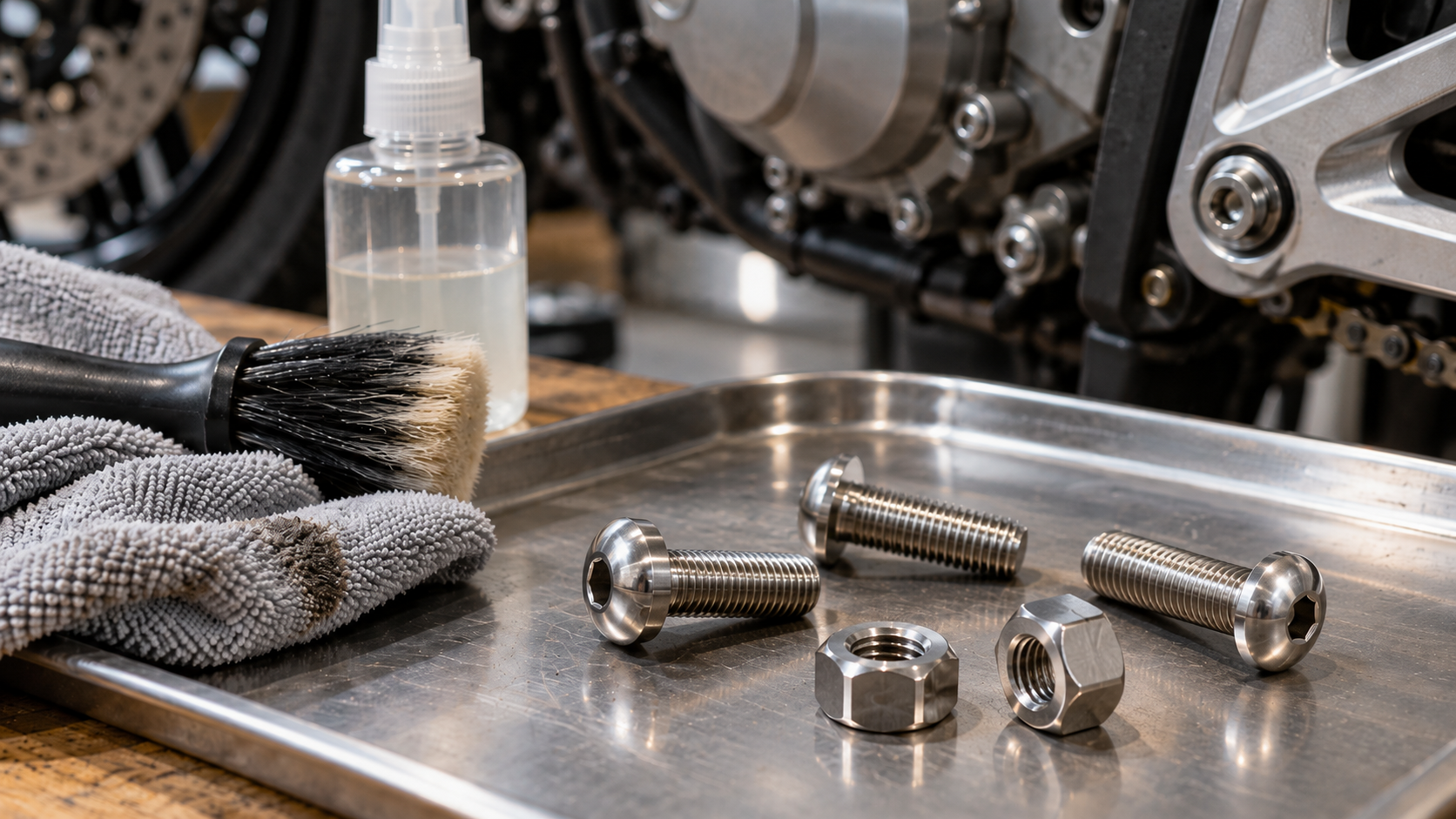
304 stainless steel motorcycle bolts are widely used where good corrosion resistance, a clean appearance and suitable mechanical properties are required.
However, stainless steel is corrosion resistant rather than completely corrosion-proof.
Road salt, chloride contamination, trapped moisture, dirt, iron contamination and poor cleaning can all affect the appearance and condition of stainless steel over time.
Regular cleaning and sensible maintenance can help 304 stainless steel motorcycle bolts retain their appearance and reduce avoidable surface staining.
304 Stainless Steel Motorcycle Bolts: The Short Answer
304 stainless steel offers good general corrosion resistance for many suitable motorcycle fastener applications.
To look after it:
- Remove road salt and heavy contamination promptly.
- Wash with clean water and a mild suitable detergent.
- Use a soft cloth, sponge or non-aggressive brush.
- Rinse thoroughly.
- Dry the area where practical.
- Avoid contaminating stainless steel with ordinary carbon-steel brushes or steel wool.
- Use cleaning chemicals only when they are suitable for stainless steel and the surrounding motorcycle components.
- Inspect fasteners periodically for staining, pitting, thread damage or other deterioration.
304 stainless should not be described as completely rust-proof or maintenance-free.
It also should not automatically replace every original motorcycle fastener simply because of its corrosion resistance.
For information about where different fastener materials may be appropriate, see Motorcycle Bolt Materials Explained.
What Is 304 Stainless Steel?
304 is a widely used austenitic stainless steel.
Its chromium content allows a thin protective oxide film to form naturally on the surface.
This passive layer is one of the main reasons stainless steel resists corrosion significantly better than ordinary unprotected carbon steel in many environments.
For fasteners, you may also see the designation A2.
A2 fasteners are generally associated with the 304 family of stainless steels.
However, the exact material designation and the fastener’s mechanical property class are separate parts of its specification.
For example:
A2-70
contains:
- A2 — the stainless material family.
- 70 — the fastener property class.
For more information about these markings, see Motorcycle Bolt Strength Grades Explained.
Is 304 Stainless Steel Rust-Proof?
No.
304 stainless steel is corrosion resistant, but it is not immune to corrosion, staining or surface contamination.
Under favourable conditions it can retain its appearance for a long time.
However, aggressive environments can still affect it.
Examples include:
- Road salt.
- Chloride-rich water.
- Coastal environments.
- Trapped moisture.
- Dirt and road grime.
- Long periods without cleaning.
- Contact with contaminated tools or abrasives.
- Crevices where salts and moisture remain trapped.
This is why phrases such as “rust-proof” or “will never corrode” are not technically appropriate for 304 stainless steel.
Why Does Stainless Steel Resist Corrosion?
Stainless steel contains sufficient chromium to form a very thin protective oxide layer on its surface.
This is usually referred to as the passive layer.
Unlike a coating that has simply been painted or plated onto the metal, this protective film develops naturally from the stainless material itself.
If the surface is kept in suitable conditions, the passive film can reform after minor surface disturbance in the presence of oxygen.
However, the passive layer can still be challenged by aggressive environments, particularly where contamination, chloride salts and moisture remain trapped against the surface.
Why Can 304 Stainless Steel Still Develop Brown Marks?
Brown or orange staining on stainless steel does not always mean the fastener itself has suffered serious structural corrosion.
Surface staining can sometimes come from contamination.
For example, small particles of ordinary carbon steel or iron can become embedded on the stainless surface.
Those particles can rust and create brown staining even though the underlying stainless steel remains largely unaffected.
Possible sources of iron contamination include:
- Carbon-steel wire brushes.
- Steel wool.
- Grinding debris.
- Metal workshop dust.
- Tools previously used aggressively on ordinary steel.
- Contaminated polishing equipment.
For this reason, avoid using ordinary carbon-steel abrasives to clean stainless motorcycle fasteners.
Road Salt & 304 Stainless Steel Motorcycle Bolts
Road salt creates a more aggressive environment for stainless steel.
Chloride salts can remain on motorcycle fasteners after winter riding or wet-road use.
If they are left in place, especially in damp crevices, they can increase the risk of:
- Surface staining.
- Localised corrosion.
- Pitting.
- Crevice corrosion.
Motorcycles used throughout winter therefore benefit from more frequent cleaning.
After riding on heavily salted roads, rinsing accumulated salt away rather than allowing it to remain on the bike for long periods is sensible maintenance.
Pay particular attention to areas where salt can collect around:
- Bolt heads.
- Washers.
- Fairing fixings.
- Engine covers.
- Brackets.
- Recessed fasteners.
- Mudguards.
- Underside components.
What Is Pitting Corrosion?
Pitting is a localised form of corrosion that creates small cavities or pits in a metal surface.
Rather than attacking the entire fastener evenly, corrosion becomes concentrated in particular spots.
Chloride exposure can increase the risk of pitting in stainless steels.
A fastener showing deep or significant pitting should be inspected carefully.
If the corrosion has materially damaged the fastener, threads, shoulder, head or another important feature, replacement may be appropriate.
Our guide When Should Motorcycle Bolts Be Replaced? explains other signs that a fastener may no longer be suitable for continued use.
What Is Crevice Corrosion?
Crevice corrosion can occur where moisture and contaminants remain trapped in a narrow gap.
On a motorcycle, possible crevice areas can include:
- Beneath washers.
- Under bolt heads.
- Between overlapping components.
- Around collars or spacers.
- Under dirt deposits.
- Between a fastener and surrounding hardware.
These areas may retain salt and moisture even after the exposed surfaces appear dry.
This is one reason simply polishing the visible bolt head does not necessarily count as complete maintenance.
Keeping the surrounding assembly reasonably clean can also matter.
What Is Tea Staining?
The term tea staining is commonly used to describe brown surface discolouration that can develop on stainless steel exposed to aggressive atmospheric conditions.
It is generally an appearance issue rather than automatically evidence that a fastener is about to fail.
However, visible staining should still be investigated rather than ignored.
Clean the area and inspect the surface.
If staining returns rapidly or the metal shows actual pitting, cracking, severe corrosion or damaged threads, the fastener may require closer inspection or replacement.
How to Clean 304 Stainless Steel Motorcycle Bolts
For routine cleaning, begin with the least aggressive method.
A sensible general process is:
- Allow hot components to cool.
- Remove loose dirt and road contamination.
- Wash with clean water and a mild suitable detergent.
- Use a soft cloth, sponge or non-aggressive brush where needed.
- Rinse away the cleaning product thoroughly.
- Dry the area where practical.
- Inspect the fasteners once clean.
Always consider surrounding materials such as:
- Paint.
- Anodised aluminium.
- Plastic.
- Rubber.
- Brake components.
- Polished finishes.
A product that is acceptable on bare stainless steel may not necessarily be appropriate for every material around it.
Follow the cleaning-product manufacturer’s instructions.
Cleaning Light Surface Marks
If normal washing does not remove a light surface mark, use a cleaning product specifically suitable for stainless steel and compatible with the surrounding motorcycle finish.
Start gently.
Do not immediately reach for aggressive abrasives.
A harsh abrasive may:
- Scratch polished surfaces.
- Change the surface finish.
- Damage surrounding paint or coatings.
- Embed contaminants.
- Make the fastener harder to keep looking clean.
Test unfamiliar products on an inconspicuous area where practical.
Avoid Carbon-Steel Wire Brushes & Steel Wool
Ordinary carbon-steel wire brushes and steel wool should generally be avoided on stainless fasteners.
They can leave iron particles on the stainless surface.
Those particles may subsequently corrode and create rust-coloured marks.
If mechanical cleaning is genuinely required, use tools specifically suitable for stainless steel and keep them free from carbon-steel contamination.
For most routine motorcycle cleaning, a non-aggressive cloth or brush should be sufficient.
Be Careful With Strong Cleaning Chemicals
Do not assume that a stronger cleaner is automatically better.
Aggressive chemicals can damage:
- Stainless surfaces.
- Aluminium.
- Paint.
- Plating.
- Anodising.
- Rubber.
- Plastic.
- Other motorcycle finishes.
Chlorine-containing or chloride-rich cleaning products can also be undesirable around stainless steel.
Use products according to their instructions and confirm that they are suitable for both the fastener and the surrounding components.
If in doubt, use a milder cleaning method.
Can You Polish 304 Stainless Steel Motorcycle Bolts?
Yes, suitable stainless fasteners can be polished for appearance.
However, polishing should not be used to disguise significant deterioration.
Before polishing a fastener, inspect it for:
- Damaged threads.
- Deep pitting.
- Cracks.
- Distortion.
- Rounded drive surfaces.
- Damaged shoulders.
- Severe corrosion.
A mechanically damaged fastener should not simply be polished and returned to service because it looks better afterwards.
How Often Should 304 Stainless Steel Motorcycle Bolts Be Cleaned?
There is no single cleaning interval suitable for every motorcycle.
Cleaning frequency depends on how and where the motorcycle is used.
A motorcycle ridden only occasionally in dry conditions may require relatively little attention.
A motorcycle regularly exposed to:
- Winter roads.
- Road salt.
- Coastal air.
- Frequent rain.
- Mud.
- Road spray.
may benefit from much more frequent cleaning.
The useful rule is to avoid allowing aggressive contamination to remain on the fasteners unnecessarily.
Should Road Salt Be Washed Off Immediately?
You do not need to treat every ride as an emergency, but salt should not be left on the motorcycle indefinitely.
Where a motorcycle has been used on heavily salted roads, removing the salt reasonably promptly can reduce the time the stainless steel and other motorcycle materials remain exposed to concentrated chlorides.
A gentle rinse followed by normal motorcycle cleaning can be useful.
Take appropriate care around hot components, electrical systems, bearings, brakes and other areas where careless pressure washing or chemical use could cause problems.
Pressure Washing Around Motorcycle Fasteners
Pressure washers can remove heavy contamination, but high-pressure water should be used with care on motorcycles.
Avoid forcing water directly into sensitive areas such as:
- Electrical connectors.
- Bearings.
- Seals.
- Instruments.
- Air intakes.
- Other components not designed for concentrated high-pressure water.
Cleaning stainless fasteners does not require extremely high water pressure.
Normal rinsing and sensible manual cleaning are often sufficient.
Can 304 Stainless Steel Corrode Against Aluminium?
Stainless steel and aluminium are dissimilar metals.
Where dissimilar metals are electrically connected and exposed to a suitable electrolyte, such as salty water, galvanic corrosion can become a consideration.
The actual behaviour depends on factors including:
- Materials involved.
- Joint design.
- Surface-area relationship.
- Coatings and finishes.
- Moisture.
- Salt exposure.
- Maintenance.
This does not mean 304 stainless steel cannot be used with aluminium.
It does mean the original motorcycle design, material specification and environmental exposure should be considered.
For more detailed information, see Motorcycle Bolts Into Aluminium: How to Avoid Damaged & Stripped Threads.
Should Anti-Seize Be Used to Prevent Corrosion?
Not automatically.
Anti-seize can be useful in some fastener applications, but it should not be treated as a universal corrosion treatment for every stainless motorcycle bolt.
Anti-seize changes friction within the threaded joint.
That can affect the relationship between tightening torque and the clamp load produced.
Whether it should be used depends on the particular fastener and the motorcycle manufacturer’s instructions.
Our Stainless Steel Motorcycle Bolt Torque, Anti-Seize & Galling Guide explains this in more detail.
Also see Threadlocker vs Anti-Seize on Motorcycle Bolts for the different purposes of these products.
304 Stainless Steel & Thread Galling
Stainless steel threads can be susceptible to galling.
Galling is different from ordinary corrosion.
It involves adhesion and material transfer between contacting thread surfaces and can result in the threads binding or seizing.
Factors that may contribute include:
- Damaged threads.
- Contamination.
- Misalignment.
- High installation speed.
- Friction.
- Surface condition.
A stainless bolt that begins to bind unexpectedly should not simply be forced tighter.
Stop and investigate the cause.
For fitting guidance, read How to Fit Stainless Steel Motorcycle Bolts: Step-by-Step Guide.
Do Stainless Steel Bolts Need Grease?
There is no universal answer.
The correct thread condition may be:
- Dry.
- Lubricated.
- Treated with anti-seize.
- Treated with threadlocker.
- Prepared in another manufacturer-specified way.
Do not apply grease to every motorcycle fastener as a routine rule.
Grease changes thread friction and can affect tightening behaviour.
Follow the motorcycle manufacturer or component manufacturer’s installation procedure where one is provided.
304 Stainless Steel vs 316 Stainless Steel Corrosion Resistance
304 and 316 are both austenitic stainless-steel families.
One important difference is that 316 contains molybdenum, which generally improves resistance to localised corrosion in chloride-containing environments.
For fasteners:
- A2 is generally associated with the 304 family.
- A4 is generally associated with the 316 family.
This is why A4/316 is commonly selected for more aggressive chloride environments and is often associated with the term marine grade.
A2/304 should not normally be described as marine grade.
However, 316 is not automatically stronger than 304.
Corrosion resistance and mechanical strength are separate properties.
Our Motorcycle Bolt Materials Explained guide compares 304, 316, titanium and high-tensile steel in more detail.
Does 316 Stainless Mean No Maintenance Is Needed?
No.
316/A4 generally provides improved chloride resistance compared with 304/A2, but it is still not immune to every form of corrosion or contamination.
Salt, deposits, trapped moisture and harsh environments can still affect stainless steel.
Good cleaning and inspection remain useful regardless of which stainless family is used.
What If a Stainless Bolt Has Surface Rust?
First clean and inspect it.
A small rust-coloured mark may come from external iron contamination rather than significant corrosion of the stainless fastener itself.
After cleaning, look for:
- Surface staining only.
- Actual pits in the stainless.
- Damaged threads.
- Cracking.
- Distortion.
- Material loss.
- Damage to the drive or head.
- Corrosion hidden beneath washers or collars.
If the issue appears to be superficial contamination and the fastener is otherwise sound, cleaning may be sufficient.
If there is significant deterioration, replace the fastener with one confirmed as suitable for that application.
When Should a Corroded Stainless Bolt Be Replaced?
Replace or seek appropriate technical advice where corrosion or damage has affected an important part of the fastener.
Examples can include:
- Significant thread damage.
- Deep pitting.
- Cracking.
- Serious material loss.
- Damaged shoulders.
- Rounded or badly damaged drive surfaces.
- Distortion.
- Uncertainty about a safety-critical fastener.
The decision should consider both condition and application.
A cosmetic fairing bolt and a safety-critical fastener do not carry the same consequences if they fail.
See When Should Motorcycle Bolts Be Replaced? for a fuller inspection guide.
Cleaning Does Not Make the Wrong Bolt Suitable
Keeping a stainless fastener clean does not change its fundamental mechanical specification.
A beautifully maintained 304 stainless steel bolt is still not automatically a suitable replacement for an OEM fastener requiring a different:
- Property class.
- Material.
- Geometry.
- Shoulder.
- Head design.
- Special feature.
If the original motorcycle uses a high-strength or special-purpose fastener, corrosion resistance alone is not a reason to substitute it with standard 304 stainless steel.
Our Motorcycle Bolt Strength Grades Explained guide explains why material and strength classification need to be considered separately.
For replacement-fastener selection, see How to Choose the Correct Replacement Motorcycle Bolt.
Caring for 304 Stainless Steel Motorcycle Bolts in Winter
Winter use can expose motorcycles to particularly aggressive conditions.
A useful routine is to:
- Remove heavy road salt regularly.
- Wash away accumulated grime.
- Pay attention to recessed and sheltered fasteners.
- Rinse cleaning products away thoroughly.
- Inspect stainless surfaces for staining.
- Check surrounding aluminium and coated components.
- Investigate damaged or heavily corroded fasteners rather than simply polishing them.
The aim is not to keep every bolt permanently spotless.
It is to avoid allowing concentrated salt and contamination to remain undisturbed for long periods.
304 Stainless Steel Motorcycle Bolts: Simple Care Checklist
For routine maintenance:
- Rinse away salt and heavy contamination.
- Wash with a mild suitable cleaner.
- Use non-aggressive cleaning tools.
- Avoid carbon-steel brushes and steel wool.
- Rinse thoroughly.
- Dry where practical.
- Inspect for staining, pitting and damage.
- Investigate recurring corrosion rather than simply hiding it.
- Replace damaged fasteners with the correct specification.
- Follow the motorcycle manufacturer’s maintenance and installation requirements.
More Biker Bling Motorcycle Fastener Guides
This guide to 304 stainless steel motorcycle bolts forms part of the Biker Bling technical information library.
For guides covering bolt materials, strength grades, fitting, torque, galling, aluminium threads, replacement-fastener selection and other motorcycle hardware, visit our Motorcycle Fastener Guides & Technical Information Hub.
You can also use our Motorcycle Fastener Glossary for explanations of terms such as corrosion, galling, property class, shoulder bolt and thread pitch.
Find 304 Stainless Steel Motorcycle Bolt Kits
Biker Bling supplies 304 stainless steel motorcycle fasteners and model-specific bolt kits for a wide range of motorcycles and applications.
Browse the available 304 stainless steel motorcycle bolt kits by motorcycle make, model and year.
Shop Biker Bling Motorcycle Fasteners →
Always check the individual product listing for exact fitment, year coverage and the hardware supplied.
Technical information prepared and reviewed by Biker Bling Limited. Learn how we research, measure and verify motorcycle fasteners.
Technical Information Disclaimer
The information on this page is provided as general educational guidance about the cleaning, corrosion resistance and maintenance of 304 stainless steel motorcycle fasteners.
It does not provide model-specific fastener specifications or maintenance requirements and is not intended to replace the motorcycle manufacturer’s workshop manual, component manufacturer’s instructions, cleaning-product instructions or advice from a suitably qualified motorcycle technician.
Fastener condition, motorcycle materials, environmental exposure, previous maintenance and cleaning products can vary.
A fastener that is dimensionally correct and corrosion resistant may still be unsuitable for a particular application because of its material, property class, geometry or intended function.
Always confirm that a replacement fastener is suitable for the particular motorcycle and mounting position.
Where a fastener shows significant corrosion, pitting, cracking, thread damage or other deterioration, particularly in a safety-critical application, obtain appropriate technical advice before continued use.
Nothing on this page is intended to affect your statutory rights or to exclude or restrict any responsibility that cannot lawfully be excluded or restricted.