
Motorcycle Bolt Head Types: Allen, Hex, Torx, Button, Flange & Pan Head Guide
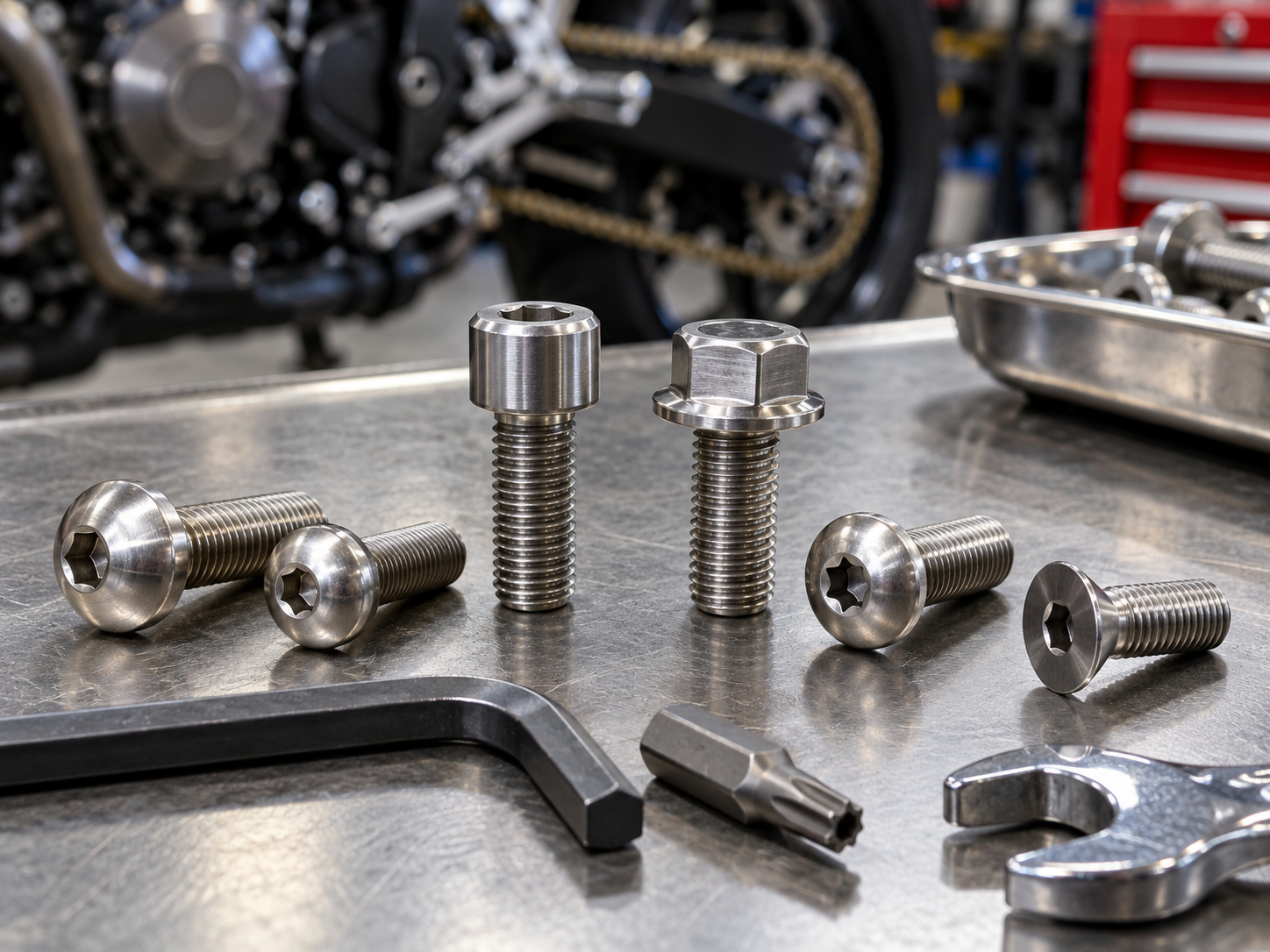
Motorcycle bolt head types vary considerably, and the shape of the head is only one part of identifying a fastener correctly.
Motorcycles can use socket-cap, button, hex, flange, pan-head and countersunk fasteners, together with different drive systems such as internal hex, Torx and external hex.
These terms are sometimes mixed together, but head type and drive type are not the same thing.
A replacement bolt therefore needs more than the correct diameter, thread pitch and length. Its head shape, dimensions, seating surface, drive and clearance can also matter.
Motorcycle Bolt Head Types: The Short Answer
Common motorcycle bolt head types include:
- Socket-cap head.
- Button head.
- External hex head.
- Flange head.
- Pan head.
- Countersunk head.
- Special or manufacturer-specific heads.
Common drive types include:
- Internal hex / Allen.
- Torx.
- External hex.
- Cross-recess drives.
- Other specialist drives.
The important distinction is:
The head is the physical shape of the top of the fastener. The drive is the feature the tool engages with.
For example, both a button-head bolt and a socket-cap bolt can use an internal hex drive.
Head Type vs Drive Type
This distinction is useful when identifying motorcycle fasteners.
A button head describes the rounded, low-profile shape of the head.
An Allen or internal hex drive describes the hexagonal recess used to turn it.
Likewise, a fastener may have a button-shaped head but use a Torx drive rather than an internal hex.
This means descriptions such as “Allen bolt” do not fully identify the fastener.
You may still need to establish:
- Head shape.
- Head diameter.
- Head height.
- Drive type.
- Drive size.
- Thread diameter.
- Thread pitch.
- Bolt length.
- Shoulder dimensions.
- Material and strength requirements.
If you need to identify the complete fastener, see How to Choose the Correct Replacement Motorcycle Bolt.
Why Motorcycle Bolt Head Types Matter
The bolt head is not always just an appearance feature.
Depending on the application, its shape and dimensions can affect:
- Clearance around surrounding components.
- Tool access.
- The area over which clamping load is applied.
- How the bolt seats against a washer or component.
- Whether the head sits proud or recessed.
- Compatibility with collars, spacers or captive washers.
- Bodywork appearance.
A replacement with the correct thread but the wrong head may therefore fit the threaded hole while still being unsuitable for the assembly.
Socket-Cap Motorcycle Bolts
A socket-cap bolt typically has a cylindrical head with an internal hex drive.
These are often referred to informally as:
- Cap screws.
- Socket-head bolts.
- Allen bolts.
The internal hex allows the bolt to be tightened from the top without requiring access around the outside of the head.
Socket-cap fasteners are available in many thread sizes, lengths, materials and strength classes.
Their relatively tall cylindrical head can provide good tool engagement, but the increased head height means they are not automatically suitable where the original fastener was low profile.
Before replacing another head style with a socket-cap bolt, check:
- Head height.
- Head diameter.
- Surrounding clearance.
- Seating surface.
- Strength specification.
- Intended application.
Button-Head Motorcycle Bolts
Button-head bolts have a low, rounded profile.
They are commonly seen on visible motorcycle components and bodywork because the smooth, shallow head can provide a neat appearance and useful clearance.
They are often supplied with an internal hex or Torx-style drive.
A button head can also offer a wider head diameter than some socket-cap designs of the same thread size.
However, a button-head bolt should not automatically replace another fastener simply because it looks suitable.
Check whether the original bolt requires a particular:
- Head diameter.
- Head height.
- Shoulder.
- Washer.
- Collar.
- Mechanical property class.
This is especially important with motorcycle fairings and other plastic components.
Our Motorcycle Fairing Fasteners Explained guide covers bodywork fasteners in more detail.
External Hex-Head Motorcycle Bolts
An external hex-head bolt is turned using a socket or spanner around the outside of the head.
This traditional design provides six external flats.
External hex fasteners are widely used throughout motorcycles and general engineering.
Depending on the application, they may be used with:
- Flat washers.
- Locking arrangements.
- Flanges.
- Spacers.
- Brackets.
- Nuts.
When identifying one, do not confuse the spanner size across the head with the thread diameter.
For example, the fact that a socket fits the head does not directly tell you whether the bolt is M6, M8, M10 or another thread size.
Measure the thread itself.
See How to Measure Motorcycle Bolts for the correct measuring process.
Motorcycle Flange Bolts
A flange bolt has an enlarged flange incorporated beneath the head.
The flange provides a larger bearing surface than the narrower underside of many conventional bolt heads.
Depending on the design, this may help distribute load or form part of the intended seating arrangement.
Some flanges are smooth.
Others may incorporate serrations or other features, although these should not be assumed to be interchangeable with a smooth OEM flange.
A flange is not automatically equivalent to fitting a separate washer.
The dimensions and design of the original fastener still matter.
When replacing a flange bolt, check:
- Flange diameter.
- Flange thickness.
- Head style.
- Bolt length.
- Thread.
- Material.
- Property class.
- The surface against which the flange seats.
Pan-Head Motorcycle Screws & Bolts
Pan-head fasteners have a relatively low, rounded top with a broad head.
They are commonly encountered in lighter-duty assemblies, bodywork and electrical or trim-related applications, although the exact use varies by motorcycle.
The drive may be:
- Internal hex.
- Torx.
- Cross-recess.
- Another design.
Pan-head fasteners can sometimes be confused visually with button-head fasteners.
The profiles differ, and head dimensions vary between manufacturers and standards.
Where head clearance or washer fit matters, compare actual dimensions rather than relying on the general name alone.
Countersunk Motorcycle Bolts
Countersunk fasteners have a tapered underside designed to seat into a matching countersunk recess.
When installed correctly, the top of the head may sit flush or close to flush with the surrounding surface.
This type of fastener is fundamentally different from a bolt with a flat bearing surface beneath its head.
A countersunk fastener should only be used where the mating component has the appropriate seating geometry.
Do not replace a conventional flat-bottomed head with a countersunk fastener simply because:
- The thread matches.
- The length appears similar.
- A flush appearance is preferred.
The seating surface and joint design must suit the fastener.
Countersunk bolts are also measured differently from most conventional bolts because the head normally forms part of their overall measured length.
Our How to Measure Motorcycle Bolts guide explains this distinction.
What Is an Allen Bolt?
“Allen bolt” is a commonly used informal description for a fastener with an internal hexagonal drive.
Technically, this tells you about the drive rather than the complete head type.
An internal hex drive can be found in fasteners such as:
- Socket-cap bolts.
- Button-head bolts.
- Countersunk bolts.
- Other specialist fasteners.
So if somebody describes a fastener simply as an “M6 Allen bolt”, more information may still be required.
You may need to know:
M6 thread + pitch + length + head style + head dimensions + drive size + material + strength + application
What Is a Torx Motorcycle Bolt?
A Torx drive uses a multi-lobed internal tool interface rather than the six straight sides of an internal hex.
Torx drives are used on many motorcycle and automotive fasteners.
They can appear in different head styles.
For example, a Torx-driven fastener might have a:
- Button-style head.
- Pan-style head.
- Countersunk head.
- Flanged head.
- Specialist OEM head.
Again, Torx describes the drive rather than the entire bolt design.
Use the correctly fitting tool when removing or installing one.
If the drive is already damaged or rounded, avoid repeatedly forcing a poorly fitting tool into it.
See How to Remove Seized, Stuck & Rounded Motorcycle Bolts if removal is becoming difficult.
Internal Hex vs Torx
Internal hex and Torx are different drive systems.
They require the appropriate matching tool.
Using an approximate or incorrect tool can damage the drive recess, particularly if the fastener is tight or corroded.
Before applying significant force:
- Clean the recess.
- Identify the drive correctly.
- Use the correct tool size.
- Fully seat the tool.
- Keep it aligned with the fastener.
Do not assume a Torx bit is suitable for removing a damaged internal hex fastener, or vice versa, unless you are deliberately using a recognised damaged-fastener extraction method and understand the risks involved.
Cross-Recess Motorcycle Screws
Motorcycles can also use cross-recess screws, particularly on smaller covers, clamps, electrical components and older assemblies.
Several cross-recess drive standards and profiles exist.
A tool that appears to fit may not engage correctly with every type.
Poor engagement can cause the drive to cam out and damage the screw head.
Use the correct tool specification where known and stop if the tool does not seat properly.
Why Head Diameter Matters
Two bolts with identical threads and lengths can have different head diameters.
That can affect how the fastener contacts the component.
A larger head may provide a larger bearing area.
A smaller head may provide better clearance.
The original design may also use a separate washer, collar or spacer to control how the load is transferred.
For this reason, simply choosing the widest available head is not automatically an improvement.
Match the requirements of the original assembly.
Our Motorcycle Washers, Spacers & Collars Explained guide explains how these associated components can affect the joint.
Why Head Height Matters
Head height can be important where clearance is restricted.
A taller replacement bolt head may interfere with:
- Fairings.
- Covers.
- Moving components.
- Cables or hoses.
- Rider controls.
- Adjacent brackets.
- Other fasteners.
A lower-profile head may solve a clearance problem only if the rest of the fastener specification is also suitable.
Do not change head type solely for clearance without checking the complete application.
Motorcycle Bolt Heads & Fairings
Fairing bolts often use low-profile heads for both appearance and clearance.
However, the visible bolt may work together with:
- A nylon washer.
- A metal washer.
- A collar.
- A rubber grommet.
- A well nut.
- A clip nut.
- A spacer.
Head diameter and seating arrangement can influence how the load reaches the plastic panel.
The bolt should secure the assembly without relying on excessive tightening force.
For more information, see:
Motorcycle Fairing Fasteners Explained
and
How to Fit Motorcycle Fairing Bolts Without Damaging Plastic Panels.
Shoulder Bolts Can Use Different Head Types
The presence of a shoulder is separate from the head design.
A motorcycle fastener can have an important smooth shoulder while also using a:
- Button head.
- Socket-cap head.
- Flange head.
- Other specialist head.
Do not focus only on the visible head.
The shoulder may be doing an important job inside the assembly.
See Motorcycle Shoulder Bolts Explained for more information.
Head Type Does Not Tell You the Thread Pitch
A button-head M6 fastener is not automatically M6 × 1.0.
Likewise, an M10 external hex bolt is not automatically M10 × 1.5.
Head style and thread specification are separate features.
Always identify the thread diameter and pitch independently.
Our Motorcycle Metric Thread Pitch Reference Chart covers common coarse and fine metric pitches.
Head Type Does Not Tell You the Strength Grade
You also cannot reliably determine a bolt’s mechanical strength from its head shape.
Socket-cap, hex, flange and other head types can be manufactured in different:
- Materials.
- Property classes.
- Stainless grades.
- Surface finishes.
Some fasteners may carry identification markings, but appearance alone is not enough.
A black fastener is not automatically high strength, and a polished stainless fastener is not automatically suitable for replacing an original high-strength steel bolt.
See Motorcycle Bolt Strength Grades Explained for guidance on markings such as 8.8, 10.9, 12.9 and A2-70.
Can You Change Motorcycle Bolt Head Type?
Sometimes, but not automatically.
Changing from one head style to another may be acceptable where all important requirements are maintained.
However, first consider:
- Thread diameter.
- Thread pitch.
- Length.
- Threaded length.
- Shoulder.
- Head diameter.
- Head height.
- Bearing surface.
- Washer arrangement.
- Clearance.
- Tool access.
- Material.
- Strength/property class.
- Intended application.
A different-looking head is not necessarily a problem if the functional requirements remain correct.
Equally, a visually attractive replacement is not automatically suitable just because it fits the thread.
For a complete replacement checklist, see How to Choose the Correct Replacement Motorcycle Bolt.
OEM Motorcycle Bolt Heads
Motorcycle manufacturers can use fasteners that do not correspond neatly to a simple generic description.
An OEM bolt may include:
- An unusually wide flange.
- A reduced head.
- A shallow head.
- A special shoulder.
- A captive washer.
- An unusual drive.
- A pre-applied locking feature.
- Application-specific dimensions.
This is why an OEM part number can be useful when identifying a replacement.
A generic bolt with the same thread size may not reproduce all of these features.
Our Generic Motorcycle Bolt Kits vs Model-Specific Kits guide explains this difference in more detail.
Measuring a Motorcycle Bolt Head
A vernier or digital caliper can be used to compare important head dimensions.
Depending on the fastener, useful measurements may include:
- Head diameter.
- Head width across flats.
- Head height.
- Flange diameter.
- Drive size.
- Countersunk-head diameter.
However, these measurements should be considered alongside the rest of the fastener.
A matching head does not prove that the thread, material or strength is correct.
Choosing the Correct Motorcycle Bolt Head Type
When replacing an original fastener, compare:
- Head shape.
- Head diameter.
- Head height.
- Drive type and size.
- Bearing or seating surface.
- Flange dimensions where applicable.
- Thread diameter and pitch.
- Bolt length.
- Shoulder dimensions.
- Material and property class.
- Associated washers, spacers or collars.
- The intended mounting position.
If a feature looks unusual, do not assume it is unnecessary.
Establish what the original fastener is doing before replacing it with a simpler design.
Safety-Critical Motorcycle Fasteners
Particular care is required when changing fasteners associated with:
- Brakes.
- Steering.
- Suspension.
- Wheels.
- Axles.
- Structural mountings.
- Other highly loaded components.
In these areas, matching the head shape and thread size is not enough.
The motorcycle manufacturer may specify a particular material, strength class, geometry, locking method and tightening procedure.
Do not substitute another bolt simply because it physically fits.
Fitting Replacement Motorcycle Bolts
Once the correct fastener has been identified, start it carefully by hand where practical and make sure the threads engage normally.
Do not force a bolt that begins to bind unexpectedly.
Follow the motorcycle manufacturer’s tightening procedure and specified thread condition.
Our How to Fit Stainless Steel Motorcycle Bolts guide explains the general installation process.
Motorcycle Bolt Head Types: Simple Identification Rule
When identifying a motorcycle fastener, separate the two questions:
What shape is the head?
and
What tool drives it?
Then check the rest of the specification.
For example:
Button head + internal hex drive + M6 × 1.0 thread + correct length + correct shoulder + suitable material and strength
is far more useful than simply calling the fastener an “Allen bolt”.
More Biker Bling Motorcycle Fastener Guides
This motorcycle bolt head types guide forms part of the Biker Bling technical information library.
For guides covering bolt measurement, metric thread pitch, strength grades, materials, shoulder bolts, replacement selection and specialist motorcycle fixings, visit our Motorcycle Fastener Guides & Technical Information Hub.
You can also use the Motorcycle Fastener Glossary for quick explanations of common fastener terminology.
Find Motorcycle Fasteners & Bolt Kits
Browse the Biker Bling range of 304 stainless steel motorcycle fasteners and model-specific bolt kits.
Products are available for a wide range of motorcycle makes, models, year ranges and applications.
Shop Biker Bling Motorcycle Fasteners →
Always check the individual product listing for exact fitment and the hardware supplied.
Technical information prepared and reviewed by Biker Bling Limited. Learn how we research, measure and verify motorcycle fasteners.
Technical Information Disclaimer
The information on this page is provided as general educational guidance about motorcycle bolt head and drive types.
It does not establish that a particular fastener is suitable for a specific motorcycle or mounting position and is not intended to replace the motorcycle manufacturer’s workshop manual, parts information, component manufacturer’s instructions or advice from a suitably qualified motorcycle technician.
Fasteners with similar heads can differ in thread, dimensions, shoulder geometry, material, strength, surface treatment and intended function.
Always confirm that a replacement fastener is suitable for the particular motorcycle and application before installation.
Where the motorcycle or component manufacturer specifies a particular fastener type, material, property class, locking method or installation procedure, follow those requirements.
Particular care should be taken with braking, steering, wheels, suspension, structural mountings and other safety-critical components.
If you cannot establish the required fastener specification, use the manufacturer-specified part or obtain appropriate technical advice.
Nothing on this page is intended to affect your statutory rights or to exclude or restrict any responsibility that cannot lawfully be excluded or restricted.