
When Should Motorcycle Bolts Be Replaced?
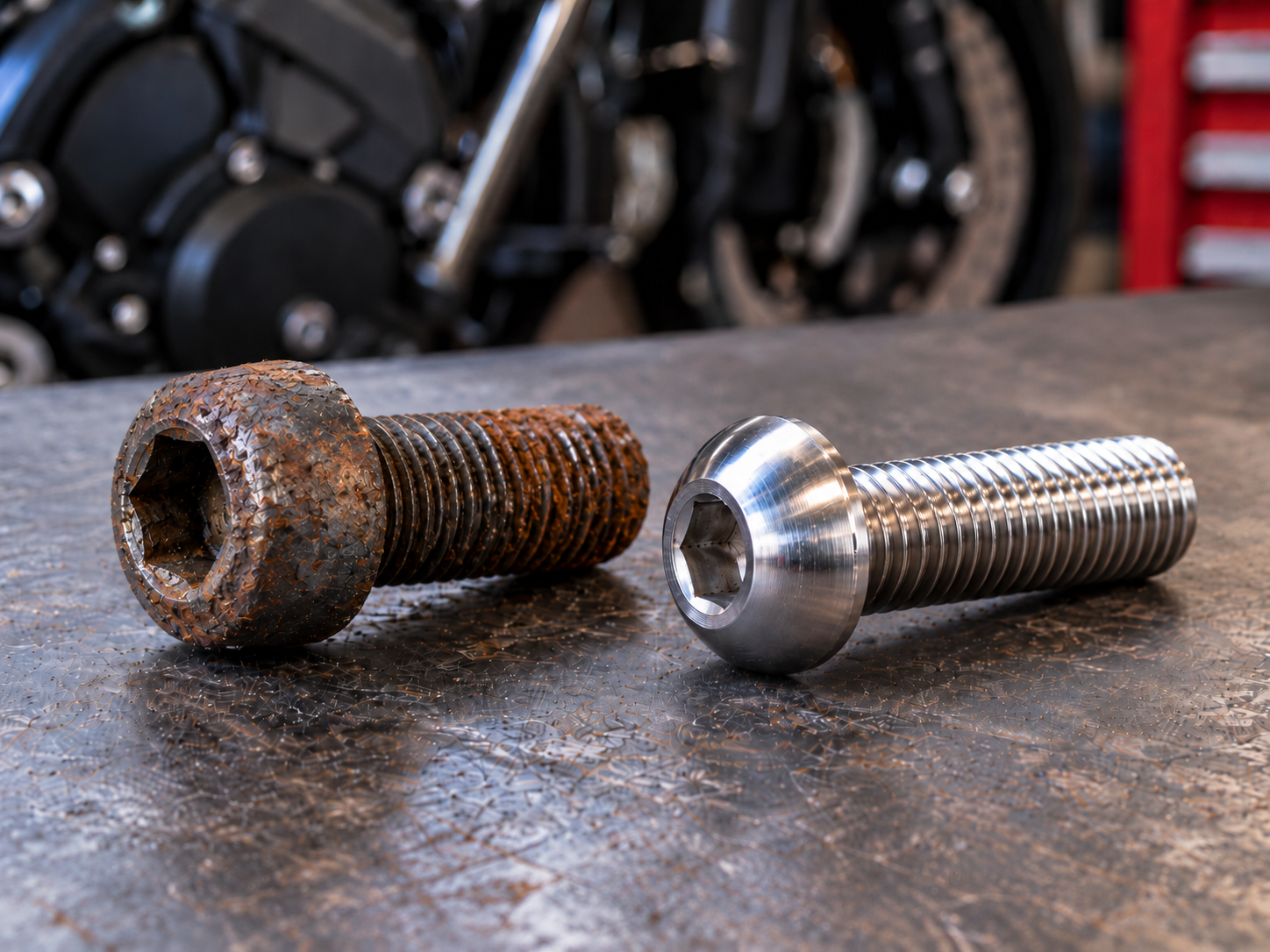
Motorcycle bolts should be replaced when their condition, history or manufacturer specification means they can no longer be relied upon to perform their intended job correctly.
A fastener does not necessarily need replacing simply because it looks old, but visible damage, damaged threads, severe corrosion, distortion, a rounded drive, galling or a manufacturer instruction to replace after removal are all reasons to take replacement seriously.
Some problems are easy to see. Others, particularly on highly loaded or safety-critical fasteners, may not be obvious from appearance alone.
If the motorcycle manufacturer states that a fastener must be replaced after removal, that instruction takes priority even if the old bolt still looks serviceable.
When Should Motorcycle Bolts Be Replaced? The Short Answer
Consider replacing a motorcycle bolt if it has:
- Damaged or distorted threads.
- Severe corrosion or significant pitting.
- A badly rounded head or damaged drive recess.
- Visible bending or distortion.
- Signs of stretching or necking.
- Thread galling or transferred metal.
- A damaged shoulder or locating surface.
- Cracks or other obvious physical damage.
- Been subjected to an incorrect removal or installation procedure that may have damaged it.
- Been specified by the motorcycle manufacturer as single-use or replace-on-removal.
- An uncertain specification or history in a safety-critical application.
A bolt should also be replaced if the manufacturer requires a new fastener as part of a particular repair or servicing procedure.
Not Every Old Motorcycle Bolt Needs Replacing
Age alone does not automatically make a motorcycle bolt unserviceable.
A correctly specified fastener that remains:
- Undamaged.
- Straight.
- Free from significant corrosion.
- Correctly threaded.
- Within any manufacturer reuse requirements.
may remain suitable for service.
The decision depends on the actual fastener and its application.
A lightly loaded bodywork fastener and a highly loaded suspension fastener should not be assessed in exactly the same way.
Replace Bolts With Damaged Threads
Inspect the threads whenever a motorcycle bolt is removed.
Look for:
- Flattened thread crests.
- Torn threads.
- Missing sections of thread.
- Cross-threading.
- Heavy wear.
- Distortion.
- Metal transfer.
- Galling.
- Corrosion that has significantly damaged the thread profile.
A damaged thread should not be forced back into the motorcycle simply because the bolt can still be turned.
Damaged male threads can also damage the female thread during reinstallation.
This is particularly important when the bolt screws into aluminium.
Our Motorcycle Bolts Into Aluminium guide explains why care is required with softer female threads.
Replace Cross-Threaded Motorcycle Bolts
A bolt that has been cross-threaded may have damaged or deformed threads even if it can eventually be removed.
Inspect both:
- The bolt.
- The female thread.
Do not simply install the damaged bolt again.
If aluminium or other thread material is visible on the bolt, the female thread may also require assessment or repair.
A replacement bolt will not correct a damaged threaded hole.
Replace Bolts Affected by Thread Galling
Galling can cause material to transfer between mating threads.
On a damaged fastener you may see:
- Rough thread surfaces.
- Torn material.
- Localised raised areas.
- Metal welded or smeared onto the thread.
- Significant resistance during removal.
A badly galled fastener should not normally be reused.
Installing it again can damage the mating thread or seize during tightening.
If a bolt is already stuck, see How to Remove Seized, Stuck & Rounded Motorcycle Bolts before applying more force.
When Corroded Motorcycle Bolts Should Be Replaced
Not every small mark of corrosion means immediate replacement.
The important question is whether corrosion has affected the fastener’s condition or ability to perform its intended function.
Replacement should be considered where corrosion has caused:
- Deep pitting.
- Significant loss of material.
- Damaged threads.
- Severe scaling.
- Weakening around the head or shank.
- Difficulty obtaining reliable tool engagement.
- Seizure with the mating component.
Surface appearance alone does not always reveal how much material has been affected.
Be particularly cautious with highly loaded or safety-critical fasteners.
Surface Staining on Stainless Steel Bolts
304 stainless steel is corrosion resistant rather than completely corrosion-proof.
Light brown staining can sometimes result from iron contamination, road salt or surface deposits rather than significant attack of the stainless fastener itself.
That does not mean every stained stainless bolt needs replacing.
Clean and inspect it.
If the surface remains sound and there is no meaningful pitting, thread damage or loss of section, cosmetic staining alone may not justify replacement.
However, deep pitting or significant material loss is different from simple surface staining.
For maintenance information, see 304 Stainless Steel Motorcycle Bolts: Corrosion Resistance, Cleaning & Care.
Replace Badly Rounded Bolt Heads
A slightly marked bolt head is not automatically unusable.
The question is whether the correct tool can still engage safely and fully.
Replacement is sensible where:
- External hex flats are badly rounded.
- An internal hex recess has become significantly enlarged or rounded.
- A Torx drive is damaged.
- The tool repeatedly slips.
- The remaining engagement is insufficient for reliable tightening or later removal.
Continuing to reuse a badly damaged fastener may make the next removal considerably harder.
Our Motorcycle Bolt Head Types guide explains common head and drive designs.
Replace Bent Motorcycle Bolts
A visibly bent fastener should normally be replaced rather than straightened and reused.
Bending may indicate:
- Overload.
- Impact.
- Misalignment.
- Incorrect assembly.
- Movement within the joint.
If a bolt has bent, also inspect the surrounding assembly to understand why.
Simply installing another bolt without correcting the cause can result in the replacement suffering the same damage.
What Does a Stretched Bolt Look Like?
Some overloaded bolts can permanently elongate.
Possible signs may include:
- Local narrowing or necking.
- Distorted threads.
- A visibly elongated section.
- A bolt that no longer matches an identical known-good fastener.
- Permanent dimensional change.
However, not all harmful stretching is obvious by eye.
This is one reason manufacturer instructions are particularly important for fasteners designed to be tightened into a controlled yield region.
Torque-to-Yield & Single-Use Motorcycle Bolts
Some fasteners are designed or specified to be replaced after use.
These are sometimes described as:
- Single-use fasteners.
- Replace-on-removal fasteners.
- Torque-to-yield fasteners.
- Stretch bolts.
These terms should not automatically be applied to every bolt tightened with an angle procedure, and not every motorcycle bolt is single-use.
The correct source is the motorcycle manufacturer’s workshop information.
If the procedure says:
“Replace bolt”
or otherwise specifies a new fastener during reassembly, fit a new correctly specified bolt.
Do not reuse the old one simply because it appears undamaged.
Other Fasteners May Be Specified as Replace-on-Removal
A manufacturer can require replacement for reasons other than deliberate yielding.
A fastener may have:
- A factory-applied locking feature.
- A sealing feature.
- A specialised coating.
- A particular locking mechanism.
- Another application-specific reason for replacement.
Therefore, do not assume that a bolt is reusable purely because it is not described as a stretch bolt.
Check the motorcycle’s service information.
Do Brake Bolts Need Replacing Every Time?
There is no universal rule.
Some brake-related fasteners may be reusable when they remain within specification and the manufacturer permits reuse.
Others may have specific replacement instructions.
Because brakes are safety-critical, check the procedure for the exact motorcycle and exact fastener.
Do not apply a general rule such as:
“All brake bolts must always be replaced.”
or:
“Brake bolts can always be reused.”
Neither is reliable across every motorcycle.
Do Brake Disc or Rotor Bolts Need Replacing?
Again, it depends on the motorcycle manufacturer’s specification.
Some brake-disc fasteners may have particular requirements involving:
- Replacement after removal.
- Threadlocking product.
- Tightening sequence.
- Specified torque.
- Special bolt construction.
Follow the model-specific procedure.
Do not decide based only on how good the old bolt looks.
Replace Damaged Shoulder Bolts
A shoulder bolt has a smooth unthreaded section that may perform an important locating, bearing or spacing function.
Inspect the shoulder for:
- Scoring.
- Wear.
- Grooving.
- Corrosion.
- Reduced diameter.
- Bending.
- Damage around transitions between shoulder and thread.
A replacement must reproduce the dimensions and function required by the original assembly.
See Motorcycle Shoulder Bolts Explained for more information.
Inspect the Area Under the Bolt Head
Damage does not only occur on the threads.
Check the bearing surface beneath the bolt head.
Look for:
- Heavy scoring.
- Distortion.
- Cracks.
- Embedded debris.
- Damaged flange surfaces.
- Excessive wear.
If the bolt uses a captive washer, flange or special seating arrangement, inspect those features too.
The fastener should be considered as a complete component.
What About Damaged Washers, Collars & Spacers?
Sometimes the bolt remains serviceable but another part of the fixing does not.
Inspect any:
- Flat washers.
- Sealing washers.
- Copper washers.
- Collars.
- Spacers.
- Locking tabs.
- Rubber components.
- Well nuts.
- Captive hardware.
A new bolt fitted with a damaged collar or washer may still leave the assembly incorrect.
Our Motorcycle Washers, Spacers & Collars Explained guide covers these components in more detail.
Should a Bolt Be Replaced After Difficult Removal?
Not automatically, but it should be inspected carefully.
A difficult removal can damage:
- The head.
- Drive recess.
- Threads.
- Shank.
- Surface finish.
If extraction tools, excessive force or other aggressive methods were required, inspect the fastener before considering reuse.
In many cases, replacing a damaged low-cost fastener is preferable to reinstalling one that may be difficult to remove again.
Safety-critical fasteners require a higher level of certainty.
Replace Bolts After Severe Galling or Seizure
A bolt that has seized badly enough to require significant extraction work may have suffered thread or shank damage.
Do not assume that cleaning it makes it suitable for reuse.
Inspect the complete fastener and mating thread.
Where thread material has transferred or torn away, replacement is normally appropriate.
When Should Motorcycle Bolts Be Replaced After Overtightening?
If a fastener has definitely been substantially overtightened, assess it before reuse.
Potential effects can include:
- Permanent stretching.
- Damaged threads.
- Distorted head or flange.
- Damage to the female thread.
- Damage to the component being clamped.
The absence of visible damage does not necessarily prove that a highly loaded bolt remains within specification.
For an important or safety-critical joint, manufacturer guidance should take priority.
Under-Tightening Does Not Usually Damage the Bolt — But Inspect the Joint
A bolt that was previously loose is not automatically damaged.
However, movement in the joint can cause:
- Fretting.
- Enlarged mounting holes.
- Wear on the bolt shank.
- Damaged threads.
- Damaged washers.
- Movement against a shoulder.
- Distortion of surrounding components.
Identify why the fastener became loose and inspect the entire assembly before simply retightening it.
Does Repeated Removal Mean a Bolt Must Be Replaced?
Not necessarily.
Many motorcycle fasteners are intended to be removed and refitted during normal servicing.
Examples can include suitable fasteners on:
- Covers.
- Bodywork.
- Service-access components.
- Brackets.
Reuse depends on:
- Manufacturer instructions.
- Fastener condition.
- Thread condition.
- Locking method.
- Application.
Repeated removal becomes a concern when the bolt, drive, threads or associated hardware begin to show wear or damage.
Manufacturer Instructions Override Visual Inspection
A bolt can look perfect and still be specified for replacement.
This is particularly important where the workshop manual states that a new fastener must be fitted during reassembly.
Visual inspection does not override a replace-on-removal instruction.
Likewise, if a manufacturer provides a dimensional or reuse limit, use that specification rather than a general rule.
Hydrogen Embrittlement & High-Strength Steel Fasteners
Certain high-strength steel fasteners can be susceptible to hydrogen embrittlement if hydrogen is introduced during some manufacturing, plating, pickling or chemical-cleaning processes and is not adequately controlled.
This is primarily a concern with susceptible high-strength steels rather than ordinary surface rust on every motorcycle bolt.
Hydrogen embrittlement can be serious because cracking may occur without the obvious bending or stretching normally associated with overload.
For that reason:
- Do not assume an unknown replated high-strength bolt is equivalent to the original.
- Be cautious about aggressive acid cleaning or uncontrolled replating of critical high-strength fasteners.
- Use correctly specified replacement fasteners from a reliable source where the condition or processing history of a critical fastener is uncertain.
This is particularly relevant where a manufacturer requires a specific high-strength or special-purpose fastener.
For more information about bolt classes, see Motorcycle Bolt Strength Grades Explained.
Replace Fasteners With Unknown Specifications Where It Matters
An unknown bolt from a miscellaneous box may appear to match the original dimensions.
But appearance does not tell you:
- Material.
- Property class.
- Heat treatment.
- Manufacturing history.
- Intended application.
For a non-critical decorative fixing, identifying a suitable standard replacement may be straightforward.
For braking, steering, suspension, wheels or structural applications, uncertainty about specification is much more important.
Use a correctly identified fastener rather than guessing.
Our How to Choose the Correct Replacement Motorcycle Bolt guide explains the factors to check.
Do Not Replace High-Strength Bolts With Ordinary Stainless Steel Automatically
304 stainless steel is useful for many suitable motorcycle applications because of its corrosion resistance and appearance.
That does not mean it should replace every original motorcycle bolt.
If the original is a high-strength or special-purpose fastener, the replacement must meet the requirements of that application.
Matching diameter, pitch and length does not prove equivalent mechanical strength.
See:
Motorcycle Bolt Materials Explained
and
Motorcycle Bolt Strength Grades Explained.
When Should Motorcycle Bolts Be Replaced in Safety-Critical Areas?
Use greater caution with fasteners associated with:
- Brakes.
- Wheels.
- Axles.
- Steering.
- Suspension.
- Structural mountings.
- Highly loaded engine components.
In these areas, replace the fastener where required by the manufacturer and do not reuse a questionable bolt simply to save the cost of a replacement.
If its specification, condition or reuse status cannot be established confidently, obtain suitable technical advice.
Check the Female Thread as Well
Replacing a damaged bolt does not solve a damaged female thread.
Inspect the threaded component for:
- Cross-threading.
- Stripped threads.
- Pulled aluminium.
- Old locking compound.
- Corrosion.
- Previous repairs.
- Loose threaded inserts.
A new bolt installed into a damaged thread may not clamp correctly.
This is particularly important with aluminium engine casings and brackets.
Compare the Replacement With the Original
Before installing a replacement fastener, compare:
- Thread diameter.
- Thread pitch.
- Length.
- Threaded length.
- Head type.
- Head diameter.
- Shoulder dimensions.
- Washers and collars.
- Material.
- Strength or property class.
- OEM or manufacturer specification where relevant.
Our How to Measure Motorcycle Bolts and Motorcycle Metric Thread Pitch Reference Chart can help with dimensional identification.
Fit the Replacement Correctly
Replacing a damaged fastener only solves part of the problem.
The new bolt still needs to be installed correctly.
Check:
- Threads are clean and serviceable.
- The bolt starts correctly.
- Required washers or spacers are fitted.
- Components are aligned.
- The specified thread treatment is used.
- The correct tightening procedure is followed.
See How to Fit Stainless Steel Motorcycle Bolts for step-by-step fitting guidance.
When Should Motorcycle Bolts Be Replaced? Inspection Checklist
When a bolt is removed, check:
- Is the head or drive badly damaged?
- Are the threads torn, flattened or cross-threaded?
- Is there evidence of galling or metal transfer?
- Is the bolt bent?
- Is there visible stretching or necking?
- Is corrosion deep or heavily pitted?
- Is the shoulder worn or damaged?
- Has the fastener been seriously overtightened?
- Does the manufacturer specify replacement after removal?
- Is its strength or specification uncertain?
- Is it being used in a safety-critical location?
- Is the mating female thread also in good condition?
If there is meaningful doubt about an important fastener, replacing it with the correct specified part is usually preferable to gambling on a questionable one.
Frequently Asked Questions
Should rusty motorcycle bolts be replaced?
It depends on the severity of the corrosion.
Light surface corrosion or staining does not always mean the fastener is structurally compromised.
Deep pitting, material loss, severely damaged threads or heavy corrosion on an important fastener are stronger reasons for replacement.
Can I reuse a motorcycle bolt with a rounded Allen head?
Minor marking does not automatically make the bolt unusable.
If the correct tool no longer engages securely or the recess is badly rounded, replacement is advisable.
A damaged drive may make correct tightening difficult and future removal much harder.
Can a stretched motorcycle bolt be reused?
If a bolt has permanently stretched or the manufacturer specifies it as single-use, it should not be reused.
Some stretching may not be visually obvious, so follow any manufacturer replacement or measurement requirements.
Should motorcycle bolts be replaced every time they are removed?
No.
Many motorcycle bolts are designed to be reused.
However, some are specifically designated replace-on-removal or single-use.
Always check the workshop manual where this is relevant.
Should seized motorcycle bolts be reused after removal?
Only if their condition and application justify it.
A heavily seized bolt may have damaged threads, galling, corrosion or extraction damage.
Inspect it carefully and replace it if there is significant damage or uncertainty.
Should I replace an OEM bolt with stainless steel if the OEM bolt is rusty?
Only after confirming that the stainless replacement is suitable for that particular application.
The original bolt may have a specific strength class, geometry or function that an ordinary stainless bolt does not reproduce.
Corrosion resistance alone does not establish suitability.
The Simple Rule
Replace a motorcycle bolt when damage, corrosion, wear, uncertain specification or the manufacturer’s instructions mean its continued reuse cannot be justified confidently.
For ordinary serviceable fasteners, condition and manufacturer requirements matter more than age alone.
For safety-critical fasteners, use a higher level of caution.
More Biker Bling Motorcycle Fastener Guides
This guide forms part of the Biker Bling technical information library.
For information about selecting replacement fasteners, bolt strength, materials, thread pitch, fitting, aluminium threads and seized-fastener removal, visit our Motorcycle Fastener Guides & Technical Information Hub.
You can also use our Motorcycle Fastener Glossary for explanations of terms including galling, property class, shoulder bolt, thread engagement and torque-to-yield.
Find Replacement Motorcycle Bolts & Fastener Kits
Browse the Biker Bling range of 304 stainless steel motorcycle fasteners and model-specific bolt kits.
Shop Biker Bling Motorcycle Fasteners →
Always check the individual product listing for exact motorcycle fitment, year coverage, application and hardware supplied.
Technical information prepared and reviewed by Biker Bling Limited. Learn how we research, measure and verify motorcycle fasteners.
Technical Information Disclaimer
The information on this page is provided as general educational guidance about motorcycle-fastener inspection and replacement.
It does not provide a model-specific decision that a particular fastener is safe to reuse and is not intended to replace the motorcycle manufacturer’s workshop manual, parts information, component manufacturer’s instructions or advice from a suitably qualified motorcycle technician.
Fastener materials, strength classes, designs, service histories and replacement requirements vary between applications.
Where the motorcycle or component manufacturer specifies a fastener as single-use, replace-on-removal or subject to a particular inspection or reuse limit, follow that requirement.
Particular care should be taken with braking, steering, suspension, wheels, axles, structural mountings and other safety-critical components.
If a fastener’s specification, condition or suitability for reuse cannot be established with appropriate confidence, obtain suitable technical advice or replace it with the correctly specified fastener.
Nothing on this page is intended to affect your statutory rights or to exclude or restrict any responsibility that cannot lawfully be excluded or restricted.