
Motorcycle Banjo Bolts & Copper Washers Explained
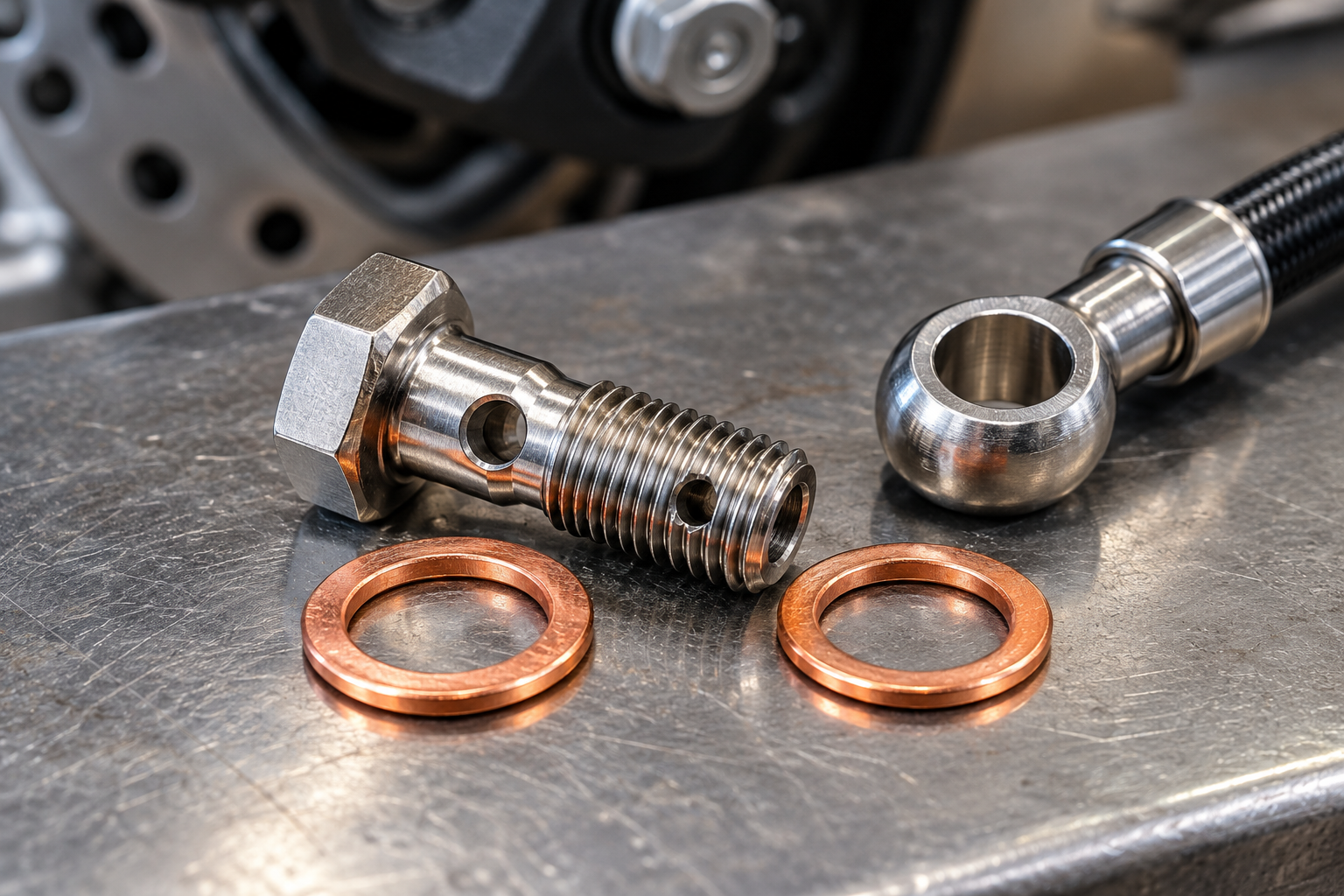
Motorcycle banjo bolts and copper washers form part of the hydraulic connections used on many motorcycle braking and clutch systems.
Unlike an ordinary solid bolt, a banjo bolt contains internal fluid passages that allow hydraulic fluid to move through the bolt and into the banjo fitting attached to the hose.
Copper or other manufacturer-specified sealing washers are fitted between the mating surfaces to create the hydraulic seal.
Because these connections can form part of a motorcycle’s braking system, the correct banjo bolt, thread, length, sealing washers and tightening procedure are safety-critical.
A normal bolt should never be substituted for a banjo bolt simply because the thread appears to fit.
Motorcycle Banjo Bolts & Copper Washers: The Short Answer
A motorcycle banjo connection normally consists of:
- A hollow banjo bolt with internal fluid passages.
- A banjo fitting attached to the hydraulic hose.
- Sealing washers positioned at the required sealing faces.
- A threaded hydraulic component such as a caliper, master cylinder or junction.
The banjo bolt must have the correct:
- Thread diameter.
- Thread pitch.
- Length.
- Head and seating arrangement.
- Fluid-port design.
- Material and mechanical specification.
- Number of banjo fittings it is intended to secure.
The sealing washers must also be the correct size, material and quantity.
Do not reuse, substitute or omit hydraulic sealing components unless the motorcycle or component manufacturer specifically permits it.
What Is a Motorcycle Banjo Bolt?
A banjo bolt is a specialised hollow fastener used to secure a banjo-style hydraulic fitting while allowing fluid to pass through the connection.
The bolt normally contains:
- A longitudinal internal bore.
- One or more cross-drilled fluid ports.
- A threaded section.
- A head used for tightening.
Hydraulic fluid can travel through the internal bore and cross-drilled openings into the passage within the banjo fitting.
This is why a banjo bolt is fundamentally different from an ordinary solid motorcycle bolt.
Why Is It Called a Banjo Fitting?
The hose fitting typically has a circular eye surrounding the bolt.
Its shape resembles the round body of a banjo, which is where the name comes from.
The hollow banjo bolt passes through this eye and secures the fitting against the hydraulic component.
When assembled correctly, fluid can flow through the bolt and fitting while the sealing washers prevent leakage from the joint.
Where Are Motorcycle Banjo Bolts Used?
Depending on the motorcycle, banjo bolts may be found at:
- Front brake master cylinders.
- Rear brake master cylinders.
- Front brake calipers.
- Rear brake calipers.
- Hydraulic clutch master cylinders.
- Hydraulic clutch slave cylinders.
- Brake-hose junctions.
- ABS hydraulic connections.
- Other manufacturer-designed hydraulic fittings.
Not every motorcycle uses the same hydraulic layout.
ABS-equipped machines in particular can have additional connections that are less visible than the fittings at the master cylinder or caliper.
How Does a Banjo Bolt Work?
The banjo bolt performs two jobs at the same time.
It mechanically secures the hydraulic fitting and provides a route for fluid.
When assembled, hydraulic fluid passes through the drilled passages in the bolt and into the internal passage of the banjo fitting.
The sealing washers sit between the mating surfaces and prevent fluid escaping externally.
The bolt therefore needs to provide:
- Correct mechanical clamping.
- Correct fluid communication.
- Correct alignment with the hydraulic fitting.
- A reliable seal through the specified washers and mating surfaces.
This makes banjo-bolt selection much more application-specific than choosing an ordinary bolt of the same thread diameter.
Banjo Bolt Thread Diameter & Pitch
Thread diameter alone does not identify a banjo bolt.
Two banjo bolts can have the same nominal diameter but different thread pitches.
For example, M10 banjo bolts are available with different metric pitches.
A bolt with the wrong pitch can damage the threaded hydraulic component if forced.
Never identify a replacement banjo bolt simply by saying that it is “M10”.
Confirm both:
- Thread diameter.
- Thread pitch.
Our Motorcycle Metric Thread Pitch Reference Chart explains how metric thread pitch is identified.
Banjo Bolt Length Matters
Banjo-bolt length must suit the complete hydraulic fitting arrangement.
A bolt that is too short may not provide sufficient thread engagement.
A bolt that is too long may:
- Bottom out in the threaded hole.
- Prevent the fitting from clamping correctly.
- Interfere with an internal passage.
- Give a false impression that the joint is tight.
The required length can also differ depending on whether the connection uses:
- One banjo fitting.
- Two stacked banjo fittings.
- A particular washer arrangement.
Do not assume that two banjo bolts with the same thread are interchangeable.
For general dimensional guidance, see How to Measure Motorcycle Bolts.
Single Banjo Bolts
A single banjo bolt is generally intended to secure one banjo fitting.
In a conventional arrangement, sealing washers are fitted on the sealing faces around that fitting.
However, the exact number, position and type of washers must follow the motorcycle or component manufacturer’s design.
Do not copy the washer arrangement from another motorcycle simply because the fitting looks similar.
Double Banjo Bolts
A double banjo bolt is designed to accommodate two banjo fittings stacked at the same mounting point.
These may be used where two hydraulic lines connect to one component.
Because the assembly is thicker, the bolt is normally longer than the equivalent single-banjo version.
The sealing arrangement must also account for the surfaces between the two banjo fittings.
A typical double-banjo assembly may use a sealing washer:
- Between the hydraulic component and first banjo.
- Between the two banjo fittings.
- Between the second banjo and bolt head.
That arrangement should only be treated as a general example.
Follow the exact manufacturer arrangement for the motorcycle being serviced.
Do Not Use a Double Banjo Bolt Where a Single Bolt Is Required
A longer double banjo bolt is not automatically suitable for a single-banjo connection.
The excess length may:
- Bottom in the threaded hole.
- Reduce correct clamping.
- Interfere with an internal passage.
- Damage the component.
Likewise, a single banjo bolt may be too short for a stacked double-banjo connection.
Use the bolt designed for the actual fitting stack.
What Do Copper Washers Do?
Copper washers used in banjo connections are sealing washers.
They sit between the mating surfaces and deform slightly when correctly tightened.
This helps create a hydraulic seal around the connection.
The washer is therefore not simply there to protect the surface beneath the bolt head.
It performs a specific sealing function.
Our broader Motorcycle Washers, Spacers & Collars Explained guide explains why washer type and dimensions can matter in motorcycle assemblies.
Copper Washers Are Not Ordinary Flat Washers
A general-purpose steel washer should not be fitted in place of a specified copper sealing washer.
The materials behave differently.
An ordinary washer may provide a bearing surface but is not necessarily designed to create the required hydraulic seal.
Similarly, do not substitute:
- Nylon washers.
- Stainless flat washers.
- Spring washers.
- Random aluminium washers.
unless that particular material and washer specification is approved for the hydraulic connection.
Copper Washer Size Matters
A sealing washer must fit both the banjo bolt and sealing surfaces correctly.
Important dimensions can include:
- Inside diameter.
- Outside diameter.
- Thickness.
A washer with an excessively large centre hole may not locate properly.
A washer that is too small may not fit over the bolt.
An incorrect outside diameter may also affect the available sealing area.
Use the washer specified for the connection rather than selecting one purely because it appears close enough.
Should Motorcycle Banjo Bolt Copper Washers Be Reused?
Follow the motorcycle or hydraulic-component manufacturer’s instructions.
Many hydraulic sealing washers are treated as replacement items once the joint has been dismantled.
The washer has already been compressed during the previous installation and may not seal in exactly the same way when reused.
For a braking system, the cost of new sealing washers is insignificant compared with the consequences of a hydraulic leak.
Where the manufacturer specifies new sealing washers, fit new correctly specified washers.
What About Annealing Used Copper Washers?
Copper can be softened through controlled heat treatment, which is why annealing is sometimes discussed as a way of preparing previously used copper washers.
However, this should not be treated as a universal motorcycle brake-service recommendation.
A washer may also have:
- Surface damage.
- Grooves.
- Distortion.
- Incorrect dimensions.
- Contamination.
- An unknown material specification.
For a safety-critical hydraulic connection, use new manufacturer-specified sealing washers where replacement is required rather than relying on an improvised reconditioning method.
Inspect the Sealing Surfaces
A new copper washer cannot compensate for badly damaged mating surfaces.
Before assembly, inspect the surfaces that the washers seal against.
Look for:
- Deep scratches.
- Burrs.
- Corrosion.
- Embedded debris.
- Distortion.
- Old washer material.
- Other damage.
The surfaces should be suitable for the specified sealing arrangement.
Do not aggressively grind or sand a hydraulic sealing surface without an approved repair procedure.
Banjo Fitting Orientation Matters
The banjo fitting normally needs to sit in the correct orientation so the hydraulic hose follows its intended route.
Incorrect positioning can potentially cause:
- Hose twisting.
- Excessive bending.
- Contact with moving components.
- Contact with hot components.
- Poor steering clearance.
- Strain on the hose or fitting.
Before final tightening, ensure the hose and fitting are routed according to the manufacturer’s arrangement.
After assembly, check clearance through the full relevant range of steering or suspension movement where applicable.
Never Twist a Brake Hose to Make It Fit
A hydraulic hose should not be forced into position by twisting it excessively.
If the fitting does not naturally align, investigate:
- Whether the correct hose is fitted.
- Whether the correct banjo bolt and washers are being used.
- Whether the fitting is positioned correctly.
- Whether another hose or bracket has been routed incorrectly.
Do not use bolt tightening force to pull a badly misaligned hydraulic hose into position.
Banjo Bolt Fluid Ports
The cross-drilled holes in a banjo bolt provide the route between the central bore and banjo fitting.
These passages need to remain clear.
Before installing a replacement, ensure there is no:
- Manufacturing debris.
- Dirt.
- Corrosion product.
- Threadlocker.
- Anti-seize.
- Cleaning residue.
inside the fluid passages.
Anything introduced into a brake or clutch hydraulic system can potentially cause problems elsewhere in the system.
Use appropriate cleanliness procedures for the hydraulic system being serviced.
Do Not Block Banjo Bolt Passages With Threadlocker
Threadlocker should not be applied casually to a hydraulic banjo bolt.
Excess product could potentially enter or obstruct a fluid passage, and the manufacturer may not specify threadlocker for that connection at all.
The copper or other sealing washers normally provide the external hydraulic seal.
Do not assume that threadlocker should be used because the bolt is part of a braking system.
If the manufacturer specifies a particular thread treatment, follow that exact procedure.
See Threadlocker vs Anti-Seize on Motorcycle Bolts for more information.
Should Anti-Seize Be Used on Motorcycle Banjo Bolts?
Do not apply anti-seize automatically.
A banjo connection is a safety-critical hydraulic joint, and any thread treatment can alter friction and tightening behaviour.
Anti-seize can change the relationship between tightening torque and clamp load.
It may also create contamination concerns if applied excessively near a hydraulic system.
Use the thread condition specified by the motorcycle or component manufacturer.
Our Stainless Steel Motorcycle Bolt Torque, Anti-Seize & Galling Guide explains why thread treatments and torque specifications should be considered together.
How Tight Should a Motorcycle Banjo Bolt Be?
There is no universal banjo-bolt torque that is correct for every motorcycle.
Required tightening torque depends on factors including:
- Thread diameter.
- Thread pitch.
- Banjo-bolt material.
- Threaded component material.
- Washer specification.
- Number of banjo fittings.
- Manufacturer design.
- Specified thread condition.
Always use the torque and procedure for the exact motorcycle or hydraulic component.
Do not use a torque value merely because another motorcycle uses a visually similar banjo bolt.
Why Over-Tightening a Banjo Bolt Is Dangerous
Excessive tightening can damage:
- The banjo bolt.
- Copper washers.
- Banjo fitting.
- Female thread.
- Aluminium caliper or master-cylinder body.
- Sealing faces.
Possible consequences can include:
- Stripped threads.
- Distorted fittings.
- Cracked components.
- Excessively crushed washers.
- Hydraulic leakage.
More tightening does not automatically create a better seal.
If a correctly specified and correctly tightened new sealing arrangement leaks, identify the cause rather than simply tightening it harder.
Under-Tightening Can Also Cause Leaks
A banjo bolt that is not tightened correctly may fail to compress the sealing washers sufficiently.
This can allow hydraulic fluid to leak from the connection.
A leaking brake or clutch connection requires immediate attention.
Do not ride the motorcycle with a known brake-fluid leak.
Check for Leaks After Assembly
After the hydraulic system has been assembled, serviced and correctly bled, inspect the banjo connections carefully.
Look for:
- Wetness around the washers.
- Fluid forming around the bolt head.
- Fluid tracking down the hose.
- Loss of hydraulic pressure.
- A change in brake or clutch lever feel.
A connection should remain dry.
If there is any doubt about the integrity of a brake connection, do not ride the motorcycle until the fault has been identified and corrected.
Brake Fluid Can Damage Painted Surfaces
Many motorcycle brake fluids can damage paint and some finishes.
When working on hydraulic systems:
- Protect surrounding painted components.
- Avoid unnecessary spills.
- Follow the brake-fluid manufacturer’s handling instructions.
- Deal with any spill using the appropriate procedure.
Do not allow contamination to reach brake pads, brake discs or tyres.
Keep Brake Hydraulic Components Clean
Cleanliness is extremely important when working on braking systems.
Dirt, fibres, metal particles or inappropriate chemicals should not be introduced into:
- Banjo bolts.
- Banjo fittings.
- Master cylinders.
- Calipers.
- Hydraulic hoses.
- ABS units.
Keep replacement components clean before installation and avoid touching sealing or fluid-contact surfaces unnecessarily.
Stainless Steel Motorcycle Banjo Bolts
Stainless steel can provide useful corrosion resistance in suitable banjo-bolt applications.
However, the fact that a replacement is stainless steel does not automatically establish that it is suitable for every motorcycle hydraulic system.
A suitable replacement must have the correct:
- Thread.
- Length.
- Fluid passages.
- Head and sealing geometry.
- Mechanical properties.
- Material compatibility.
- Intended application.
Do not substitute an ordinary stainless bolt or an unidentified stainless banjo bolt simply because the dimensions appear close.
For more information about fastener materials, see Motorcycle Bolt Materials Explained.
Banjo Bolt Strength & Material Requirements
Hydraulic banjo bolts experience both mechanical loading and internal hydraulic pressure.
Their suitability cannot be established from appearance alone.
Different fastener materials and grades can have different mechanical properties.
If the motorcycle manufacturer specifies a particular banjo bolt, material or component, use a replacement that is confirmed as suitable.
Our Motorcycle Bolt Strength Grades Explained guide explains why material and mechanical strength are separate considerations.
Aluminium Hydraulic Components Need Care
Banjo bolts frequently screw into aluminium calipers and master-cylinder bodies.
Aluminium female threads can be damaged by:
- Cross-threading.
- Wrong thread pitch.
- Overtightening.
- A bolt that is too long.
- Contaminated threads.
Start the bolt carefully and never use tightening force to overcome unexpected resistance.
Our Motorcycle Bolts Into Aluminium guide covers aluminium-thread protection in more detail.
Never Force a Banjo Bolt Into the Thread
A banjo bolt should engage correctly in the mating thread.
If it becomes unexpectedly tight before the fitting is clamped:
Stop.
Check:
- Diameter.
- Thread pitch.
- Alignment.
- Thread condition.
- Bolt length.
- Whether the correct replacement is being used.
Hydraulic components can be expensive and safety-critical, so damaging the female thread can create a much larger repair.
Inspect the Banjo Bolt Before Reuse
If the manufacturer permits reuse, inspect the bolt carefully.
Look for:
- Damaged threads.
- Corrosion.
- Pitting.
- A damaged head.
- Cracks.
- Distortion.
- Blocked fluid passages.
- Galling.
- Damaged sealing surfaces.
If the bolt’s condition or specification is uncertain, replacement with the correctly specified component is preferable.
See When Should Motorcycle Bolts Be Replaced? for general fastener inspection guidance.
Banjo Bolt Head Types
Banjo bolts can use different external or internal drive arrangements depending on the manufacturer.
The tool interface does not determine:
- Thread diameter.
- Thread pitch.
- Bolt length.
- Fluid-port design.
A banjo bolt with the same head size as another bolt is not necessarily interchangeable.
See Motorcycle Bolt Head Types for an explanation of head and drive terminology.
ABS Motorcycle Banjo Connections
ABS-equipped motorcycles can have more complicated hydraulic circuits than conventional non-ABS systems.
Connections may exist at:
- Master cylinders.
- Calipers.
- ABS hydraulic units.
- Intermediate junctions.
Do not assume that the visible banjo bolts at the calipers represent every hydraulic connection on the motorcycle.
Likewise, a banjo-bolt kit for one ABS configuration may not necessarily suit a non-ABS motorcycle or another ABS version.
Check the exact model, year and braking-system configuration.
Replacing Motorcycle Brake Hoses
If a banjo bolt is being changed as part of a brake-hose replacement, follow the hose manufacturer’s installation instructions as well as the motorcycle workshop manual.
Check:
- Hose routing.
- Banjo fitting angle.
- Washer arrangement.
- Bolt specification.
- Torque.
- Full steering clearance.
- Suspension clearance where applicable.
- Bleeding procedure.
- Leak inspection.
Brake-hose work should not be considered complete until the hydraulic system operates correctly and all connections have been checked.
Brake System Bleeding After Opening a Banjo Connection
Removing a banjo bolt opens the hydraulic system.
Air can enter the system and fluid can be lost.
The system will normally require the correct bleeding procedure before the motorcycle is returned to service.
Different motorcycles, particularly ABS-equipped machines, can have different bleeding procedures.
Some systems may require specific sequences or diagnostic equipment.
Always use the manufacturer-specified bleeding procedure.
If you are not confident carrying out hydraulic brake work correctly, use a suitably qualified motorcycle technician.
Why Air in a Brake System Is Dangerous
Brake fluid is intended to transmit hydraulic pressure.
Air is compressible.
Air trapped in the hydraulic system can therefore affect lever or pedal feel and reduce effective hydraulic operation.
Do not treat a soft or abnormal brake lever after hydraulic work as acceptable.
Identify and correct the cause before riding.
Choosing Replacement Motorcycle Banjo Bolts & Copper Washers
Before fitting a replacement, check:
- Motorcycle make, model and year.
- ABS or non-ABS configuration where relevant.
- Exact mounting position.
- Thread diameter.
- Thread pitch.
- Banjo-bolt length.
- Single or double banjo arrangement.
- Fluid-port design.
- Bolt material and specification.
- Correct sealing-washer material.
- Washer inside and outside dimensions.
- Correct washer quantity and position.
- Manufacturer tightening procedure.
- Required hydraulic bleeding procedure.
If any safety-critical specification is uncertain, do not guess.
Do Not Judge a Banjo Bolt by Thread Size Alone
The most important principle is:
A banjo bolt is a hydraulic component, not simply a hollow version of an ordinary bolt.
Two bolts can share the same thread diameter and pitch but still differ in:
- Length.
- Cross-hole position.
- Internal bore.
- Head geometry.
- Material.
- Strength.
- Number of fittings they are intended to clamp.
Use the replacement specified for the actual hydraulic application.
For the broader replacement-fastener process, see How to Choose the Correct Replacement Motorcycle Bolt.
Motorcycle Banjo Bolts & Copper Washers: Simple Rule
The simple rule is:
Match the complete hydraulic connection, not just the thread.
The correct banjo bolt, correct sealing washers, clean undamaged surfaces and correct tightening procedure all work together.
If any part of that arrangement is wrong, the joint may leak or the component may be damaged.
With brake systems in particular, uncertainty should be resolved before the motorcycle is ridden.
More Biker Bling Motorcycle Fastener Guides
This motorcycle banjo bolts and copper washers guide forms part of the Biker Bling technical information library.
For information about washers, thread pitch, bolt measurement, materials, aluminium threads and correct fitting, visit our Motorcycle Fastener Guides & Technical Information Hub.
You can also use the Motorcycle Fastener Glossary for explanations of common bolt, thread, washer and fixing terminology.
Find Motorcycle Banjo Bolts & Copper Washers
Biker Bling supplies stainless steel banjo bolts, copper washers and model-specific motorcycle fastener products for selected makes, models and applications.
Browse Biker Bling Motorcycle Fasteners →
Always check the individual product listing for the exact motorcycle, year range, hydraulic configuration, quantity and components supplied.
Technical Information Disclaimer
The information on this page is provided as general educational guidance about motorcycle banjo bolts, copper sealing washers and hydraulic fastener connections.
Brake and hydraulic systems are safety-critical. This page does not provide model-specific banjo-bolt specifications, torque values, brake-fluid requirements or bleeding procedures and is not intended to replace the motorcycle manufacturer’s workshop manual, brake-component manufacturer’s instructions or advice from a suitably qualified motorcycle technician.
Banjo-bolt thread, length, fluid passages, material, washer specification, tightening procedure and hydraulic-system layout can vary between motorcycles.
Always confirm that replacement components are specifically suitable for the motorcycle and exact hydraulic connection before installation.
Where the motorcycle or component manufacturer specifies new sealing washers, a particular banjo bolt, torque, hose-routing arrangement, bleeding sequence or other service procedure, follow those requirements.
Do not ride a motorcycle with a known or suspected hydraulic leak, abnormal brake operation or uncertainty about the integrity of a braking-system connection.
If you are not competent and properly equipped to carry out hydraulic brake work, use a suitably qualified motorcycle technician.
Nothing on this page is intended to affect your statutory rights or to exclude or restrict any responsibility that cannot lawfully be excluded or restricted.