
Motorcycle Fastener Glossary: Bolt, Thread & Fixing Terms Explained
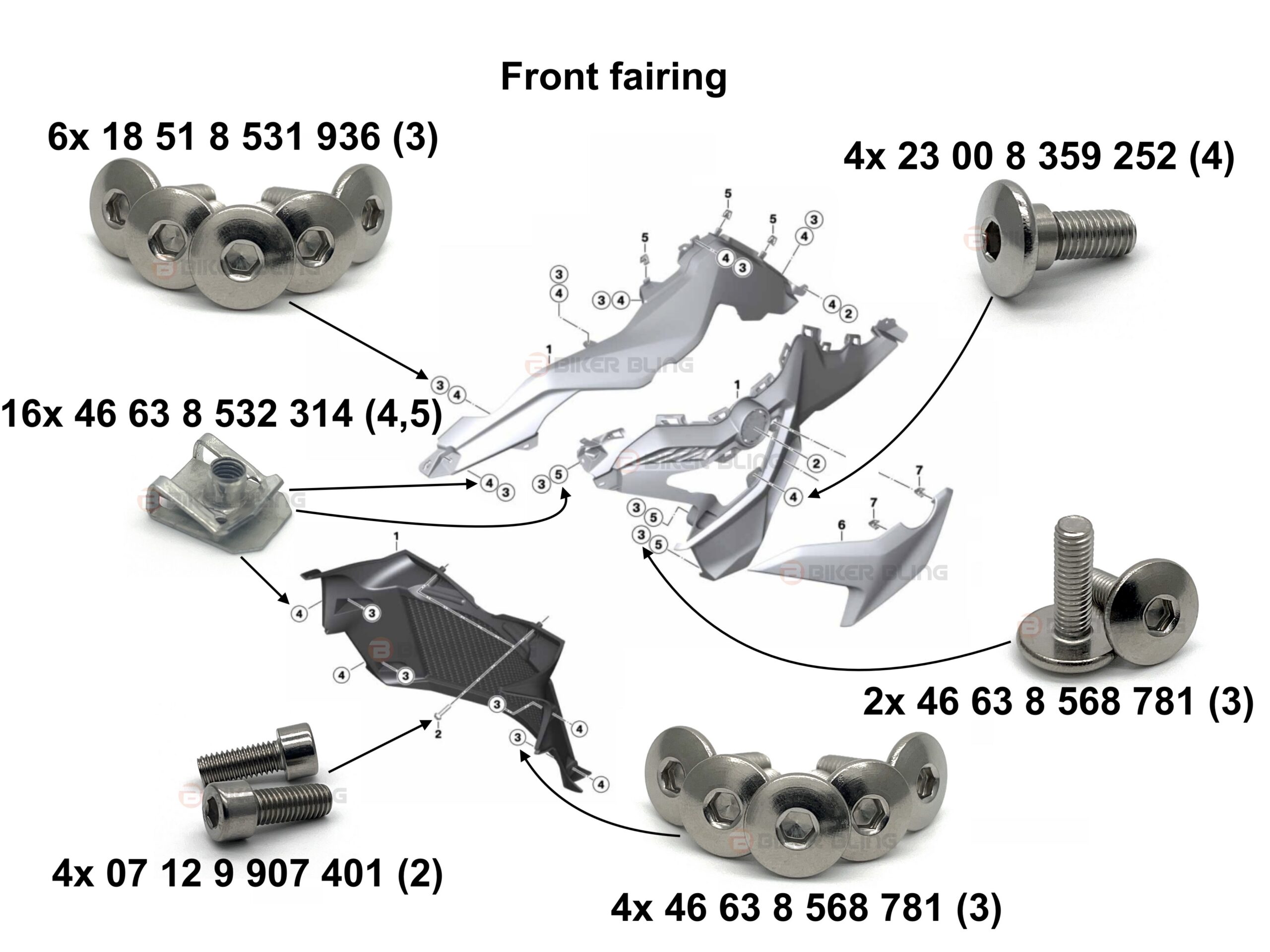
This motorcycle fastener glossary explains common bolt, thread, washer, material and fixing terms used when working on motorcycles.
Motorcycle fastener terminology can become confusing because a simple-looking fixing may be described by its thread, head shape, drive type, material, strength class or function.
For example, an M6 button-head Allen bolt describes several different characteristics at once.
Understanding the correct term can make it easier to identify a replacement, read an OEM parts catalogue, compare fasteners and follow a workshop manual correctly.
This motorcycle fastener glossary provides plain-English definitions while linking to the more detailed Biker Bling technical guides where useful.
How to Use This Motorcycle Fastener Glossary
The definitions below explain general motorcycle-fastener terminology.
They should not be used on their own to decide whether a particular bolt is suitable for a safety-critical application.
Correct replacement can also depend on:
- Thread diameter.
- Thread pitch.
- Bolt length.
- Shoulder dimensions.
- Head geometry.
- Material.
- Strength or property class.
- Washers, collars and spacers.
- Manufacturer specifications.
- Intended mounting position.
For help identifying an actual replacement, see How to Choose the Correct Replacement Motorcycle Bolt.
304 Stainless Steel
304 stainless steel is a widely used austenitic stainless-steel family offering useful corrosion resistance for many suitable motorcycle applications.
In stainless fastener terminology, A2 stainless commonly corresponds to the 304 family.
304 stainless steel is corrosion resistant rather than completely corrosion-proof.
Road salt, chlorides, iron contamination and trapped dirt can still affect its appearance or cause corrosion in some conditions.
See 304 Stainless Steel Motorcycle Bolts: Corrosion Resistance, Cleaning & Care for more information.
316 Stainless Steel
316 stainless steel is another austenitic stainless-steel family.
It normally contains molybdenum, which provides improved resistance to some forms of localised corrosion in chloride-containing environments compared with 304.
In fastener terminology, A4 stainless commonly corresponds to the 316 family.
316 is often described as marine-grade stainless steel.
That description should not normally be applied to ordinary A2/304 stainless.
316 is not automatically stronger than 304 and should not be selected purely on the assumption that a higher number means greater mechanical strength.
See Motorcycle Bolt Materials Explained.
A2 Stainless Steel
A2 is a common stainless-steel fastener designation generally associated with the 304 stainless family.
The A identifies an austenitic stainless-steel group.
The complete marking may also include a strength class, such as A2-70.
A2 describes the stainless-steel group; it does not by itself describe every mechanical property of the fastener.
A4 Stainless Steel
A4 is a stainless fastener designation generally associated with the 316 stainless family.
A4 stainless usually offers improved resistance to some chloride-related corrosion compared with A2.
A marking such as A4-70 includes both the stainless group and strength class.
A4 should not automatically be assumed to be stronger than A2.
Allen Bolt / Allen Drive
Allen is the common name for an internal hexagonal drive.
The tool fits into a six-sided recess in the bolt or screw head.
It may also be described as:
- Internal hex.
- Hex socket.
- Socket drive.
Allen describes the drive, not necessarily the shape of the bolt head.
For example, both a socket-cap bolt and a button-head bolt can use an Allen drive.
See Motorcycle Bolt Head Types.
Anti-Seize
Anti-seize is an assembly compound intended to reduce seizure, galling or difficult future disassembly in suitable applications.
Different anti-seize products use different lubricating solids and carrier materials.
Anti-seize also changes friction within the threaded joint.
That means applying it can change the relationship between tightening torque and clamp load.
Do not assume there is one universal percentage by which every torque value should be reduced.
See Threadlocker vs Anti-Seize on Motorcycle Bolts and the Stainless Steel Motorcycle Bolt Torque, Anti-Seize & Galling Guide.
Axle
An axle is a shaft associated with supporting or locating a wheel or other rotating component.
On motorcycles, the wheel axle may also be described as a spindle, particularly in UK terminology.
Axle and spindle fasteners can be safety-critical.
Always use the manufacturer’s specified parts and tightening procedure.
Banjo Bolt
A banjo bolt is a hollow bolt containing internal fluid passages.
It is used with a banjo fitting to create a hydraulic connection.
Motorcycle banjo bolts can be used in:
- Brake systems.
- Hydraulic clutch systems.
- ABS circuits.
- Other hydraulic connections.
Thread diameter, pitch, bolt length, fluid passages and sealing-washer arrangement all matter.
See Motorcycle Banjo Bolts & Copper Washers Explained.
Bearing Surface
The bearing surface is the area through which clamping force is transferred beneath a bolt head, nut, washer or other fastener component.
Its size, material and condition can affect how load is distributed.
This is one reason why changing:
- Head diameter.
- Washer size.
- Flange diameter.
- Surface condition.
can change how a joint behaves.
Blind Hole
A blind hole is a drilled or threaded hole that does not pass completely through the component.
The hole has a bottom.
Bolt length is particularly important in a blind hole.
A bolt that is too long may reach the bottom before correctly clamping the component.
Fluid, debris or excessive assembly compound trapped in a blind hole can also cause problems.
See Motorcycle Bolts Into Aluminium for more information.
Bolt
A bolt is an externally threaded fastener used to join or secure components.
In everyday motorcycle use, the words bolt and screw are often used loosely.
A bolt can vary in:
- Diameter.
- Pitch.
- Length.
- Head type.
- Drive type.
- Shoulder.
- Material.
- Strength.
Two bolts that look similar are not necessarily interchangeable.
Bolt Diameter
Bolt diameter normally refers to the nominal outside diameter of the threaded section.
For example:
M6
indicates a nominal 6 mm metric thread diameter.
Diameter alone does not identify the complete thread.
Thread pitch must also be considered.
Bolt Length
Bolt length describes the specified length of the fastener.
For many common bolt-head designs, length is measured from beneath the head to the end of the bolt.
Countersunk fasteners are generally measured differently because the head sits within the component.
See How to Measure Motorcycle Bolts for a complete explanation.
Button-Head Bolt
A button-head bolt has a low, rounded head profile.
Button heads are commonly used on visible motorcycle bodywork because they can provide:
- A neat appearance.
- Relatively low head height.
- A useful bearing area.
They often use an internal hex drive.
Button head describes the head shape rather than the thread or material.
Captive Nut
A captive nut is retained within or against a component so that it normally remains in position while the bolt is installed or removed.
Examples may be fitted within:
- Frames.
- Brackets.
- Bodywork.
- Welded assemblies.
- Clips or cages.
If a captive nut becomes loose and begins rotating, removing the bolt can become difficult.
Captive Washer
A captive washer is retained on the fastener so that it does not normally fall away during assembly or disassembly.
The washer can still perform a functional role in the joint.
Do not assume that a captive washer can simply be discarded when replacing the bolt.
Clamp Load
Clamp load is the compressive force holding components together after a fastener has been tightened.
Torque is one method used to create preload and therefore clamp load, but the relationship is strongly affected by friction.
Changes in:
- Lubrication.
- Thread condition.
- Washer condition.
- Surface finish.
can change the clamp load produced by the same applied torque.
Clip Nut
A clip nut is a removable fixing that clips over a panel, bracket or mounting tab and provides a threaded or formed-thread location.
Related terms include:
- U-nut.
- Spring nut.
- Speed nut.
- Spire clip.
- Panel nut.
Clip nuts are common on motorcycle fairings and bodywork.
See Motorcycle Fairing Well Nuts, Clips & Washers Explained.
Coarse Thread
A coarse thread has a larger pitch than a finer thread of the same nominal diameter.
For example, one diameter may be available in several pitches.
The coarse version generally has greater spacing between adjacent thread peaks.
The word coarse does not mean badly made or rough.
It refers to thread geometry.
See Motorcycle Metric Thread Pitch Reference Chart.
Collar
A collar is normally a cylindrical component fitted around a bolt or through another component.
Depending on the application, it may:
- Maintain spacing.
- Locate a bolt.
- Pass through a rubber grommet.
- Limit compression.
- Provide a smooth bearing surface.
A small collar can be an important part of a motorcycle fixing.
See Motorcycle Washers, Spacers & Collars Explained.
Copper Washer
A copper washer is commonly used as a sealing washer in hydraulic or fluid connections.
On motorcycles, copper washers are often fitted around banjo bolts.
Their function is different from a normal steel flat washer.
When correctly specified and installed, the copper deforms to help create a seal between mating surfaces.
Countersunk Bolt / Screw
A countersunk fastener has a tapered head designed to sit within a matching countersunk recess.
When correctly fitted, the head can sit approximately flush with or below the surrounding surface.
Countersunk fasteners are generally measured by overall length, including the head.
Do not automatically replace a countersunk fixing with a conventional flat-bottomed head.
Cross-Threading
Cross-threading occurs when a male and female thread engage incorrectly.
The fastener may start at an angle or the wrong thread pitch may be forced into the hole.
Signs can include:
- Unexpected resistance.
- A bolt entering at an angle.
- Torn or flattened threads.
- Metal debris.
Stop if a bolt does not start correctly.
Forcing a cross-threaded fastener can damage both components.
Crush Washer
A crush washer is a sealing component designed to deform during tightening.
Common examples can be found on:
- Drain plugs.
- Hydraulic connections.
- Other fluid-sealing joints.
The manufacturer may specify replacement whenever the joint is dismantled.
A crush washer should not automatically be treated as a reusable ordinary washer.
Fairing Bolt
A fairing bolt is a fastener used to secure motorcycle bodywork.
The term does not describe one universal bolt design.
Motorcycle fairing bolts can vary in:
- Diameter.
- Pitch.
- Length.
- Head style.
- Shoulder.
- Washer arrangement.
See Motorcycle Fairing Fasteners Explained and How to Fit Motorcycle Fairing Bolts Without Damaging Plastic Panels.
Fastener
Fastener is a broad term for a component used to join, locate or secure parts.
Motorcycle fasteners can include:
- Bolts.
- Screws.
- Nuts.
- Studs.
- Washers.
- Clips.
- Rivets.
- Well nuts.
- Other specialised fixings.
This motorcycle fastener glossary concentrates mainly on threaded motorcycle hardware and closely related components.
Female Thread
A female thread is an internal thread.
It may be found within:
- A nut.
- Engine casing.
- Frame component.
- Bracket.
- Well-nut insert.
- Clip nut.
The male thread on the bolt or stud screws into the female thread.
Fine Thread
A fine thread has a smaller pitch than a coarser thread of the same nominal diameter.
For example, an M10 fastener can exist in more than one pitch.
A fine-thread bolt must be matched to the correct female thread.
Do not assume that every motorcycle uses the same pitch for a given diameter.
Flange Bolt
A flange bolt has an enlarged bearing surface incorporated into the head.
The flange can perform some functions that might otherwise require a separate washer.
However, a flange bolt is not automatically equivalent to another bolt plus a random washer.
Flange diameter, geometry and surface design can matter.
Galling
Galling is adhesive wear that can occur when sliding metal surfaces seize and transfer material.
Thread galling is particularly associated with some stainless-steel fastener combinations.
Possible symptoms include:
- Increasing resistance while tightening.
- Torn threads.
- Metal transfer.
- A fastener suddenly locking.
If a stainless bolt begins tightening abnormally before reaching the clamping stage, stop and investigate.
See the Stainless Steel Motorcycle Bolt Torque, Anti-Seize & Galling Guide.
Galvanic Corrosion
Galvanic corrosion can occur when dissimilar metals are electrically connected in the presence of an electrolyte such as water containing salts.
The actual corrosion risk depends on several factors, including:
- Materials involved.
- Surface condition.
- Relative exposed areas.
- Environment.
- Coatings.
- Amount of moisture or salt.
It is not accurate to say that stainless steel and aluminium can never be used together.
The application and environment need to be considered.
See Motorcycle Bolts Into Aluminium.
Grip Length
Grip length normally describes the unthreaded section of a fastener that passes through the components being joined.
It should not be confused with the grip range of a well nut, rivet or similar fixing.
On a specialised motorcycle bolt, grip length can influence how the bolt locates or supports components.
Grip Range
Grip range describes the range of material thickness over which some inserts or fasteners are designed to work.
For example, a well nut needs to suit the thickness of the material and mounting arrangement in which it is installed.
Grip range is therefore different from ordinary bolt length.
Head Diameter
Head diameter is the outside width of a circular or approximately circular bolt head.
It can matter where the bolt:
- Fits into a recess.
- Bears against a washer.
- Contacts plastic.
- Needs clearance from another component.
Two bolts with the same thread and length can still have different head diameters.
Head Type
Head type describes the external shape or geometry of the fastener head.
Examples include:
- Button head.
- Socket cap.
- Pan head.
- Hex head.
- Flange head.
- Countersunk head.
Head type should be distinguished from drive type, which describes how the tool engages the fastener.
Hex Head
A hex-head bolt has a six-sided external head designed for use with a spanner or socket.
The external hex shape is the head and drive arrangement.
It should not be confused with an internal hex or Allen socket.
Hex Socket
A hex socket is a six-sided internal drive recess.
It is commonly called an Allen drive.
A hex socket can be used in several different head types.
High-Tensile Steel
High-tensile steel is a general term commonly used for stronger steel fasteners.
In technical work it is better to identify the actual property class where known, such as:
- 8.8.
- 10.9.
- 12.9.
A high-strength steel bolt should not automatically be replaced with an ordinary stainless fastener simply because the dimensions match.
See Motorcycle Bolt Strength Grades Explained.
Internal Drive
An internal drive is a tool recess formed inside the fastener head.
Examples include:
- Internal hex / Allen.
- Torx.
- Some cross-recess designs.
The drive type does not by itself identify the bolt’s thread, length, material or strength.
Locking Tab Washer
A locking tab washer is designed so that part of the washer can be bent against a nut, bolt or surrounding component after tightening.
The bent tab helps resist unwanted rotation.
Repeated bending and straightening can fatigue or crack the tab.
Where the manufacturer specifies replacement, use a new locking washer.
Male Thread
A male thread is an external thread.
It is found on components such as:
- Bolts.
- Screws.
- Studs.
The male thread engages with a corresponding female thread.
Metric Thread
A metric thread is specified using metric dimensions.
For example:
M6 × 1.0
means a nominal 6 mm thread diameter with a 1.0 mm pitch.
Adding bolt length gives a specification such as:
M6 × 1.0 × 25
See Motorcycle Metric Thread Pitch Reference Chart.
Nylon Washer
A nylon washer is a non-metallic washer made from nylon or a similar polymer.
On motorcycle bodywork, nylon washers can help:
- Protect paint.
- Reduce direct metal-to-plastic contact.
- Provide a suitable interface beneath the fastener head.
Do not automatically replace a nylon washer with a metal one where the original design relies on it.
Nyloc Nut / Nylon-Insert Locknut
A nylon-insert locknut, often called a Nyloc nut, contains a nylon locking element.
The bolt thread passes through the nylon insert, creating resistance to rotation.
Reuse requirements depend on the application and manufacturer instructions.
If the locking action has deteriorated or the manufacturer specifies replacement, fit a new correctly specified nut.
OEM
OEM means Original Equipment Manufacturer.
In motorcycle parts terminology, OEM can refer to:
- Original manufacturer parts.
- Original part numbers.
- Original specifications or components supplied for the motorcycle.
An OEM part number can be extremely useful when identifying the correct replacement, but a matching-looking aftermarket part should not automatically be assumed equivalent in every respect.
Pan-Head Screw
A pan-head screw has a rounded top and a relatively flat underside bearing surface.
Pan-head fasteners are commonly used in lighter-duty assemblies and some motorcycle bodywork applications.
The drive may be cross-recessed, Torx, internal hex or another design.
Pitch
Pitch is the distance between corresponding points on adjacent threads.
For metric threads, pitch is normally stated in millimetres.
For example:
M8 × 1.25
has 1.25 mm between adjacent corresponding thread points.
See our Motorcycle Metric Thread Pitch Reference Chart.
Preload
Preload is the tensile force developed in a fastener when it is tightened.
That tension helps create clamp load within the joint.
Applied torque is commonly used to generate preload, but much of that torque is affected by friction.
This is why lubrication and thread condition can significantly influence the result.
Property Class
Property class is a marking system used to identify defined mechanical properties of many steel fasteners.
Common metric examples include:
- 8.8.
- 10.9.
- 12.9.
Stainless fasteners use a different marking system, such as A2-70.
Property class should not be confused with material grade.
See Motorcycle Bolt Strength Grades Explained.
Push Rivet / Push Clip
A plastic push rivet is a reusable or replaceable bodywork fastener that expands or locks when its centre mechanism is operated.
They are commonly used on:
- Inner fairings.
- Undertrays.
- Mudguards.
- Trim panels.
Different push-rivet designs use different removal methods.
Forcing the wrong section can break the retaining legs.
Sealing Washer
A sealing washer is intended to help prevent fluid or gas leakage.
Examples include:
- Copper washers.
- Aluminium sealing washers.
- Bonded sealing washers.
- Other manufacturer-specific designs.
A sealing washer performs a different function from a general-purpose flat washer.
SEMS Fastener
A SEMS fastener is a screw or bolt supplied with one or more washers preassembled onto it.
The washer is retained on the fastener during handling.
This can help:
- Prevent washer loss.
- Maintain the intended bolt/washer combination.
- Speed up assembly.
Do not assume that the captive washer is unnecessary.
Shoulder Bolt
A shoulder bolt has a smooth unthreaded section between the head and threaded portion.
The shoulder may perform functions such as:
- Locating a component.
- Passing through a bushing or grommet.
- Providing a bearing surface.
- Controlling clamping depth.
- Maintaining spacing.
Replacing it with a fully threaded bolt can change how the assembly works.
See Motorcycle Shoulder Bolts Explained.
Socket-Cap Bolt
A socket-cap bolt has a cylindrical head, usually with an internal hex drive.
It is sometimes casually described simply as an Allen bolt.
However:
- Socket cap describes the head style.
- Allen/internal hex describes the drive.
That distinction can matter when identifying a replacement.
Spacer
A spacer maintains a designed distance between components.
Motorcycle spacers can be found around:
- Bodywork.
- Brackets.
- Footrests.
- Wheels.
- Axles.
- Engine mountings.
- Other assemblies.
Spacer length can be critical to alignment.
See Motorcycle Washers, Spacers & Collars Explained.
Spindle Pinch Bolt
A spindle pinch bolt clamps a fork or other component around a wheel spindle or axle.
The terminology varies between manufacturers and markets.
These bolts form part of the motorcycle’s wheel or front-end assembly and can be safety-critical.
Follow the motorcycle manufacturer’s fastener and tightening specification.
Stainless Steel
Stainless steel is a family of corrosion-resistant steels containing sufficient chromium to form a protective passive surface layer.
Different stainless families and grades have different properties.
For motorcycle fasteners, common terminology includes:
- A2 / 304 family.
- A4 / 316 family.
Stainless steel is not automatically the correct replacement material for every OEM fastener.
See Motorcycle Bolt Materials Explained.
Stud
A stud is an externally threaded fastener that normally has no conventional bolt head.
It may be threaded:
- At both ends.
- Along most or all of its length.
One end can remain installed in a component while a nut secures the other side.
Exhaust systems and engine assemblies commonly use studs.
Tensile Strength
Tensile strength describes the maximum tensile stress a material or fastener can withstand during a standard tensile test before fracture.
It should not be confused with:
- Yield strength.
- Proof load.
- Hardness.
- Torque.
The fact that one bolt has greater tensile strength does not automatically make it the correct replacement for another application.
Thread Diameter
Thread diameter is the nominal diameter used to identify the thread size.
For metric fasteners:
- M5 ≈ nominal 5 mm diameter.
- M6 ≈ nominal 6 mm diameter.
- M8 ≈ nominal 8 mm diameter.
Thread diameter must be considered together with pitch.
Thread Engagement
Thread engagement describes how much of the male and female thread is engaged when assembled.
Adequate engagement is necessary for the joint to function correctly.
There is no reliable universal rule such as “every motorcycle bolt always needs one bolt diameter of engagement.”
Required engagement depends on factors including:
- Materials.
- Thread size.
- Joint design.
- Loading.
- Manufacturer specification.
Threadlocker
Threadlocker is a chemical product applied to threads for purposes that can include resisting unwanted loosening or movement.
Many common liquid threadlockers are anaerobic products that cure when air is largely excluded between close-fitting metal surfaces.
Different products vary in:
- Strength.
- Temperature resistance.
- Thread-size suitability.
- Material compatibility.
- Removal requirements.
Threadlocker and anti-seize are not interchangeable.
See Threadlocker vs Anti-Seize on Motorcycle Bolts.
Thread Pitch
Thread pitch is the distance between corresponding points on adjacent threads.
It is a critical part of identifying a metric thread.
For example:
M10 × 1.5 and M10 × 1.25
share the same nominal diameter but have different pitches.
A wrong-pitch bolt can damage the female thread if forced.
Torque
Torque is a turning moment applied to a fastener.
It is commonly measured in units such as:
- Nm.
- lbf·ft.
Torque is not the same thing as clamp load.
Thread friction, under-head friction, lubrication and joint condition all affect how applied torque translates into preload.
Always use the manufacturer-specified tightening procedure where available.
Torque-to-Yield / TTY
Torque-to-yield describes a fastening method or fastener application in which the bolt is intentionally tightened into a controlled yielding region.
Such fasteners can have specific replacement requirements.
Do not assume that every angle-tightened bolt is automatically torque-to-yield, and do not assume a bolt can be reused simply because it still looks normal.
Follow the workshop manual.
See When Should Motorcycle Bolts Be Replaced?.
Torx
Torx is a six-lobed internal drive design.
It provides a different tool interface from an Allen/internal hex drive.
Torx describes the drive system, not the bolt’s:
- Thread size.
- Material.
- Strength.
- Length.
Use the correct size tool to minimise damage to the drive.
U-Nut
A U-nut is a type of clip-style fixing that fits over the edge of a panel or bracket.
Depending on its design, it can provide a threaded or formed-thread location for the fastener.
U-nuts are common around motorcycle bodywork.
They should match both the mounting tab and the intended bolt or screw.
Washer
A washer is a component normally fitted beneath a bolt head or nut.
Depending on the application, it can:
- Provide a bearing surface.
- Spread load.
- Protect a surface.
- Seal a joint.
- Form part of a locking arrangement.
- Work with a grommet or collar.
Not all washers perform the same function.
See Motorcycle Washers, Spacers & Collars Explained.
Well Nut
A well nut is a flexible threaded insert commonly used on motorcycle windscreens and bodywork.
A typical well nut contains:
- A rubber or elastomer body.
- A flange.
- A threaded metal insert.
As the bolt is tightened, the flexible body compresses and expands behind the mounting surface.
The correct well nut must suit:
- Bolt thread.
- Hole diameter.
- Panel thickness.
- Grip range.
- Intended application.
See Motorcycle Fairing Well Nuts, Clips & Washers Explained.
How to Identify an Unknown Motorcycle Fastener
If you have an unknown motorcycle bolt or fixing, work through the identification systematically.
Check:
- Where it came from on the motorcycle.
- Thread diameter.
- Thread pitch.
- Bolt length.
- Threaded length.
- Head type.
- Drive type.
- Shoulder dimensions.
- Washers, spacers or collars.
- Material and strength markings.
- OEM part number where available.
- Manufacturer service information for the mounting point.
Do not select a replacement from appearance alone.
Our How to Measure Motorcycle Bolts and How to Choose the Correct Replacement Motorcycle Bolt guides take you through the process in more detail.
Motorcycle Fastener Glossary: The Simple Rule
The simplest rule from this motorcycle fastener glossary is:
A motorcycle fastener should be identified by its complete function and specification rather than by one feature such as diameter, head shape or material.
An M6 stainless bolt is not automatically equivalent to every other M6 bolt.
The correct replacement may also depend on:
- Pitch.
- Length.
- Shoulder.
- Head.
- Washer.
- Collar.
- Spacer.
- Strength.
- Intended location.
More Biker Bling Technical Information
This motorcycle fastener glossary forms part of the Biker Bling technical information library.
For more detailed information, visit our Motorcycle Fastener Guides & Technical Information Hub.
The library includes detailed guides covering:
- Bolt measurement.
- Metric thread pitch.
- Bolt head types.
- Stainless-steel materials.
- Strength grades.
- Anti-seize and galling.
- Threadlocker.
- Aluminium threads.
- Replacement fasteners.
- Washers and collars.
- Banjo bolts.
- Fairing hardware.
- Correct fitting.
Use this motorcycle fastener glossary when you need a quick definition, then follow the linked technical guide when you need more detail about the subject.
Find Motorcycle Bolts & Fastener Kits
Biker Bling supplies 304 stainless steel motorcycle fasteners and model-specific bolt kits for a wide range of makes, models and applications.
Browse Biker Bling Motorcycle Fasteners →
Always check the individual product listing for exact motorcycle fitment, year coverage, intended mounting positions and components supplied.
Technical Information
This motorcycle fastener glossary provides general definitions for educational purposes.
Terminology can vary between motorcycle manufacturers, parts catalogues, countries and fastener suppliers.
A general definition does not establish that a particular fastener is suitable for a specific motorcycle or mounting position.
Where the motorcycle or component manufacturer specifies a particular fastener, material, property class, torque, locking method or installation procedure, follow those requirements.
Take particular care with brakes, steering, wheels, axles, suspension and other safety-critical assemblies.
Nothing on this page is intended to affect your statutory rights or to exclude or restrict any responsibility that cannot lawfully be excluded or restricted.