
Motorcycle Fastener Guides & Technical Information
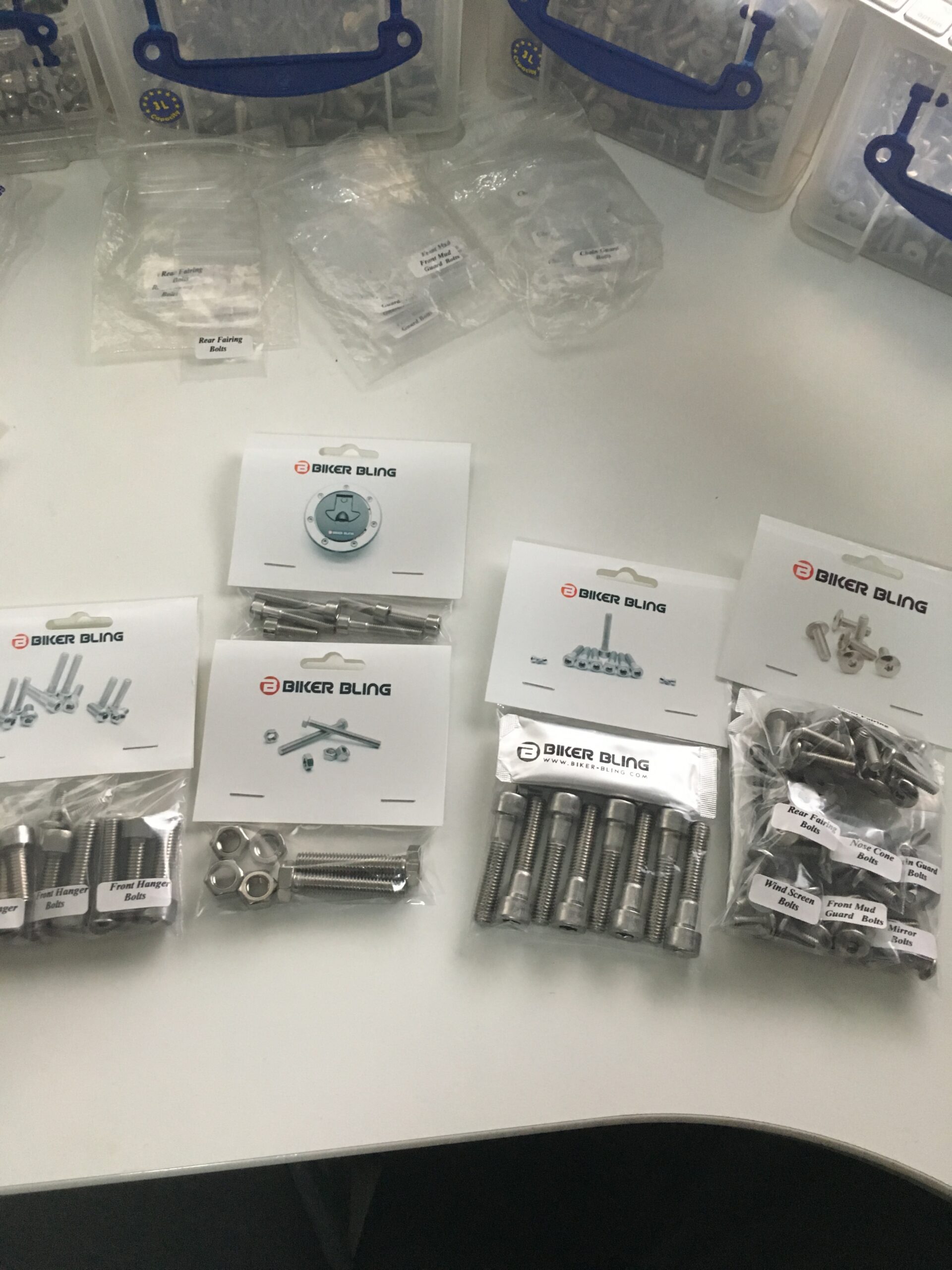
Biker Bling motorcycle fastener guides cover bolt identification, measurement, thread pitch, materials, strength, fitting, fairing hardware, washers, banjo bolts and other common motorcycle fixing questions.
The aim of this technical library is simple: help motorcycle owners understand what a fastener is, how to identify it correctly and what needs to be checked before fitting a replacement.
A motorcycle bolt should not be selected from diameter alone.
Depending on the application, the correct replacement can also depend on:
- Thread pitch.
- Bolt length.
- Threaded length.
- Head type.
- Drive type.
- Shoulder dimensions.
- Washer arrangement.
- Collar or spacer.
- Material.
- Strength or property class.
- Thread treatment.
- Intended mounting position.
Use the sections below to go directly to the Biker Bling motorcycle fastener guide that matches the job you are carrying out.
Motorcycle Fastener Guides: Quick Route
I need to identify or measure a bolt
Start with:
How to Measure Motorcycle Bolts
Then check:
Motorcycle Metric Thread Pitch Reference Chart
Motorcycle Shoulder Bolts Explained
How to Choose the Correct Replacement Motorcycle Bolt
I am fitting stainless steel motorcycle bolts
Use:
How to Fit Stainless Steel Motorcycle Bolts
Then read:
Stainless Steel Motorcycle Bolt Torque, Anti-Seize & Galling Guide
Threadlocker vs Anti-Seize on Motorcycle Bolts
Motorcycle Bolts Into Aluminium
I have a seized, rounded or damaged bolt
See:
How to Remove Seized, Stuck & Rounded Motorcycle Bolts
Then check:
When Should Motorcycle Bolts Be Replaced?
I want to understand motorcycle bolt materials or strength
Read:
Motorcycle Bolt Materials Explained
Motorcycle Bolt Strength Grades Explained
304 Stainless Steel Motorcycle Bolts: Corrosion Resistance, Cleaning & Care
I am working on motorcycle fairings or bodywork
Start with:
Motorcycle Fairing Fasteners Explained
Then see:
Motorcycle Fairing Well Nuts, Clips & Washers Explained
How to Fit Motorcycle Fairing Bolts Without Damaging Plastic Panels
I need information about washers, collars or hydraulic fittings
Read:
Motorcycle Washers, Spacers & Collars Explained
Motorcycle Banjo Bolts & Copper Washers Explained
I want to understand the difference between generic and model-specific kits
See:
Generic Motorcycle Bolt Kits vs Model-Specific Kits
You can also read:
Inside Biker Bling: Our Workshop, Bikes & How We Work
I do not recognise a fastener term
Use the:
Identifying & Measuring Motorcycle Bolts
Correct bolt identification starts with more than diameter.
A replacement fastener may need to match:
- Diameter.
- Thread pitch.
- Length.
- Head style.
- Drive.
- Shoulder.
- Material.
- Strength.
- Associated washers or spacers.
How to Measure Motorcycle Bolts
Our How to Measure Motorcycle Bolts guide explains how to check:
- Nominal thread diameter.
- Thread pitch.
- Overall length.
- Threaded length.
- Shoulder length.
- Head dimensions.
It also explains why countersunk bolts are normally measured differently from many conventional bolt-head designs.
Motorcycle Metric Thread Pitch
A bolt described only as M6, M8 or M10 has not necessarily been fully identified.
Metric threads are specified by both diameter and pitch.
For example:
M10 × 1.5
and:
M10 × 1.25
have the same nominal diameter but different thread pitches.
See the Motorcycle Metric Thread Pitch Reference Chart for common metric thread sizes and guidance on identifying pitch.
Motorcycle Bolt Head Types
A bolt’s head shape and its drive type are separate characteristics.
For example:
- Button head describes a head shape.
- Socket cap describes a head shape.
- Allen or internal hex describes a drive.
- Torx describes a drive.
- External hex can form both the head shape and tool interface.
Our Motorcycle Bolt Head Types guide explains common motorcycle bolt heads and drive systems.
Motorcycle Shoulder Bolts
A shoulder bolt contains a smooth unthreaded section between the head and threaded portion.
That shoulder may:
- Locate a component.
- Pass through a bushing.
- Work with a rubber grommet.
- Provide a bearing surface.
- Control clamping depth.
A fully threaded replacement is therefore not automatically equivalent.
Read Motorcycle Shoulder Bolts Explained before replacing an unusual shouldered fastener.
Choosing the Correct Replacement Bolt
Once the basic dimensions have been identified, the replacement still needs to suit the intended application.
Our How to Choose the Correct Replacement Motorcycle Bolt guide brings together:
- Diameter.
- Pitch.
- Length.
- Head geometry.
- Shoulder.
- Material.
- Strength.
- Supporting hardware.
- OEM information.
- Mounting position.
A bolt that screws into the thread is not automatically the correct bolt.
Motorcycle Fastener Guides for Fitting & Tightening
Correct installation is just as important as choosing the replacement.
Thread condition, lubrication, component material and manufacturer instructions can all affect the fitting process.
How to Fit Stainless Steel Motorcycle Bolts
Our How to Fit Stainless Steel Motorcycle Bolts guide covers the general installation process.
It includes:
- Checking the replacement before fitting.
- Inspecting female threads.
- Starting bolts correctly.
- Fitting washers and spacers.
- Aligning components.
- Avoiding cross-threading.
- Final inspection.
Where the motorcycle manufacturer provides a specific procedure, that information takes priority over general guidance.
Torque, Anti-Seize & Galling
Torque does not act independently of friction.
Thread lubrication, anti-seize and surface condition can change the relationship between applied torque and the clamp load produced.
Our Stainless Steel Motorcycle Bolt Torque, Anti-Seize & Galling Guide explains:
- Torque and clamp load.
- Thread friction.
- Lubricated versus dry threads.
- Stainless-steel galling.
- Tightening speed.
- Anti-seize.
- Stainless into aluminium.
There is no universal torque-reduction percentage that should automatically be applied whenever anti-seize is used.
Follow the relevant manufacturer or component instructions.
Threadlocker vs Anti-Seize
Threadlocker and anti-seize perform different jobs.
Threadlocker may be specified to resist unwanted loosening or movement.
Anti-seize may be used in suitable applications to reduce seizure, galling or difficult later disassembly.
They are not interchangeable.
See Threadlocker vs Anti-Seize on Motorcycle Bolts for the differences and the reasons thread treatment can affect tightening behaviour.
Motorcycle Bolts Into Aluminium
Motorcycles contain many threaded aluminium components.
These can be damaged by:
- Wrong thread pitch.
- Cross-threading.
- Overtightening.
- Excessively long bolts.
- Dirty threads.
- Damaged threads.
Our Motorcycle Bolts Into Aluminium guide explains how to reduce the risk of stripped or damaged aluminium threads.
Removing & Replacing Damaged Motorcycle Bolts
Corrosion, damaged drives and seized threads can make otherwise simple jobs much more difficult.
Removing Seized, Stuck & Rounded Bolts
Before applying more force to a seized fastener, it is useful to understand why it may be stuck and what the bolt screws into.
Our How to Remove Seized, Stuck & Rounded Motorcycle Bolts guide covers:
- Correct tool selection.
- Corroded fasteners.
- Rounded Allen and Torx drives.
- Threadlocker.
- Broken bolts.
- Aluminium-thread precautions.
- When to stop before causing further damage.
When Should a Motorcycle Bolt Be Replaced?
A motorcycle bolt does not necessarily need replacing simply because it is old.
Replacement may be appropriate when there is:
- Damaged thread.
- Severe corrosion or pitting.
- Galling.
- Distortion.
- Stretching.
- A badly rounded drive.
- A damaged shoulder.
- Cracking.
- A manufacturer replace-on-removal requirement.
See When Should Motorcycle Bolts Be Replaced?.
Motorcycle Bolt Materials & Strength
Material and mechanical strength are related subjects, but they are not the same thing.
304, 316, Titanium & High-Tensile Steel
Our Motorcycle Bolt Materials Explained guide compares common motorcycle-fastener materials including:
- 304 stainless steel.
- 316 stainless steel.
- Titanium.
- High-tensile steel.
In fastener terminology:
- A2 is generally associated with the 304 stainless family.
- A4 is generally associated with the 316 stainless family.
The term marine grade is normally associated with 316/A4 rather than ordinary 304/A2 stainless.
Material choice alone does not establish whether a fastener has the mechanical properties required for a particular motorcycle application.
Motorcycle Bolt Strength Grades
Metric steel bolts commonly use property classes such as:
- 8.8.
- 10.9.
- 12.9.
Stainless fasteners can use markings such as:
- A2-50.
- A2-70.
- A2-80.
- A4-70.
These systems should not be treated as directly interchangeable simply because some of the numbers look similar.
Read Motorcycle Bolt Strength Grades Explained before replacing an original high-strength fastener.
Caring for 304 Stainless Steel Motorcycle Bolts
304 stainless steel is corrosion resistant, not corrosion-proof.
Road salt, chlorides, trapped contamination and contact with iron particles can affect stainless surfaces.
Our 304 Stainless Steel Motorcycle Bolts: Corrosion Resistance, Cleaning & Care guide covers:
- Cleaning.
- Road-salt exposure.
- Tea staining.
- Surface contamination.
- Stainless care.
- 304 versus 316.
Washers, Spacers, Collars & Banjo Hardware
Small components can perform important jobs within a fastener assembly.
Motorcycle Washers, Spacers & Collars
A washer is not always simply a flat piece of metal under a bolt head.
Depending on the application, washers, spacers and collars may:
- Spread load.
- Protect surfaces.
- Maintain spacing.
- Control compression.
- Locate components.
- Seal fluid joints.
- Form part of a locking arrangement.
See Motorcycle Washers, Spacers & Collars Explained.
Motorcycle Banjo Bolts & Copper Washers
Banjo bolts are hollow hydraulic fasteners used with banjo fittings.
They can appear in motorcycle:
- Brake systems.
- Hydraulic clutch systems.
- ABS circuits.
- Other fluid connections.
The correct thread, length, fluid passage, sealing washers and tightening procedure all matter.
Because braking systems are safety-critical, never select a banjo bolt purely because the thread appears to fit.
Read Motorcycle Banjo Bolts & Copper Washers Explained.
Motorcycle Fairing Fastener Guides
Motorcycle bodywork can use an extensive mixture of bolts and supporting hardware.
The visible bolt is often only one part of the fixing.
Motorcycle Fairing Fasteners Explained
Our Motorcycle Fairing Fasteners Explained guide covers:
- Fairing bolts.
- Well nuts.
- Clip nuts.
- Plastic push rivets.
- Washers.
- Grommets.
- Collars.
- Spacers.
- Shoulder bolts.
It also explains why motorcycle fairing hardware is often model-specific.
Fairing Well Nuts, Clips & Washers
A worn well nut or stripped clip can cause problems even when the visible bolt is new.
Our Motorcycle Fairing Well Nuts, Clips & Washers Explained guide explains:
- How well nuts expand.
- Why well-nut size matters.
- Clip-nut alignment.
- Plastic push clips.
- Bodywork washers.
- Grommets.
- Collars and spacers.
How to Fit Motorcycle Fairing Bolts
Plastic bodywork can be damaged by poor alignment or excessive tightening.
Our How to Fit Motorcycle Fairing Bolts Without Damaging Plastic Panels guide explains how to:
- Organise removed hardware.
- Inspect panel mounting points.
- Position clips and well nuts.
- Fit washers and collars.
- Align panels.
- Start several fasteners before final tightening.
- Avoid pulling misaligned bodywork together with the bolts.
Generic vs Model-Specific Motorcycle Bolt Kits
A generic fastener assortment is usually organised around standard bolt sizes.
A model-specific motorcycle kit is selected around the actual motorcycle and intended fitting positions.
That can involve differences in:
- Length.
- Head design.
- Shoulder.
- Thread pitch.
- Washers.
- Collars.
- Well nuts.
- Other supporting hardware.
Read Generic Motorcycle Bolt Kits vs Model-Specific Kits for a detailed comparison.
Inside Biker Bling
If you want to know how Biker Bling researches motorcycle fasteners and develops model-specific kits, visit:
Inside Biker Bling: Our Workshop, Bikes & How We Work
Our general product-development principle is:
Identify it. Research it. Measure it where required. Test it in the real world where appropriate. Verify it. Label it. Do not guess.
The page explains how OEM information, original parts, measurements, internal fastener data and selected physical fitting checks can all contribute to product development.
Motorcycle Fastener Glossary
Motorcycle terminology can be confusing when several different characteristics are used to describe the same fastener.
For example, terms such as:
- Allen.
- Button head.
- Shoulder bolt.
- Pitch.
- Property class.
- Clamp load.
- Well nut.
- Galling.
- Banjo bolt.
- SEMS.
all describe different features or concepts.
Use the Motorcycle Fastener Glossary whenever you encounter an unfamiliar motorcycle bolt or fixing term.
Safety-Critical Motorcycle Fasteners
Some motorcycle fasteners require particular care because the consequences of using an unsuitable replacement can be serious.
Examples can include certain fasteners used around:
- Brakes.
- Wheels and axles.
- Steering.
- Suspension.
- Highly loaded structural joints.
- Hydraulic braking systems.
Do not assume that a 304 stainless steel replacement is suitable simply because its diameter, pitch and length match the original bolt.
The original fastener may have a specific:
- Material.
- Strength class.
- Heat treatment.
- Geometry.
- Manufacturer replacement requirement.
Where a motorcycle manufacturer specifies a particular fastener or service procedure, follow that specification.
If the required specification cannot be confirmed, obtain reliable model-specific information or advice from a suitably qualified motorcycle technician.
About These Motorcycle Fastener Guides
The Biker Bling motorcycle fastener guides are written to provide useful general technical information for motorcycle owners.
The library is intended to help explain:
- How motorcycle fasteners are identified.
- Why thread pitch matters.
- Why shoulder bolts can be different from ordinary bolts.
- How material differs from mechanical strength.
- How thread treatments affect tightening.
- Why supporting hardware matters.
- How to avoid common fitting mistakes.
They are not intended to replace the workshop manual for a specific motorcycle.
Manufacturer instructions and component-specific technical information take priority where provided.
Find Motorcycle Bolts & Fastener Kits
Biker Bling supplies 304 stainless steel motorcycle fasteners and model-specific bolt kits for a wide range of makes, models and applications.
Available products include fasteners for areas such as:
- Fairings and bodywork.
- Windscreens.
- Engine covers.
- Yokes.
- Handlebars.
- Footrests and hangers.
- Chain adjusters.
- Reservoirs.
- Other motorcycle mounting points.
Browse Biker Bling Motorcycle Fasteners →
Always check the individual product listing for exact motorcycle fitment, year coverage, intended mounting position and kit contents.
Technical Information Disclaimer
The Biker Bling motorcycle fastener guides provide general educational and technical information.
Motorcycles, fastener specifications, manufacturer procedures and previous repairs vary.
Information on these pages should not be treated as a substitute for the motorcycle manufacturer’s workshop manual, parts information, component manufacturer’s instructions or appropriate professional advice.
Always confirm the correct fastener specification, material, strength, tightening procedure and thread treatment for the individual motorcycle and mounting position.
Take particular care with braking, steering, wheels, axles, suspension and other safety-critical assemblies.
If a specification or fitting procedure cannot be established confidently, stop and obtain reliable model-specific information or assistance from a suitably qualified motorcycle technician.
Nothing on this page is intended to affect your statutory rights or to exclude or restrict any responsibility that cannot lawfully be excluded or restricted.